How much does it cost to install crown molding in Virginia?
We found no dated Virginia price list for crown molding, so no number here. A quote is mostly the length of molding, the material, how many corners there are, the ceiling height, and whether it includes painting and removing old trim. Measure the room, then get several itemized written quotes. At $1,000 or more the contractor needs a Virginia licence.
Free to ask. Local shops send quotes, and you pay only when you book one.
By Kasra Taheri, Founder, LoclisPublished
Researched and drafted with AI, then checked claim by claim against the sources listed below before it was published. Prices and rules change; the dates beside each source say when it was last checked.
Step by step
Read when to stop and call a pro, further down this page, before you start.
Step 1: Measure the runs
Measure each wall along the ceiling line and add them up to get the total length, then note how many inside and outside corners the room has.
Step 2: Choose the molding
Decide on the material and profile, and whether you want it supplied primed or finished, since the quote will depend on it.
Step 3: Write down the conditions
Note the ceiling height, whether any ceilings are vaulted or sloped, and whether old molding has to come out.
Step 4: Ask for itemized written quotes
Ask each contractor for an itemized written bid or estimate based on the same plans and specifications, so you can compare prices.[1]
Step 5: Check the licence
If the work will be valued at $1,000 or more, check the contractor's licence class and number on the DPOR licence lookup.[1]
Step 6: Compare like with like
Line the quotes up on length, material, corners, painting and cleanup, and ask why any one is far from the others.
There is no single Virginia price
We found no Virginia price list for crown molding that carries a date, so there is no per-foot figure here. A number from last year's article or a national average is not a quote for your room. What you can do is understand what the price is made of, measure the job yourself, and ask each contractor to price the same thing.
What moves the price
Length. Crown is sold and priced by the running foot, so the total of the wall lengths along the ceiling is the base of every quote.
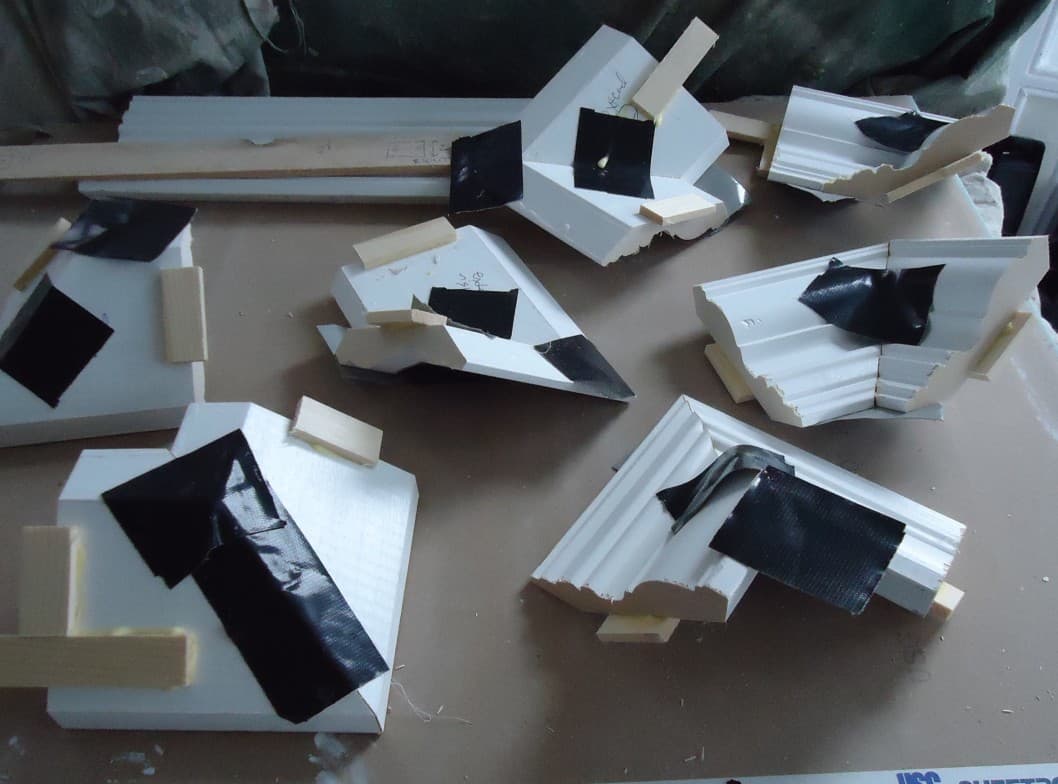
Corners. Each inside corner is coped or mitered and each outside corner is mitered. A plain rectangle has four; a room with a bay, a chimney breast or an alcove has many more, and the labor grows faster than the length.
Material. Primed MDF, solid wood, PVC and polyurethane (foam or resin) are all used. They differ in price, weight, how they take a joint and how they hold paint, and the cheaper material is not always the cheaper job once finishing is counted.
Ceiling height and shape. A standard ceiling lets a carpenter work from a ladder. A tall stairwell, vaulted or sloped ceiling can mean scaffolding or a second person, and the price reflects that.
Profile and size. A large, built-up crown with several pieces stacked takes more material and more time than a simple single piece.
Finishing. Priming, caulking, filling nail holes and painting are separate tasks. Ask whether they are in the price, and whether old molding is being taken out and the walls patched.
Condition of the walls and ceiling. Crown has to be nailed into framing, and a wavy or out-of-square ceiling takes longer to fit than a flat one.
Measure first
You can do the part that makes quotes comparable yourself. Measure each wall along the ceiling line, add the lengths, count the inside and outside corners, and note the ceiling height and any areas that are vaulted. Give every contractor the same numbers and the same list of finishing work.
How to get a fair quote
The Board for Contractors says it is advisable to get at least three written bids or estimates using identical plans and specifications so you can compare prices and contractors.[1] For crown, that translates into the profile and material, the length, the corners, painting and cleanup, the start and finish dates and who removes and disposes of any old trim.
Virginia law requires all licensed contractors to provide a written contract for residential work.[1] The Board for Contractors says the contract should include the total price, when payments will be made, and whether there is a cancellation penalty.[1] On deposits, its rule of thumb is an initial deposit of no more than 10% of the total price,[1] or $1,000, whichever is less, with more allowed for custom-made or special-order items.[1]
Licences and who can quote
If the work you are considering is valued at $1,000 or more, a valid Virginia Contractor’s License is required.[1] A Class C licence covers a single contract over $1,000 but less than $30,000, and Class B covers one of $30,000 or more, but less than $150,000.[2] Finish carpentry is a specialty that covers the installation, repair, and finishing of cabinets, sash casing, door casing, wooden flooring, baseboards, countertops, and other millwork.[3]
If the house was built before 1978 and old painted molding is coming out, ask whether the firm is lead-safe certified. EPA's rule requires that anyone paid to perform work that disturbs painted surfaces in homes, childcare facilities and preschools built before 1978 be certified.[4]
Stop and call a pro if
- The ceiling is high, vaulted or hard to reach. Do not balance a ladder on stairs or stack furniture; hire someone with the right equipment.
- The house predates 1978 and the old trim is painted. Disturbing old paint is the lead risk, and a paid firm needs certification.[4]
- The ceiling is stained, soft or sagging. That is a leak or a structure problem to fix before any molding goes up.
- The quote is $1,000 or more and the contractor has no licence number. Walk away.[1]
Getting help in Virginia
Read how to install baseboard trim to see the same fitting skills at floor level, and whether to hire a carpenter for trim. Browse home repair answers or the drywall patching services.
When you are ready, describe the molding job once and licensed local pros quote it.
Common questions
- Why is there no price per foot here?
- We did not find a Virginia source that dates a crown molding price, and a number without a date goes stale. The cost drivers below let you compare quotes properly: length, material, corners, ceiling height and finishing.
- Does a crown molding contractor need a licence in Virginia?
- If the work is valued at $1,000 or more, yes. The Board for Contractors says a valid Virginia contractor's licence is required at that point. Finish carpentry is a defined specialty, and the licence classes are set by the value of the contract.
- Which costs more, a plain room or a room with many corners?
- The room with many corners, usually, even with the same total length. Every inside and outside corner is a fitted joint, and a room with bay windows, alcoves or angled walls takes noticeably longer than a rectangle.
- Should the quote include painting?
- It should say, one way or the other. Some contractors install primed molding and leave painting to a painter, others finish it. Ask for painting, caulking and nail-hole filling to be listed as included or excluded so quotes can be compared.
- How much deposit is reasonable?
- The Board for Contractors gives a rule of thumb of an initial deposit of no more than 10% of the total price or $1,000, whichever is less, with more allowed for custom-made or special-order items.[^dpor-guide] Put the payment schedule in the written contract.
Sources
- [1] What You Should Know Before You Hire a Contractor, Virginia Board for Contractors, Department of Professional and Occupational Regulation. Checked October 27, 2026.
- [2] Va. Code § 54.1-1100, Definitions, Code of Virginia, Virginia General Assembly. Checked October 27, 2026.
- [3] 18VAC50-22-30, Definitions of specialty services (Board for Contractors Regulations), Virginia Administrative Code, Board for Contractors. Checked October 27, 2026.
- [4] Lead Renovation, Repair and Painting Program, U.S. Environmental Protection Agency. Checked October 27, 2026.
Want a pro to handle it?
Describe the job once. Licensed local businesses send quotes, and you pay only when you book one.
Get a quote for Home Repair