How do I clean a clogged faucet aerator?
Unscrew the aerator from the tip of the spout. A concealed one needs a tool, such as the removal key supplied with the faucet, a small hex wrench or needle-nose pliers, depending on the type. Take out the screens and insert, rinse away grit and brush the parts clean. Flush the spout, put everything back in order and hand-tighten. If the flow stays weak, replace the aerator.
Free to ask. Local shops send quotes, and you pay only when you book one.
By Kasra Taheri, Founder, LoclisPublished
Researched and drafted with AI, then checked claim by claim against the sources listed below before it was published. Prices and rules change; the dates beside each source say when it was last checked.
Step by step
Read when to stop and call a pro, further down this page, before you start.
Step 1: Identify the aerator
Look at the spout tip with a flashlight or mirror: threads on the outside, threads on the inside, a recessed insert, or no visible aerator at all.[1]
Step 2: Cover the drain
Close the sink stopper or lay a towel in the sink so the small screens and washer cannot fall down the drain.
Step 3: Unscrew the aerator
Turn it off by hand, or with pliers over a soft cloth so the finish is not scratched; a concealed aerator needs a tool, which on Moen faucets may be a removal tool, a small hex wrench or needle-nose pliers.[1]
Step 4: Lay the parts out in order
Set the screens, flow insert and rubber washer down in the order they came out so they go back the same way.
Step 5: Rinse out the grit
Hold each part under running water from another tap and rinse away sand, pipe scale and other debris from the screens.
Step 6: Brush the parts clean
Scrub the screens gently with an old soft toothbrush and clear blocked holes with a wooden toothpick rather than a metal pin.
Step 7: Flush the spout
With the aerator off, run the faucet for a few seconds to clear any debris sitting just above it.
Step 8: Reassemble and refit
Put the parts back in their original order with the rubber seal in place, and thread the aerator on hand-tight.
Step 9: Test the flow
Run hot and cold; if the stream is still weak, check the spray-hose screen washer or replace the aerator.[2]
A clogged faucet aerator is usually a quick fix: unscrew it from the tip of the spout, rinse out the grit, brush the screens clean, and screw it back on. You rarely need to turn the water off. The only part that takes thought is working out which kind of aerator you have, because they come off in different ways.
Why aerators clog
The aerator is the small screened insert at the end of the spout that shapes the stream and limits the flow. Moen explains the problem in one line: "Over time, aerators can accumulate debris and mineral deposits, which can restrict water pressure or distort the spray pattern."[1]
Two things cause most clogs. The first is grit: sand, flakes of pipe scale or bits of old washer that break loose, often after a water main repair or plumbing work. The second is hard water. Hard water contains high levels of calcium and magnesium ions,[5] and Virginia Cooperative Extension notes that it can leave mineral deposits (scale) on plumbing fixtures.[5] If you have a well, a lab test tells you how hard your water is; Extension's guidance is that hardness below 7.0 grains per gallon (120 mg/L) generally does not require treatment.[5] For broader scale problems, see how to keep faucets and showerheads free of mineral buildup.
Find out which aerator you have
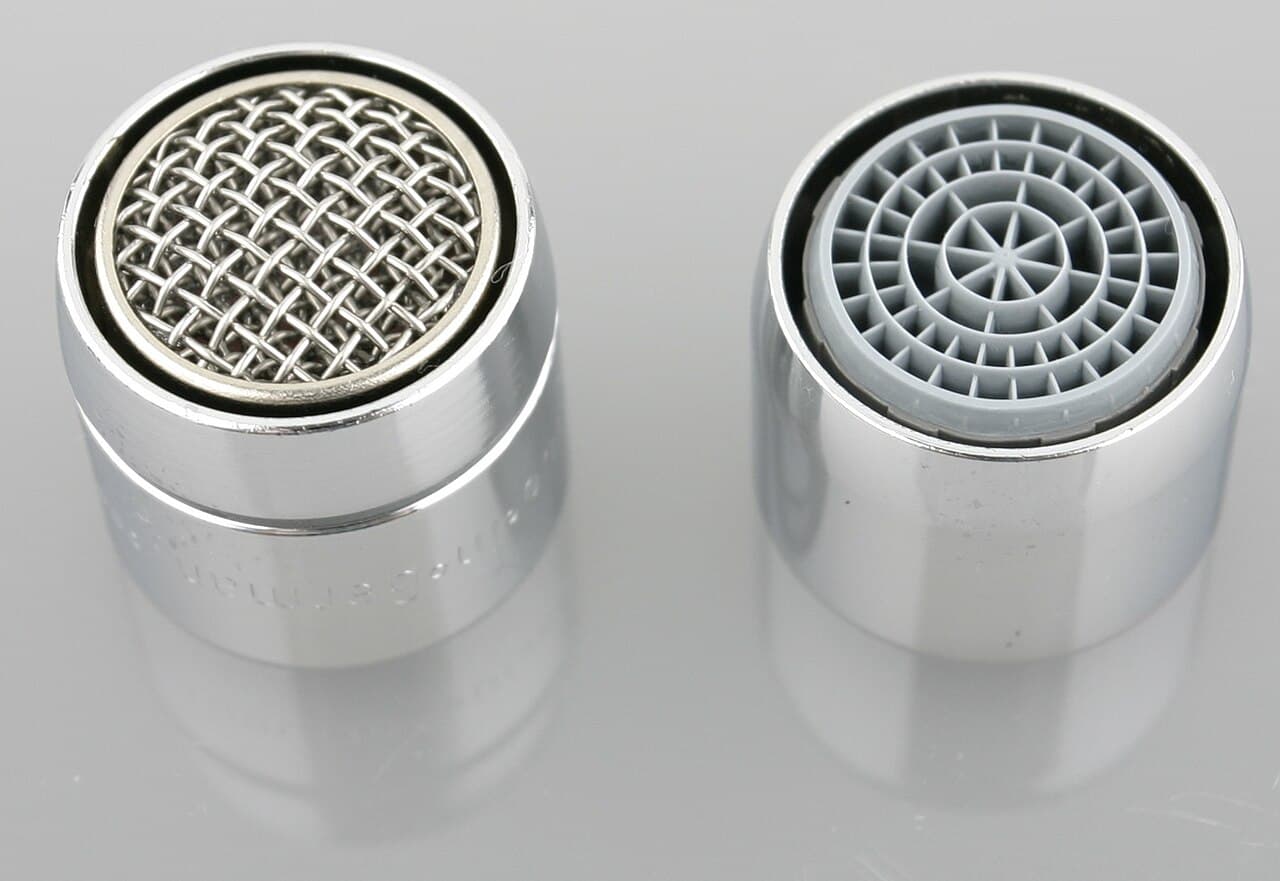
Exposed aerators have a metal shell you can see and grip at the spout tip. An exposed aerator with threads on the outside of its shell unthreads clockwise; one with threads inside the shell unthreads counter-clockwise.[1] Most come off by hand. If one is stuck, wrap a soft cloth around it before using pliers so you do not mark the finish.
Concealed aerators sit inside the spout with only the face showing. A concealed aerator threads into the spout and usually needs a removal tool, which is supplied with the faucet or with an aerator service kit.[1] Not all of them take a key: other Moen types take a 1/8-inch, 5/64-inch or 7/64-inch hex wrench, one pulls straight out with needle-nose pliers, and one needs the faucet throat gently pried away first.[1] To identify yours, Moen recommends using a mirror to closely compare the details.[1] If you have lost the key, an aerator service kit for your faucet includes one.
No visible aerator. Some faucets have an open waterway with no visible aerator or screen, and on those Moen models the filters sit at the end of each supply line under the sink.[1] In that case the water is turned off and the supply lines disconnected before the filters are cleaned the same way as an aerator.[1] That is a slightly bigger job; follow your faucet's guide.
Cleaning the parts
Work over a closed drain or a towel, because the screens and washer are small and easy to lose. Lay the parts out in the order they came apart.
Rinse the grit out first under another tap. Then scrub gently with an old soft toothbrush and poke out any blocked holes with a wooden toothpick; a metal pin can enlarge or scratch them. If white scale is caked on and will not brush off, a new aerator is usually the simpler fix; see the section on replacing it below.
Go easy on the faucet's finish while the aerator is off. For dried water spots, Moen says a 50/50 blend of household vinegar and water can be used, on several of its finishes only for a limited amount of time, followed by rinsing with water and drying with a soft cloth,[4] so rinse it off promptly rather than leaving it to sit. It also warns against harsh cleansers such as lime scale removers on polished metallic finishes.[4]
Before you put the aerator back, run the faucet for a few seconds with it off to flush out anything sitting just above it. Reassemble the parts in their original order with the rubber seal in place and thread the aerator on hand-tight.
If the flow is still weak
Moen's troubleshooting for a kitchen faucet with low overall flow is to remove the spout aerator, remove any debris and reinstall it, and if the problem persists, replace the aerator.[2] On a pull-down faucet, check the small screen washer where the spray wand screws onto its hose as well. If there is little or no water from the hose with the screen washer out, there may be an obstruction further back in the system.[3] When you reattach the wand, hand-tighten the hose to the wand and then turn it 1/8 of a turn with pliers.[3]
If only the hot or only the cold is weak, the aerator is not the problem; the faucet cartridge or the supply to it is. A new faucet that has always been slow is a different case too; see why a new faucet has low water pressure.
Replacing the aerator
Match the new aerator to your faucet. An exposed aerator is easiest: take the old one with you so you can match its size and thread. A concealed aerator is harder to find off the shelf. Moen supplies its removal tool with the faucet or with an aerator service kit,[1] so the service kit for your faucet model is the place to start.
On a bathroom sink, a replacement can also save water. WaterSense labeled bathroom sink faucets and accessories use a maximum of 1.5 gallons per minute, and EPA says they can reduce a sink's water flow by 30 percent or more from the standard flow of 2.2 gallons per minute without sacrificing performance.[6] The label does not cover kitchen faucets: EPA only has WaterSense labeling criteria for private lavatory (bathroom sink) and bar sink faucets, and EPA does not have criteria for kitchen faucets to earn the label.[6] For a kitchen faucet, buy the aerator made for that faucet. If you are fixing a bathroom tap, check with your water utility before you buy: for example, Charlottesville offers a free WaterSense labeled aerator at the Office of Utility Billing at City Hall.[7]
Stop and call a pro if
- The aerator is seized and will not turn without twisting the spout or cracking a plastic tip.
- Every faucet in the house is weak, which points to the water supply, a pressure problem or a well system rather than one aerator.
- The faucet leaks from the base or handle once you have it apart, or drips with the handle off.
- Water flow stays low after you clean the aerator and the spray-hose screen, which points to a cartridge or a supply line.
- Debris keeps coming back after every cleaning, which can mean corroding pipes.
Getting help
For a faucet that needs more than a cleaning, read how to replace a kitchen faucet, browse faucet and sink pros, find plumbers in Blacksburg, or see more plumbing answers.
If the flow will not come back, describe the low-pressure problem once and licensed local plumbers quote it.
Common questions
- How do I know the aerator is clogged?
- The stream gets weaker, sprays off to one side or splits into several jets, while the water pressure at other faucets is normal. Moen notes that debris and mineral deposits in an aerator can restrict water pressure or distort the spray pattern.
- Which way do I turn the aerator to remove it?
- It depends on the type. Moen says an exposed aerator with threads on the outside of its shell unthreads clockwise, and one with threads inside the shell unthreads counter-clockwise. A concealed aerator needs a tool: on Moen faucets that may be the removal tool supplied with the faucet or a service kit, a small hex wrench or needle-nose pliers, depending on the type.
- Can I soak the whole faucet in vinegar?
- No. For dried water spots, Moen allows a 50/50 blend of household vinegar and water on its finishes, on several of them only for a limited amount of time, rinsed off with water and dried with a soft cloth. It warns against harsh cleansers such as lime scale removers on polished metal finishes. If an aerator is too crusted to brush clean, replace it.
- My faucet has no aerator at the tip. What do I clean?
- Some faucets have an open spout and keep their filters at the end of each supply line under the sink. Those are cleaned with the water turned off and the lines disconnected, so follow your faucet's own guide.
- Should I replace the aerator instead of cleaning it?
- Replace it if cleaning does not bring the flow back, if the threads or rubber seal are damaged, or if it is badly crusted. Take an exposed one to the store to match the size and thread. A concealed aerator usually means ordering the part or service kit for your faucet model.
- How often should I clean the aerator?
- Whenever the flow drops or the spray turns ragged, and soon after any work on your water lines, which can shake grit loose. Homes with hard water usually need it more often.
Sources
- [1] Faucet Aerator Cleaning, Moen. Checked October 26, 2026.
- [2] Kitchen Faucet: Low Flow, Moen. Checked October 26, 2026.
- [3] Cleaning and Installing Screen Washers, Moen. Checked October 26, 2026.
- [4] Faucet Finish Care and Cleaning, Moen. Checked October 26, 2026.
- [5] Virginia Household Water Quality Program: Hardness in Household Water, Virginia Cooperative Extension, Virginia Tech. Checked October 26, 2026.
- [6] WaterSense: Bathroom Faucets, U.S. Environmental Protection Agency. Checked October 26, 2026.
- [7] Water Conservation Indoors, City of Charlottesville, Virginia. Checked October 26, 2026.
Want a pro to handle it?
Describe the job once. Licensed local businesses send quotes, and you pay only when you book one.
Get a quote for Plumbing Repair