How do I clean a swimming pool?
Skim the surface, empty the skimmer and pump baskets, brush the walls and floor, vacuum, then test and adjust the water. The Portsmouth Health Department's operator guide gives pH 7.2 to 7.8 and free chlorine 1.0 to 3.0 ppm for public pools; use them as targets. Check the filter, and never mix chemicals with chlorine.
Free to ask. Local shops send quotes, and you pay only when you book one.
By Kasra Taheri, Founder, LoclisPublished
Researched and drafted with AI, then checked claim by claim against the sources listed below before it was published. Prices and rules change; the dates beside each source say when it was last checked.
Step by step
Read when to stop and call a pro, further down this page, before you start.
Step 1: Skim the surface
Net floating leaves and insects off the water before they sink.
Step 2: Empty the skimmer basket
Empty the skimmer basket; it protects the pump and should be cleaned out to keep water flowing.[1]
Step 3: Empty the pump basket
Switch the pump off, open the hair and lint catcher, empty its basket, reseal the lid and restart.[1]
Step 4: Brush the walls and floor
Brush the walls, steps and floor toward the main drain so dirt reaches the filter.
Step 5: Vacuum the pool
Vacuum slowly to pick up settled debris and send it to the filter.[1]
Step 6: Test chlorine and pH
Test free chlorine and pH, and bring chlorine into range before correcting pH.[1]
Step 7: Check the filter
Read the filter gauge and clean or backwash the filter as its manual says when pressure climbs.[1]
Clean a pool in this order: skim the surface, empty the baskets, brush the walls and floor, vacuum, then test and adjust the water and check the filter. Do the baskets and the skimming often, because leaves left in the water sink and feed algae. The water chemistry matters as much as the scrubbing: a clean-looking pool with the wrong pH or too little chlorine is not safe to swim in.
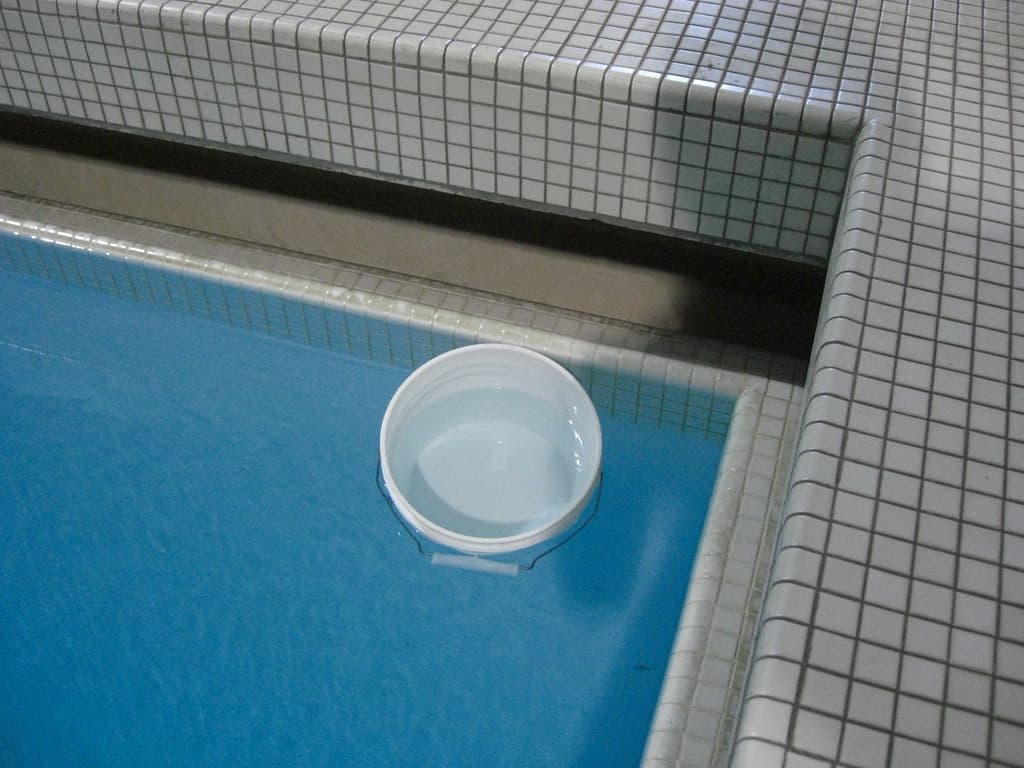
Skim and empty the baskets
Net floating leaves and bugs off the surface before they waterlog and sink. Then empty the skimmer basket. The skimmer catches debris in a basket strainer that protects the pump, and the Portsmouth Health Department's guide for pool operators says to clean it out daily to allow for maximum flow through the skimmer.[1] That is the standard for a busy public pool; a backyard pool in a quiet week can go longer, but a full basket starves the pump of water.
Behind the skimmer, the hair and lint catcher on the pump protects the pump from clogging or damage by hair, lint and other foreign material, and its basket should be cleaned daily at a public pool.[1] Switch the pump off at its own switch before you open the lid, and make sure the lid seals and the water is flowing again when you restart.
Brush and vacuum
Brush the walls, steps and floor toward the main drain, working from the shallow end down. Brushing breaks up the film where algae starts and puts dirt into the water so the filter can catch it. A manual or self-propelled vacuum then pulls the settled dirt out: the guide describes it as removing large debris from the pool sides and bottom and sending it to the filter with the pool water.[1]
Vacuum slowly so you do not stir the dirt back up. If you use a vacuum that runs off the skimmer, keep the water level high enough that the skimmer does not suck air.
Test the water, then adjust
Test with a drop-based kit or good test strips, in water taken from about elbow depth and away from the returns. Two readings matter first.
Chlorine. The Portsmouth guide cites Virginia Department of Health water quality standards that keep the free available chlorine residual for public pools within 1.0 to 3.0 parts per million.[1] A residential pool is not covered by that standard, but it is a sensible target.
pH. The same guide says pool water should be kept at a pH of 7.2 to 7.8, with 7.4 the optimum.[1] The guide says a pH below 7.0 can make pipes corrode, etch the pool surface and grout, and encourage algae.[1]
Fix the chlorine and the other readings before you touch pH. The guide warns that premature correction of pH causes an overcorrection of pH problems, because disinfection levels that are off make pH values fluctuate.[1] Total alkalinity and calcium hardness need testing too: the Portsmouth Pool Code, quoted in the guide, requires them to be tested and recorded at least weekly.[1]
Check the filter
Dirt slows the flow through a sand filter. If the filter has one gauge, the guide says to record the reading at the start of the filter cycle; for a rapid sand filter the rule of thumb is to backwash after a 3 to 5 psi increase.[1] A residential filter may be a cartridge or diatomaceous earth type with its own schedule, so follow its manual.
Handle chemicals safely
Never mix anything with chlorine except water, and keep chlorine in a closed, waterproof container away from pumps and filters.[1] The guide also says never to use granular chlorine in a chlorinator or erosion feeder, because it will explode, and not to reuse chlorine containers to store other chemicals.[1] The guide says never to add water to chlorine; add a smaller volume of chlorine to a greater volume of water.[1] Wear chemical-resistant gloves and goggles.
Stop and call a pro if
- The water stays green or cloudy after you have corrected the chemistry and run the filter. There may be a filtration or circulation fault.
- The pump runs but pulls little water, leaks, or makes a grinding noise. Pump and plumbing repair is a job for a professional.
- Anything electrical or gas is involved: a pool light, an automation panel, a heater or a buzzing motor. Do not open or rewire them yourself.
- A pool repair job that would cost $1,000 or more. Virginia requires a valid contractor's licence for work valued at that amount.[2]
- You are unsure what chemicals to mix or add. Ask the company that sells them or hire a service.
Getting help in Virginia
If you would rather not do it weekly, read what a pool service company does each visit and how much weekly pool service costs in Virginia. Loclis lists DPOR-licensed businesses: browse pool and spa services or more pool and spa answers.
When you are ready, describe the job once and local pool pros quote it.
Common questions
- How often should I clean my pool?
- Skim and empty the baskets as often as debris collects, brush and vacuum weekly or when it looks dull, and test the water at least weekly. A busy public pool is tested far more often, but a backyard pool needs regular attention in warm months.
- What pH should my pool be?
- The Portsmouth Health Department's operator guide says 7.2 to 7.8, with 7.4 the optimum.[^portsmouth]
- Can I put chlorine tablets in the skimmer?
- The Portsmouth guide says not to place chlorine tablets directly in the pool, return skimmers or gutters; it recommends an automatic chemical feeder.[^portsmouth] Follow your product's label.
- Is it safe to mix pool chemicals?
- No. The Portsmouth guide says never to mix anything with chlorine except water.[^portsmouth]
- Should I hire a pool service instead?
- If you travel, lack the time or keep ending up with green water, a weekly service is a reasonable choice. See what a visit includes and how pricing works before you sign.
Sources
- [1] Pool Operation and Maintenance Guide (compiled 2018), Portsmouth Health Department, Virginia Department of Health. Checked October 27, 2026.
- [2] What You Should Know Before You Hire a Contractor, Virginia Board for Contractors, DPOR. Checked October 27, 2026.
Want a pro to handle it?
Describe the job once. Licensed local businesses send quotes, and you pay only when you book one.
Get a quote from a local pro