How do I deep clean a kitchen?
Clear the counters, open a window or run a fan that vents outside, then work from top to bottom: cabinet tops and the range hood first, then the oven, refrigerator, cabinet fronts, sink and counters, and the floor last. Wash every surface with soap and water and rinse it before you sanitize, and never mix cleaning products such as bleach and ammonia.
Free to ask. Local shops send quotes, and you pay only when you book one.
By Kasra Taheri, Founder, LoclisPublished
Researched and drafted with AI, then checked claim by claim against the sources listed below before it was published. Prices and rules change; the dates beside each source say when it was last checked.
Step by step
Read when to stop and call a pro, further down this page, before you start.
Step 1: Clear the room
Take everything off the counters and open shelves, empty the dish rack and run the dishwasher so the sink is free to use.
Step 2: Ventilate and glove up
Open a window or run a range hood that vents outside, and wear disposable gloves and glasses while you work with cleaning products.[1]
Step 3: Start up high
Dust or wipe the tops of the cabinets, the refrigerator and the range hood first, so falling grime lands on surfaces you have not cleaned yet.
Step 4: Soak the greasy parts
Put the range hood's metal filter, the stove grates and the burner caps or drip pans in a sink of hot water and dish soap to loosen grease while you work elsewhere.
Step 5: Clean the oven
Run the self-clean cycle exactly as your range's manual describes, or use an oven cleaner exactly as its label directs with the kitchen ventilated.
Step 6: Empty the refrigerator
Throw out anything that looks or smells suspicious, wash the shelves and drawers with warm soapy water, dry them and put food back covered.[3]
Step 7: Check the fridge temperature
Use an appliance thermometer to confirm the refrigerator is at or below 40°F and the freezer at 0°F.[3]
Step 8: Degrease cabinets and backsplash
Wash cabinet fronts, handles and the backsplash with warm water and dish soap, rinse with a clean damp cloth and dry them.
Step 9: Do the small appliances
Wipe the inside of the microwave, the toaster crumb tray and the outside of every appliance, unplugging countertop appliances before you clean them.
Step 10: Scrub the sink and flush the disposal
Scrub the sink, then fill it halfway with warm water, mix in 1/4 cup of baking soda and run the disposal as you pull the stopper.[4]
Step 11: Wash, rinse, then sanitize counters
Clean counters with soap and water, rinse, then apply a food-contact sanitizer and leave it wet for the contact time on its label.[1]
Step 12: Finish the soaked parts
Scrub the filter, grates and caps with a non-scratch brush, rinse and dry them completely, and put them back.
Step 13: Floors last
Vacuum or sweep, including under the toe kicks and the edge of the refrigerator, then mop and let the floor dry.
To deep clean a kitchen, clear the counters, get air moving, and work from the top of the room to the bottom: cabinet tops and the range hood first, then the oven and refrigerator, then cabinet fronts, the sink and counters, and the floor last. Wash before you sanitize, use one product at a time, and save the floor for the end so you are not walking grime across it twice.
A regular clean wipes what you can see. A deep clean gets the grease on the hood, the spills baked onto the oven floor, the shelves inside the refrigerator, the cabinet doors near the stove, and the dirt along the toe kicks. Plan on most of a day for a kitchen that has gone a while.
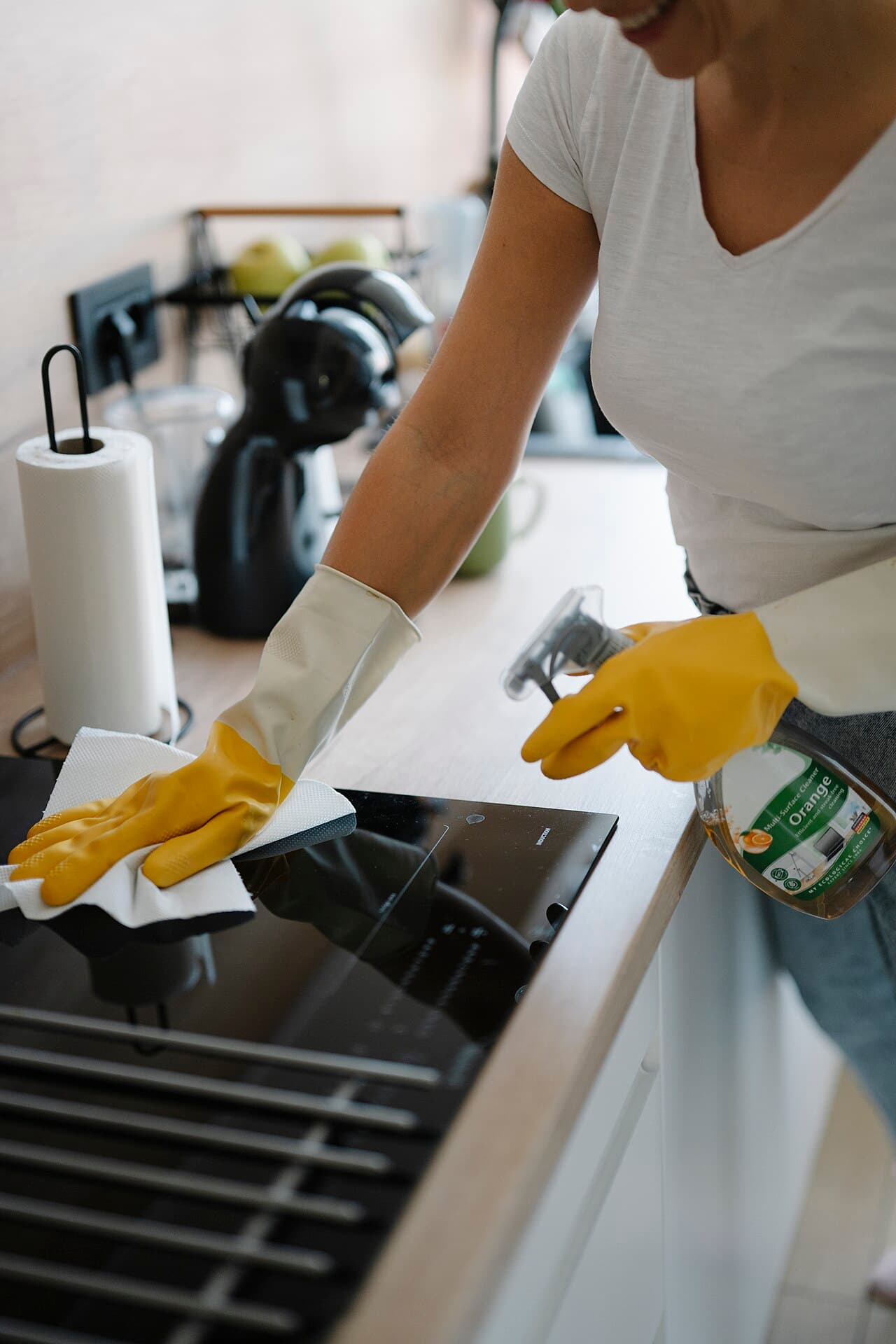
Before you start: air, gloves and products
According to EPA, many cleaning, disinfecting and degreasing products contain organic solvents that are released into the air while you use them.[5] EPA's advice is that if a label says to use a product in a well-ventilated area, open windows to bring in as much outdoor air as possible.[5] A range hood helps only if it vents outside; many recirculating hoods just filter and blow the air back into the room.
Never mix different products, for example bleach with ammonia.[1] Virginia Cooperative Extension warns that they do not make each other stronger and can give off fumes that may cause a person to pass out.[1] Pick one cleaner for each job, read its label, and rinse a surface before you switch to something else. Wear gloves, and keep cleaning products out of reach of children and pets while they are out.
The order that saves work
Top first. Dust and grease settle on top of the upper cabinets, the refrigerator and the range hood, where nobody looks. Wipe those first so whatever falls lands on surfaces you have not cleaned yet.
Soak the greasy parts. Metal hood filters, stove grates, burner caps and drip pans come clean far more easily after a soak in hot water and dish soap. Start them soaking early and come back to them. Check your hood's manual before putting a filter in the dishwasher; some are made for it and some are not. On a gas range, wash only the parts the manual says can be removed, and leave the burner tubes and valves alone.
Oven. Use the self-clean cycle exactly as your range's manual describes, or use an oven cleaner exactly as its label directs. Either way, ventilate the kitchen and keep children and pets out of the room.
Refrigerator. Take everything out, throw away anything that looks or smells off, and wash the shelves and drawers in warm soapy water. FDA's advice is to clean the refrigerator regularly and wipe spills immediately, which helps reduce the growth of Listeria bacteria.[3] While it is empty, put an appliance thermometer inside: FDA says to keep the refrigerator at or below 40°F (4°C) and the freezer at 0°F (-18°C).[3] Store eggs in their carton inside the refrigerator rather than on the door, where it is warmer.[3]
Cabinets and backsplash. Grease collects most on the doors nearest the stove and around the handles. Warm water with dish soap removes most of it. Rinse with a clean damp cloth so no soap film is left behind to catch new grease, then dry wood and painted surfaces right away.
Counters: wash, rinse, then sanitize
Virginia Cooperative Extension describes cleaning as three moves: scrape and rinse off stuck-on food and grease, wash the surface with water and a soap or detergent solution, then rinse it with clean water.[1] That alone removes most dirt and germs.
To sanitize food-prep surfaces after that, read the label. A product labeled for food contact surfaces can be used on countertops, dishes and cooking utensils.[1] Apply it to the already cleaned counter: spread it evenly, do not rinse or wipe it dry, and leave it for the contact time on the label.[1][2] Some labels then call for a rinse with clean water so no residue rubs off onto food.[1]
The sink and the disposal
Scrub the sink basin, the faucet and the area around the drain, where film builds up. A disposal that smells usually has food built up inside it from too little water during and after grinding.[4] InSinkErator's fix is a sink half full of warm water with 1/4 cup of baking soda, drained through the running disposal.[4] Going forward, run cold water while you grind and for a few seconds after, and never pour grease or fat down it.[4] Never put a hand into a disposal.
Open the cabinet under the sink while you are there. Look for a damp cabinet floor, a musty smell or swollen wood. If wet materials are dried within 24 to 48 hours of a leak, in most cases mold will not grow,[6] so a slow drip found now saves trouble later.

Floors last
Vacuum or sweep first, including the toe kicks under the cabinets and the gap at the sides of the refrigerator and range where crumbs collect. Then mop with the product your floor's maker recommends and let it dry before you put rugs back.
Stop and call a pro if
- If you smell a sulfur or rotten-egg odor near a gas range, leave the house and call 911 and your gas utility from outside.[7] Do not use switches or appliances on the way out.
- A gas burner will not light properly after cleaning, or the flame looks different from before. That is a job for the appliance's service technician, not more scrubbing.
- An outlet sparks, feels warm or has scorch marks, or an appliance cord is frayed. Stop using it and call an electrician.
- You find mold that keeps coming back under the sink, soft or stained wood, or a leak you cannot trace. That needs the water source fixed, and possibly a plumber.
- The refrigerator will not hold 40°F once it is clean and closed.
Getting help with a deep clean
If the kitchen is part of a bigger job, such as a move-out or a first clean in a new home, a cleaning business can take it on. Read what a deep clean costs in Virginia and when a deep clean is worth it, browse deep cleaning businesses or cleaning services around Blacksburg, and see the rest of the cleaning answers. When you are ready, describe the kitchen deep clean on Loclis and businesses will quote.
Common questions
- How long does it take to deep clean a kitchen?
- It depends on the size of the kitchen and how much grease has built up. A kitchen that is cleaned every week can take an afternoon; one that has gone months without a thorough clean, with a dirty oven and greasy cabinets, often takes most of a day. Soaking the hood filter and grates while you work on other things saves time.
- Do I need to sanitize the counters, or is soap and water enough?
- Soap, water and a rinse remove dirt, grease and most of the germs with them. Sanitizing is a second step for food-prep surfaces, especially after raw meat. Use a product labeled for food contact surfaces, leave it wet for the contact time on the label, and rinse afterward if the label says to.
- Can I mix bleach with other cleaners to make it work better?
- No. Mixing products such as bleach and ammonia does not make them stronger and can release fumes that may cause someone to pass out. Use one product at a time, follow its label, and rinse a surface before switching to a different product.
- How do I get grease off kitchen cabinets?
- Warm water with dish soap on a soft cloth handles most cabinet grease. Work a small section at a time, rinse with a clean damp cloth so no soap film is left to catch new grease, and dry the wood or painted surface right away. Test any stronger degreaser on a hidden spot first and follow the cabinet maker's care instructions.
- Should I use the oven's self-clean cycle?
- If your range has one and the manual allows it, it is the easiest way to deal with baked-on spills. Follow the manual exactly, including what to take out of the oven first, keep the kitchen ventilated, and keep children and pets away while it runs.
- Is it worth hiring someone to deep clean the kitchen?
- It can be, especially for a move-out, a first clean in a new home, or a kitchen with heavy grease. Ask for a written quote that lists exactly what is included, such as inside the oven, inside the refrigerator and cabinet interiors, because those are often priced as extras.
Sources
- [1] How to Clean, Sanitize, and Disinfect Surfaces (FST-395NP), Virginia Cooperative Extension, Virginia Tech. Checked October 27, 2026.
- [2] 6 Steps for Safe and Effective Disinfectant Use, U.S. Environmental Protection Agency. Checked October 27, 2026.
- [3] Are You Storing Food Safely?, U.S. Food and Drug Administration. Checked October 27, 2026.
- [4] There's an Odor Coming From Garbage Disposal, InSinkErator. Checked October 27, 2026.
- [5] Volatile Organic Compounds' Impact on Indoor Air Quality, U.S. Environmental Protection Agency. Checked October 27, 2026.
- [6] A Brief Guide to Mold, Moisture and Your Home, U.S. Environmental Protection Agency. Checked October 27, 2026.
- [7] Report Gas Leaks, Columbia Gas of Virginia. Checked October 27, 2026.
Want a pro to handle it?
Describe the job once. Licensed local businesses send quotes, and you pay only when you book one.
Get a quote from a local pro