How do I know if my garage door spring is broken?
The usual signs are a loud bang from the garage, a door that suddenly feels very heavy, an opener that hums or strains without lifting, a door that will not stay halfway up, and a visible gap in the coil. If you see any of these, stop using the door and call a licensed garage door technician.
Free to ask. Local shops send quotes, and you pay only when you book one.
By Kasra Taheri, Founder, LoclisPublished
Researched and drafted with AI, then checked claim by claim against the sources listed below before it was published. Prices and rules change; the dates beside each source say when it was last checked.
This is a job for a licensed pro in Virginia
This page explains what the work involves, the permits, what a licensed pro does and what drives the cost. It does not give step-by-step instructions, because this work needs a licence, a permit or both, and doing it wrong can injure someone. Before you hire, check the licence on Virginia's DPOR record.
A garage door with a broken spring is usually easy to spot: the door is suddenly very heavy, the opener strains or only hums, and the door will not lift more than a few inches. Often you hear a loud bang from the garage when it happens. If you see or hear any of this, stop using the door and do not try to force it open.
Signs a spring has broken
Springs do the lifting. Clopay's manual says garage doors use springs to balance the door weight, and that there are two types, extension and torsion.[1] When one breaks, the door loses that help. Look for these signs:
- A loud bang from the garage, like a gunshot, that you cannot trace to anything else. It is often heard when the door is closed.
- A door that feels very heavy when you lift it by hand with the opener released. Clopay says a single-car door may weigh as much as 200 pounds, and some large doors as much as 500 pounds, once the spring tension is removed.[1]
- An opener that strains, hums or stops. The opener is built to guide the door, not carry it. With a broken spring it either cannot lift the door or lifts it a few inches and quits.
- A door that will not stay put halfway. The CPSC says a properly operating door is "balanced," which means it will stay in place when stopped in any partially open position.[2]
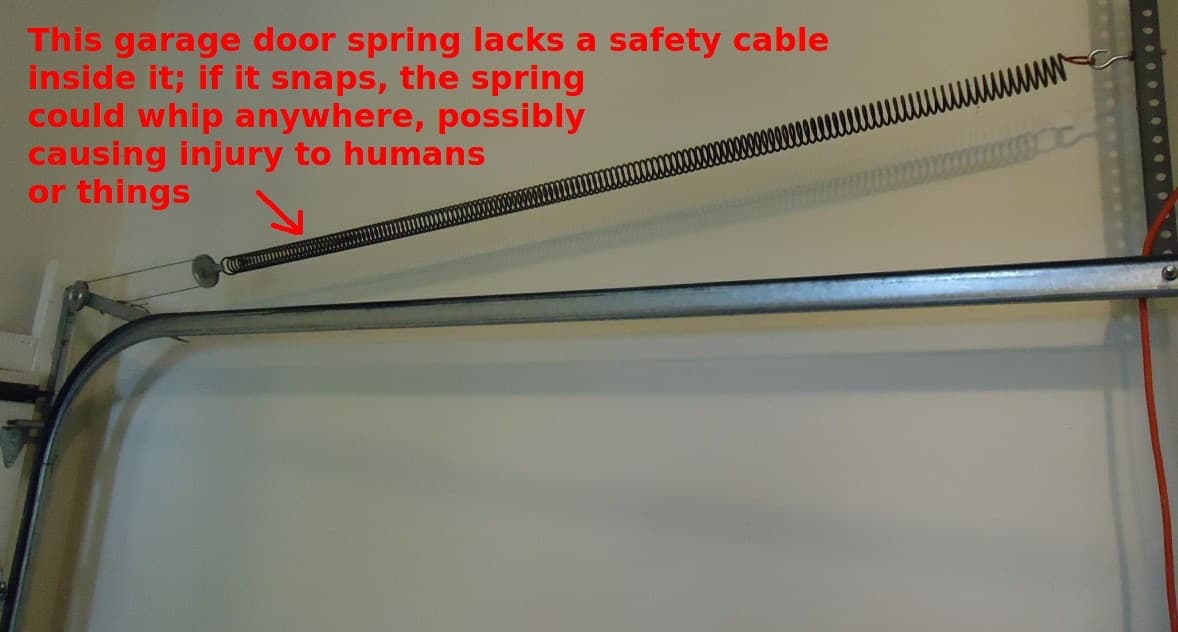
- A visible gap in the coil of a torsion spring above the door, or a stretched, snapped or dangling extension spring along the side track.
- Slack or loose cables, or a door that hangs crooked on one side.
Why it matters
A broken spring is a safety problem as well as an inconvenience. A severely unbalanced door could unexpectedly crash to the floor, possibly striking someone under the open door.[2] Garaga says a garage door with a broken torsion spring can fall rapidly and cause injury or death.[3]
If you have two springs and one has broken, the other is carrying the load alone and may be close behind. Ask the technician whether to replace both when you get a quote.
What you can safely do
You can look and listen, but you should not touch the springs. With the door closed, look at the spring from the floor. Do not climb a ladder to inspect it up close, and do not pull on cables or brackets.
Clopay says springs, cables and bottom fixtures are under strong spring tension, and not to attempt to loosen any fasteners on these components.[1] That includes the brackets at the bottom corners of the door.
Keep cars, children and pets away from the door. If the door is closed and stuck, leave it closed until a technician arrives. If you must get a car out, ask the technician whether it is safe to release the opener and lift the door, since a door that weighs hundreds of pounds can drop on a hand or foot.
When to call a licensed pro
For a suspected broken spring, call right away. Replacing a spring, matching its size to the door's weight and resetting the tension is trained work. Clopay's manual says that attempting to remove a torsion spring assembly without proper training and tools may result in an uncontrolled release of spring forces which can cause serious or fatal injury.[1]
For any spring or cable work, and for any door you are not sure about. The CPSC says doors that are not balanced, or that bind or stick, should be serviced by a professional.[2]
Hiring someone also has a legal side. DPOR's consumer guide says that if the work is valued at $1,000 or more, a valid Virginia Contractor's License is required for the license category in which the contractor is to work.[4] The same guide says unlicensed contracting is against the law.[4] Ask any company for its licence number and check it with the Board for Contractors before work starts.
To understand the parts first, read how garage door springs work. For the question of doing it yourself, see whether it is safe to replace a garage door spring yourself, and for what a repair involves in price terms, how much spring replacement costs in Virginia.
Browse garage door answers or find garage door services near you. Describe the job once and local garage door businesses will quote it.
Common questions
- What does a broken garage door spring sound like?
- Most people describe a single loud bang from the garage, like a gunshot, usually when the door is closed. Not every break is that loud, so check the door if it suddenly feels heavy or the opener strains.
- Can I still open the door with a broken spring?
- Not safely. Without the spring the door is as heavy as it is built to be, which Clopay says may be as much as 200 pounds for a single-car door once spring tension is removed. Lifting it by hand risks injury, and forcing the opener can damage it.
- Is a broken spring dangerous if the door is closed?
- It is safest to leave the door closed and keep people clear of it. The CPSC warns that a severely unbalanced door could unexpectedly crash to the floor. Do not touch the spring, cables or brackets.
- Can a door be out of balance without a broken spring?
- Yes. Springs weaken and cables stretch or slip. The CPSC says a balanced door stays in place when stopped partway, and one that does not should be serviced by a professional.
- Should I replace one spring or both?
- Ask the technician. When two springs share the load and one breaks, the other is carrying the door alone and may be near the end of its life, so replacing both is worth asking about.
Sources
- [1] Installation & Maintenance: Aluminum Full Vision Residential Garage Door Instructions, Clopay. Checked October 28, 2026.
- [2] Non-Reversing Automatic Garage Door Openers Are a Hazard (Pub. 523), U.S. Consumer Product Safety Commission. Checked October 28, 2026.
- [3] The Secrets of Garage Door Torsion Springs, Garaga (garage door manufacturer). Checked October 28, 2026.
- [4] What You Should Know Before You Hire a Contractor, Virginia Board for Contractors, DPOR. Checked October 28, 2026.
Want a pro to handle it?
Describe the job once. Licensed local businesses send quotes, and you pay only when you book one.
Get a quote from a local pro