Why is my freezer frosting up?
Frost means warm, moist air is getting in. The usual causes are a door or lid opened often, a dirty or worn gasket, a door held ajar, an unlevel freezer, or warm uncovered food. A light coat is normal in a manual-defrost model; heavy frost in a frost-free one is a fault. Fix the cause, then defrost.
Free to ask. Local shops send quotes, and you pay only when you book one.
By Kasra Taheri, Founder, LoclisPublished
Researched and drafted with AI, then checked claim by claim against the sources listed below before it was published. Prices and rules change; the dates beside each source say when it was last checked.
Step by step
Read when to stop and call a pro, further down this page, before you start.
Step 1: Check the door or lid
Close it and look for a gap, or a package, bin or shelf holding it open.[2]
Step 2: Move items off the seal
Move food packages away from the door and push the bin or shelf back into position.[2]
Step 3: Clean the gasket
Wipe the gasket clean and dry it, since dirt can build up on the surface and cause resistance.[2]
Step 4: Inspect the seal
Look for cracks, tears or a gasket that no longer closes tight; replace it if it is not airtight.[3]
Step 5: Check that it is level
Set a level on top, side to side and front to back, and shim the floor if needed.[2]
Step 6: Review what goes in
Let food cool and cover it before it goes in, and keep door openings short.[1]
Step 7: Measure the frost
If it is past about 1/4 inch on a manual-defrost model, defrost it.[1]
Most often, warm moist air is getting in
Frost in a freezer is moisture from room air freezing on the coldest surfaces. So the cause is almost always one of three things: the door or lid is being opened a lot, the seal is not airtight, or something warm or wet went in. Whirlpool lists common causes: frequent opening of the lid, allowing warm air to enter, and inadequate sealing, leading to condensation, with warm or improperly sealed items also adding to ice formation.[1]
Start by working out which kind of freezer you have, because it changes what frost means.
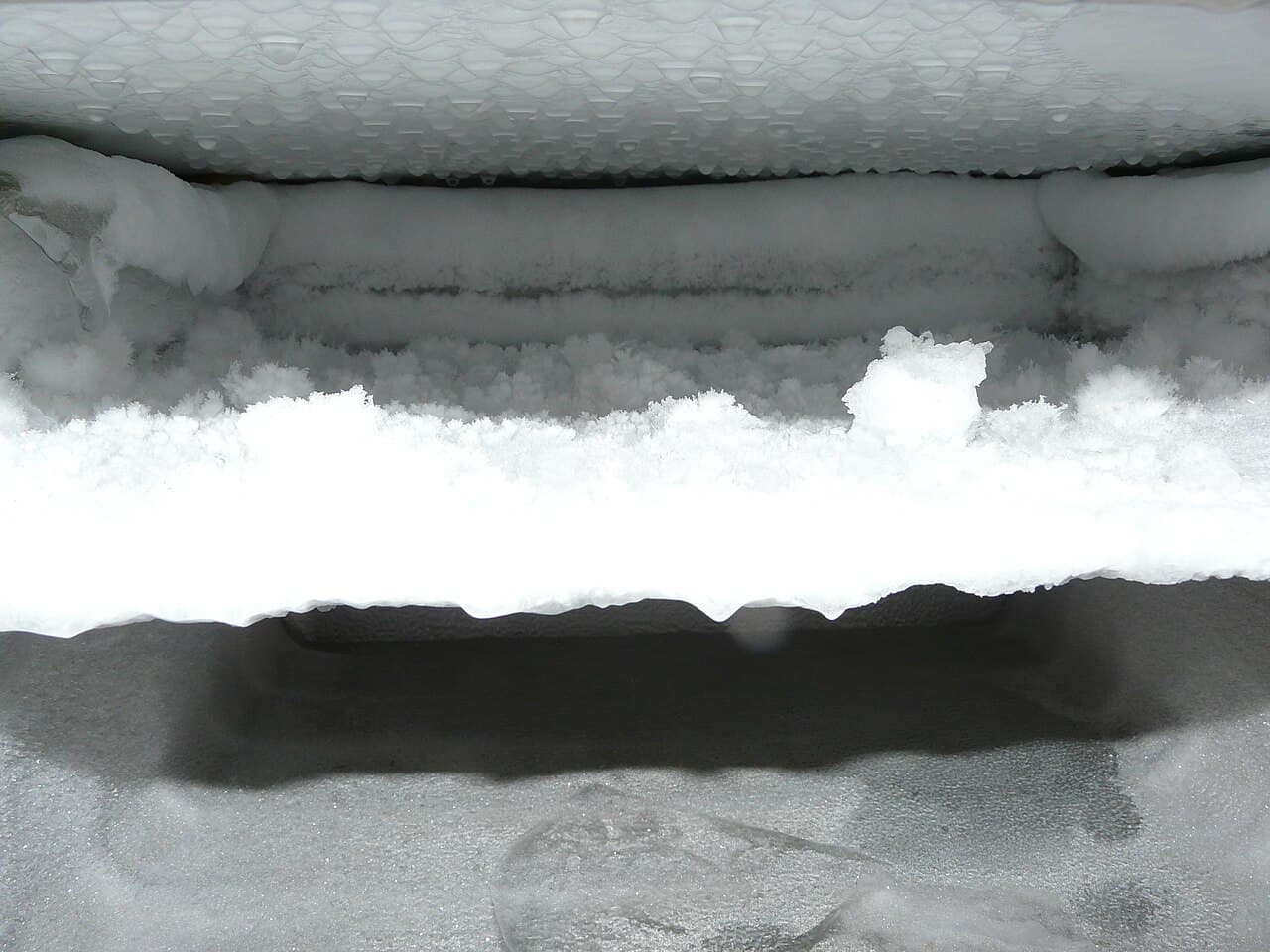
Manual-defrost freezer: some frost is normal
Chest freezers and many basic uprights are manual defrost. GE says these models must be defrosted manually, and that the frost should be taken off when it reaches 1/4 to 1/2 inch thick.[4] Whirlpool puts the line at about 1/4 inch and says complete defrosting and cleaning should be done at least once a year, more often in high-humidity areas.[1]
A light, even coat of frost on the walls is the freezer doing what it is built to do. Thicker frost is the point where it starts to cost you: Noticeable ice build-up, especially if it exceeds a quarter of an inch, can impede airflow and reduce performance.[1] Virginia summers help it along, since a garage or porch freezer pulls in damp air every time the lid opens.
Frost-free freezer: heavy frost is a fault
A frost-free freezer melts its own frost on a cycle. If you see thick ice on the walls or coating the food, something is wrong, and the seal is the first thing to look at. Whirlpool says a refrigerator that is not sealing correctly may lead to frost build-up and temperature fluctuation.[2] The same logic applies to a freezer door. The steps below cover the checks you can do yourself.
Steps
Work through these in order, cheapest first.
What to check, and what each finding means
The door or lid does not close fully. Whirlpool's advice is to move food packages away from the door and push a bin or shelf back into the correct position.[2] A box wedged against the seal lets humid air in all day.
A dirty or sticky gasket. Whirlpool says the gaskets need to be cleaned regularly for the doors to open and close properly, because dirt and other particles can build up on the gasket surface and can cause resistance.[2] Wipe the seal clean and dry it.
A seal that is cracked, torn or no longer tight. ENERGY STAR says to make sure the seals around the door are airtight, and if not, to replace them.[3] For how that job goes, read how to replace a refrigerator door gasket.
A freezer that is not level, or a door that was reversed. Whirlpool says a door that was not reinstalled correctly after reversing can fail to close or seal properly, causing frost build-up or moisture concerns.[2] It also recommends a level checked side to side and front to back, with shims if the floor is not level, for proper operation.[2]
Warm or uncovered food. Whirlpool says to ensure items are adequately cooled before storage and to regularly check seals.[1] Hot leftovers and open containers shed steam that freezes onto the walls.
A freezer in a hot, damp spot. Unless you live in a mild climate, ENERGY STAR says to keep your freezer indoors, such as in the basement.[3]
After you fix the cause
Frost already on the walls will not leave by itself in a manual-defrost model. Follow how to defrost a freezer fast to clear it safely. Do not use a hair dryer or heater and do not chip with an ice pick or knife.[1] To stop it building back, see how to keep a freezer from frosting up.
Stop and call a pro if
- Frost returns within weeks of a clean defrost and the seal is fine. In a frost-free model that points to the defrost system or its controls, which a technician should diagnose.
- The freezer does not stay cold. A sealed-system problem is not a home job.
- You see ice or water leaking out of the cabinet, or ice that has formed behind the back panel.
- Water has reached the cord, plug or outlet. Keep it unplugged and dry.
Getting help in Virginia
If the freezer is old, is it worth repairing an old freezer and how much freezer repair costs in Virginia can help you decide. See more appliance repair answers and browse appliance repair businesses near you.
When you are ready, describe the freezer problem once and local appliance repair businesses quote it.
Common questions
- How much frost in a freezer is normal?
- In a manual-defrost freezer, a light coat is normal. GE says to defrost when frost reaches 1/4 to 1/2 inch thick,[^ge-defrost] and Whirlpool says about 1/4 inch.[^wp-defrost]
- Why is my frost-free freezer frosting up?
- Heavy frost in a frost-free model is a fault. Whirlpool says a poorly sealing door can cause frost build-up and temperature swings,[^wp-seal] so check the door, gasket and what is blocking it before calling for service.
- Can a dirty gasket cause frost?
- Yes. Dirt on the gasket surface can cause resistance so the door does not seal properly.[^wp-seal] Wipe it clean and dry it.
- Does opening the lid often cause frost?
- Yes. Whirlpool names frequent opening of the lid, which lets warm air in, as a common cause.[^wp-defrost]
- Will defrosting fix the problem?
- It removes the frost but not the cause. Fix the seal, the level or the habit that let the moisture in, or the frost returns.
Sources
- [1] How to Defrost the Freezer, Whirlpool Product Help. Checked October 28, 2026.
- [2] Doors Not Sealing - Refrigerator, Whirlpool Product Help. Checked October 28, 2026.
- [3] Freezers, ENERGY STAR, U.S. Environmental Protection Agency. Checked October 28, 2026.
- [4] Chest Freezer - Manual Defrosting Instructions, GE Appliances. Checked October 28, 2026.
Want a pro to handle it?
Describe the job once. Licensed local businesses send quotes, and you pay only when you book one.
Get a quote for Appliance Repair