Why is my push mower smoking?
White or blue smoke from a push mower usually means the engine is burning oil, most often because the crankcase is overfilled or the mower was tilted so oil ran where it should not. Black smoke points to a dirty air filter or a carburetor that needs adjusting. Stop mowing, let it cool and check the oil first.
Free to ask. Local shops send quotes, and you pay only when you book one.
By Kasra Taheri, Founder, LoclisPublished
Researched and drafted with AI, then checked claim by claim against the sources listed below before it was published. Prices and rules change; the dates beside each source say when it was last checked.
Step by step
Read when to stop and call a pro, further down this page, before you start.
Step 1: Shut off and let it cool
Turn the mower off, wait for the engine to cool, then disconnect the spark plug wire before working near the engine.[3]
Step 2: Read the smoke colour
Briggs & Stratton ties white or blue smoke to burning oil and black smoke to a carburetor that needs adjusting.[2]
Step 4: Remove any extra oil
If the level is above the dipstick's full mark, draw or drain the excess down to the fill line, since exceeding the oil capacity on the dipstick is a listed cause of smoke.[1]
Step 5: Think back to how it was tipped
If the mower was tilted for cleaning or storage, oil may have run into the wrong places; the manufacturer says to tilt with the spark plug up or the muffler side down.[1]
Step 6: Clean or replace the air filter
A dirty or plugged air filter is on Briggs & Stratton's engine-smoking checklist; clean or replace it as the manual directs.[2]
Step 7: Run it and watch
Reconnect the spark plug wire and run the mower on level ground. Smoke from a small amount of spilled oil usually burns off fairly quickly; smoke that continues needs a shop.
Start with the colour of the smoke
Stop mowing first. Smoke from a push mower is a symptom with a short list of causes, and the colour narrows it down.
Blue or white smoke coming from your engine usually indicates burning oil.[1] Black smoke is a different problem: if the engine is emitting black smoke, you need to perform a carburetor adjustment.[2] Thin, brief smoke right after you added oil, with a smell of hot oil, is often just spillage burning off the muffler.
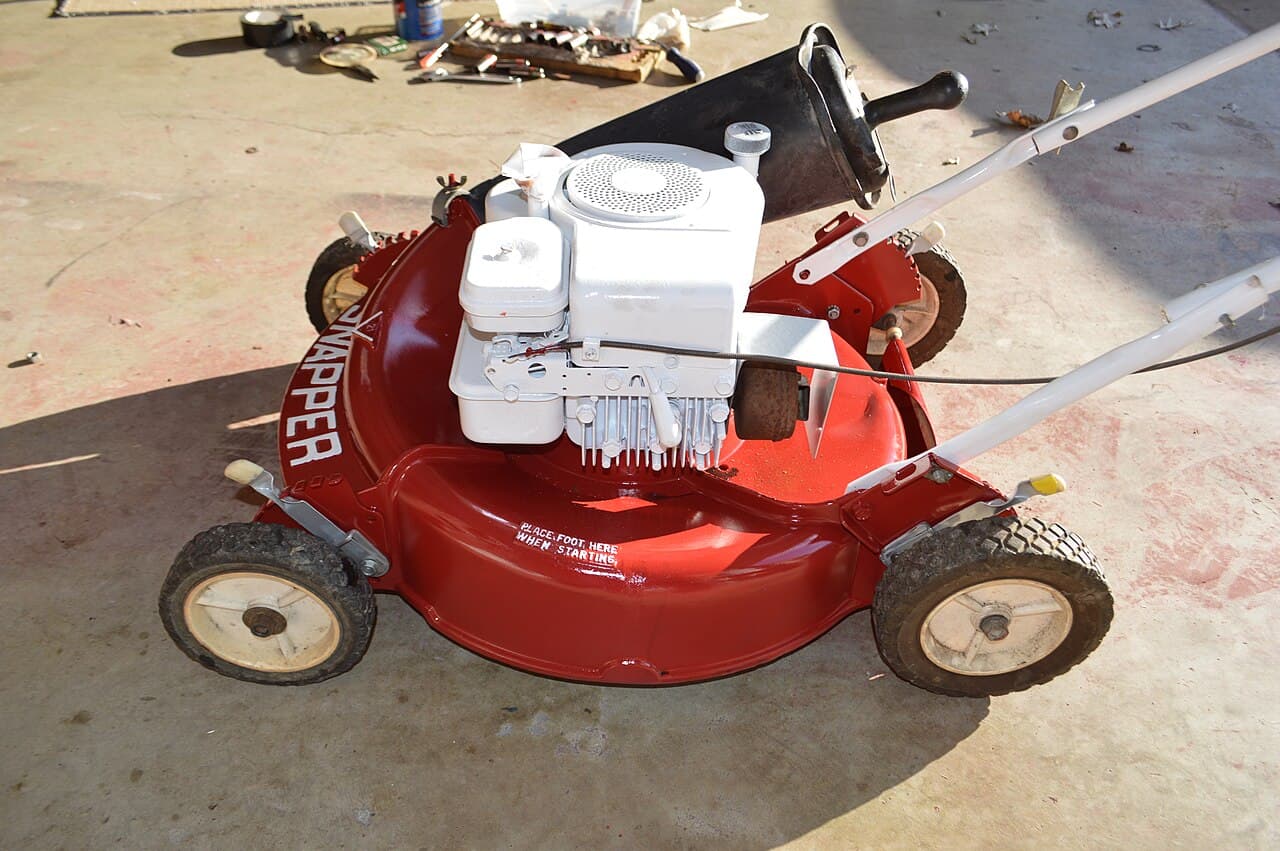
White or blue smoke: check the oil
Briggs & Stratton lists the common causes of burning oil. The ones you can check at home:
- Overfilling the crankcase with oil.[1]
- Exceeding the engine's oil capacity shown on dipstick.[1]
- Turning/tilting the engine on its side for storage, oil change or any other reason.[1]
- Operating engine at greater than a 15 degree angle.[1]
- Incorrect oil grades.[1]
So the first check is the dipstick. Check the oil level regularly, ideally every time you mow, and add oil up to the fill line on the dipstick as needed.[3] Read it on level ground, and check your oil level while the engine is still cold using your mower's dipstick.[4] If the oil is above the full mark, take the excess out through the drain or with a pump until it sits at the fill line. Wipe off spilled oil from the deck and engine before restarting.
Tipping matters because oil moves. If the engine has to be tilted, ensure that either the spark plug is facing upwards or the muffler side is facing downwards to help prevent oil from escaping the crankcase.[1] A mower tipped the wrong way for blade work or cleaning may smoke for a while at the next start.
Check your manual for the correct oil grade and capacity for your engine.
Black smoke: air and fuel
Black smoke points to the air-fuel mixture being off. Air filters keep dust from entering the engine,[4] and a dirty or plugged air filter is on Briggs & Stratton's smoking checklist: clean or replace the air filter.[2] That is the easy fix. If the smoke stays black with a clean filter, the carburetor adjustment is bench work for a small engine shop, not a driveway job.
Rarer causes that need a shop
Briggs & Stratton also lists an obstructed or crimped breather tube (located behind the air filter),[1] worn cylinder and/or rings,[1] and a blown head gasket.[1] None of these is a field repair on a push mower. Suspect them when the oil level is right, the mower was not tilted, and the smoke continues.
Safety while you check
Disconnect the spark plug before reaching under the deck or tipping the mower.[3] Let the engine cool before opening anything. If you add fuel afterwards, remember that CPSC says to never refuel the mower when it is running or while the engine is hot.[5]
Stop and call a pro if
- Smoke continues after the oil is at the right level and the mower has not been tipped.
- Black smoke stays with a clean air filter. The carburetor needs adjusting.[2]
- The mower knocks, loses power or smokes heavily under load. Stop using it.
- You see flame, or fuel is leaking. Move away and do not run the engine.
- You are not sure how the mower was tilted and the oil level looks wrong. A shop can drain, refill and test it.
Getting help in Virginia
If the mower needs a shop, see how much push mower repair costs in Virginia to know what a bill should look like. Browse lawn equipment repair answers or see lawn care services on Loclis.
When you are ready, describe the mower and the problem and local small engine shops can quote it.
Common questions
- Is white smoke from a lawn mower serious?
- Often not. Briggs & Stratton says blue or white smoke usually indicates burning oil, and the common causes are an overfilled crankcase or a mower that was tilted. A puff of white smoke after you spilled oil on a hot engine usually burns off quickly. Smoke that keeps coming after you correct the oil level is the point to book a shop.
- Why does my mower smoke after I changed the oil?
- The usual reasons are too much oil or oil spilled on the engine. Check the dipstick with the engine level and cold; if the level is above the fill line, remove the excess. Wipe up any spill and run the mower for a few minutes to see whether the smoke clears.
- Can I keep mowing a smoking mower?
- Stop, let it cool and check the oil first. Running an engine that is burning oil because of low or overfilled oil can make things worse, and a mower that smokes along with knocking or a sudden loss of power should go to a shop without further use.
- What does black smoke from a push mower mean?
- Briggs & Stratton ties black smoke to a carburetor that needs adjusting and lists a dirty or plugged air filter on the same smoking checklist. Replace or clean the filter first. If the smoke stays black, the carburetor adjustment is a job for a small engine shop.
- Is it safe to tip a mower to check underneath?
- It is a common cause of smoke. If the engine has to be tilted, Briggs & Stratton says to make sure either the spark plug is facing upwards or the muffler side is facing downwards, to help prevent oil escaping the crankcase. Disconnect the spark plug wire before working near the blade.
Sources
- [1] Why is White / Blue Smoke Coming from the Engine?, Briggs & Stratton. Checked October 28, 2026.
- [2] How do I troubleshoot & repair common small engine problems?, Briggs & Stratton. Checked October 28, 2026.
- [3] How to Perform Lawn Mower Maintenance, Briggs & Stratton. Checked October 28, 2026.
- [4] Mower Maintenance, University of Illinois Extension. Checked October 28, 2026.
- [5] Power Lawn Mowers (walk-behind mower fact sheet), U.S. Consumer Product Safety Commission. Checked October 28, 2026.
Want a pro to handle it?
Describe the job once. Licensed local businesses send quotes, and you pay only when you book one.
Get a quote for Lawn Equipment