How does a gas fireplace insert work?
A gas fireplace insert is a sealed gas heater that fits into an existing fireplace opening. A burner lights behind a closed glass front, the exhaust leaves through a liner in the old chimney, and a second pipe brings in outside air to burn. A fan blows the warmed room air out into the room. It is meant for added warmth, not as your main heat.
Free to ask. Local shops send quotes, and you pay only when you book one.
By Kasra Taheri, Founder, LoclisPublished
Researched and drafted with AI, then checked claim by claim against the sources listed below before it was published. Prices and rules change; the dates beside each source say when it was last checked.
This is a job for a licensed pro in Virginia
This page explains what the work involves, the permits, what a licensed pro does and what drives the cost. It does not give step-by-step instructions, because this work needs a licence, a permit or both, and doing it wrong can injure someone. Before you hire, check the licence on Virginia's DPOR record.
A gas fireplace insert is a sealed gas heater that slides into the opening of an existing fireplace. In a direct vent model, a gas burner lights behind a closed glass front, the exhaust leaves through a liner in the old chimney, and a second pipe brings in the outside air the flame burns. A fan then blows room air around the hot firebox and back out into the room. Columbia Gas of Virginia says direct vent gas inserts use outside air for combustion,[2] so the flame does not pull heated air out of your house the way an open wood fire does.
The parts that do the work
Kingsman's installation manual describes its inserts as gas fired direct vent room heater inserts, designed for installation in a zero clearance factory-built fireplace or in a noncombustible masonry fireplace.[1] Other brands are similar, but check the manual for the model you are quoted.
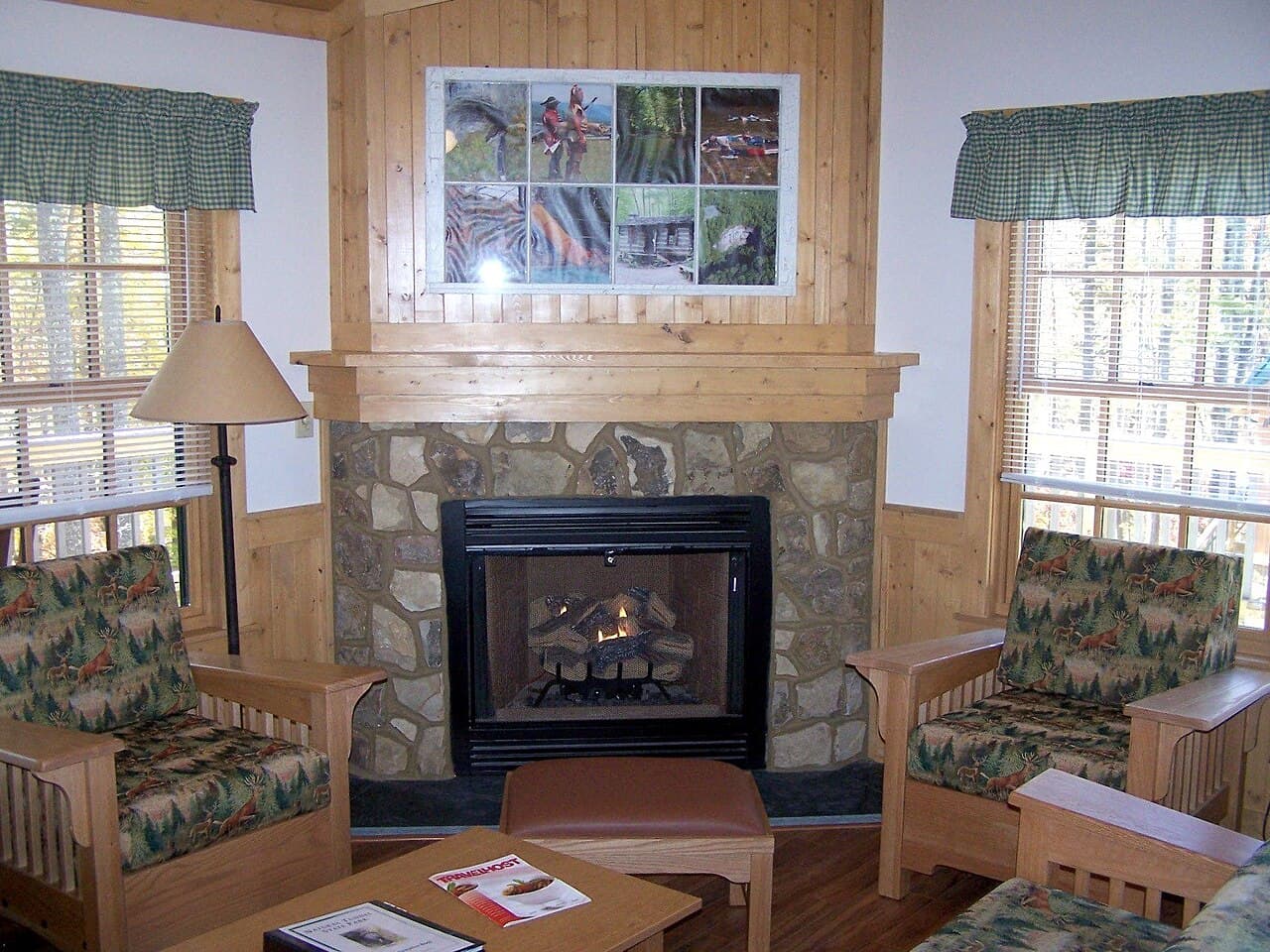
The burner and ignition. A gas valve feeds a burner under ceramic logs or a similar media, and a small pilot or electronic igniter lights it. The manual's lighting instructions cover both a millivolt pilot and electronic ignition.[1] Columbia Gas of Virginia's rebate is for direct vent gas fireplaces with an electronic pilot ignition.[2]
The sealed glass front. The flame burns in a closed chamber, which is what keeps combustion air and exhaust separate from your room. Kingsman says glass doors must be closed for safe operation and that the appliance must not be run with the glass front removed, cracked or broken.[1]
The blower. Most inserts have a fan that pushes room air across the hot outer surfaces. That is why an insert heats a room much better than a decorative log set in an open firebox. A fan makes some noise, and the manual calls it normal, adding that turning the fan speed down reduces the volume of heated air circulated into the room.[1]
How it vents: two pipes, not one
The insert has no open flue. Instead, two flexible vent pipes run from the unit up the existing chimney to a termination cap on top. One carries exhaust out, the other draws fresh air in.
Several details matter for safety, and they are why this is not a weekend project:
- The vent liners must terminate in a rain cap, and the area between the existing chimney and the liner must be capped off.[1]
- Kingsman tells installers to label the exhaust and intake flex pipes and not to connect the exhaust to the intake or the reverse.[1]
- Kingsman says the chimney must be inspected, cleaned and repaired if necessary before any vent liner is run through it, and that a chimney used for a solid fuel fireplace must be professionally cleaned.[1]
- The manual also says the insert must not be connected to a chimney flue serving a separate solid-fuel burning appliance.[1]
If your chimney is cracked, leaning or leaking, that gets fixed first. See what a chimney liner is and whether you need one for how liners work.
How much heat to expect
An insert warms the room it sits in and the rooms that open to it. Kingsman's manual says gas fired appliances may be used only for supplemental heat or decorative purposes and under no circumstances as a primary heat source,[1] and Columbia Gas of Virginia says natural gas fireplaces are meant for added warmth, not a main source of heating.[3] Think of it as a zone heater that lets you turn the furnace down a little, not a furnace replacement.
Safety and upkeep
Any fuel-burning appliance can produce carbon monoxide. It is an odorless, tasteless gas created when fuels such as natural gas burn incompletely.[4] Kingsman recommends a carbon monoxide detector in or near bedrooms and on all levels of the home.[1] The same manual recommends that the dealer or a qualified technician inspect and clean the burner system every year.[1] Keep the glass intact and the vent cap clear, and have the vent system looked at if you notice soot, a yellow flame or a new smell.
When to call a licensed pro
For the whole installation and for any service that touches the burner, gas valve or venting. Columbia Gas of Virginia says only qualified professionals should install and service natural gas space heaters and gas logs.[3] Virginia's Board for Contractors defines gas fitting contracting as the installation, repair, improvement or removal of gas piping and appliances annexed to real property.[5] If the work is valued at $1,000 or more, a valid Virginia contractor's licence is required for the licence category in which the contractor is to work.[6] The next question is usually who can install a gas fireplace insert in Virginia, followed by what it costs.
Loclis lists licensed fireplace and chimney businesses with their licence details. Browse chimney and fireplace services or read more chimney answers.
To get quotes for your own fireplace, describe the job once and licensed local businesses respond.
Common questions
- Does a gas fireplace insert need a chimney?
- An insert for an existing fireplace usually uses the chimney as a path for two vent pipes: one carries exhaust out and one brings combustion air in. Kingsman's manual requires the chimney to be inspected, cleaned and repaired if necessary before a liner goes in. Columbia Gas of Virginia notes that some direct vent units can instead vent through an exterior wall.
- Does a gas insert heat the whole house?
- No. Kingsman's manual limits gas fired appliances like its inserts to supplemental or decorative heat, and Columbia Gas of Virginia says gas fireplaces are meant for added warmth, not a main heat source. Expect it to warm the room it is in and the spaces that open to it.
- Will a gas insert work in a power outage?
- That depends on the model. Kingsman's manual covers both millivolt and electronic ignition, and the blower fan runs on electricity, so behaviour differs by model. Ask the installer which ignition your insert uses and what it does when the power fails.
- Why is there a smell when a new insert first runs?
- Kingsman's manual says new paint and firebox finishes cure during the first burns and can give off odours and leave a white film on the glass. It recommends running the unit for at least four hours at a time, with the fan off, until the odours fade, and cleaning the glass with fireplace glass cleaner once it is cool.
- Can I install a gas insert myself?
- Not in a way that is safe or legal for most homes. The job involves a gas connection, a vent liner and usually a permit, and Columbia Gas of Virginia says only qualified professionals should install natural gas space heaters and gas logs. Hire a licensed contractor.
Sources
- [1] Installation Instructions: Gas Fired Direct Vent Room Heater Inserts (IDV26, IDV33, IDV43), Kingsman Fireplaces (R-Co. Inc.). Checked October 27, 2026.
- [2] Fireplace Rebates, Columbia Gas of Virginia. Checked October 27, 2026.
- [3] Safe Appliance Installation, Columbia Gas of Virginia. Checked October 27, 2026.
- [4] Carbon Monoxide, Columbia Gas of Virginia. Checked October 27, 2026.
- [5] 18VAC50-22-30, Definitions of specialty services, Virginia Administrative Code, Board for Contractors. Checked October 27, 2026.
- [6] What You Should Know Before You Hire a Contractor, Virginia Board for Contractors, DPOR. Checked October 27, 2026.
Want a pro to handle it?
Describe the job once. Licensed local businesses send quotes, and you pay only when you book one.
Get a quote from a local pro