How is a yard regraded so water drains away from the house?
A contractor regrades a yard by reshaping the soil so the ground falls away from the foundation on every side, using compacted clay-rich fill where needed, then sending the water to an outlet where it can soak in or drain without harming neighbors. The Northern Virginia district's guideline is at least a 5% grade for ten feet, a drop of six inches. Large jobs may need erosion-control permits.
Free to ask. Local shops send quotes, and you pay only when you book one.
By Kasra Taheri, Founder, LoclisPublished
Researched and drafted with AI, then checked claim by claim against the sources listed below before it was published. Prices and rules change; the dates beside each source say when it was last checked.
This is a job for a licensed pro in Virginia
This page explains what the work involves, the permits, what a licensed pro does and what drives the cost. It does not give step-by-step instructions, because this work needs a licence, a permit or both, and doing it wrong can injure someone. Before you hire, check the licence on Virginia's DPOR record.
A yard is regraded by reshaping the soil so the ground falls away from the foundation on every side, then sending that water to a place where it can drain or soak in without harming your house or your neighbors. The Northern Virginia Soil and Water Conservation District recommends that the ground around a house slope away from the foundation walls, ideally at least a 5% grade for ten feet, which is a drop of at least six inches over those ten feet.[1]
Why the grade next to the house matters
Ground that tilts toward the house is called a negative grade, and the district calls it an undesirable condition.[1] Water then runs to the foundation instead of away from it. The district notes that most wet basements are a result of water problems outside of the house,[2] and it lists gutters that need cleaning or are undersized, downspouts and sump pump pipes, and poor grading around foundation walls as possible causes of wetness and erosion near the walls.[2]
Roof water adds to the load. When it rains hard, an average sized home can experience hundreds of gallons of runoff coming from the roof.[3] Regrading works best together with gutters and downspouts that carry that water well clear of the walls, so a good contractor looks at both.
What a regrading job involves
The work is more than pushing dirt around. A contractor will usually:
- walk the property in or just after rain to see where water travels, pools and leaves
- find the low spots, the places soil has settled against the foundation and any slope that runs toward the house
- strip or loosen the surface, then add fill where the ground needs raising
- use clay-rich fill rather than sand near the house; the district says fill soil used to fill depressions near a foundation should have high clay content and not too much sand[1]
- compact the soil in layers so it does not settle back; Fairfax County's flood program says regraded soil must be mechanically compacted to prevent settling[5]
- shape the ground to the target slope, which that program describes as at least 0.5 inch per foot for at least 10 feet[5]
- reseed, sod or mulch the bare soil so rain does not wash it away
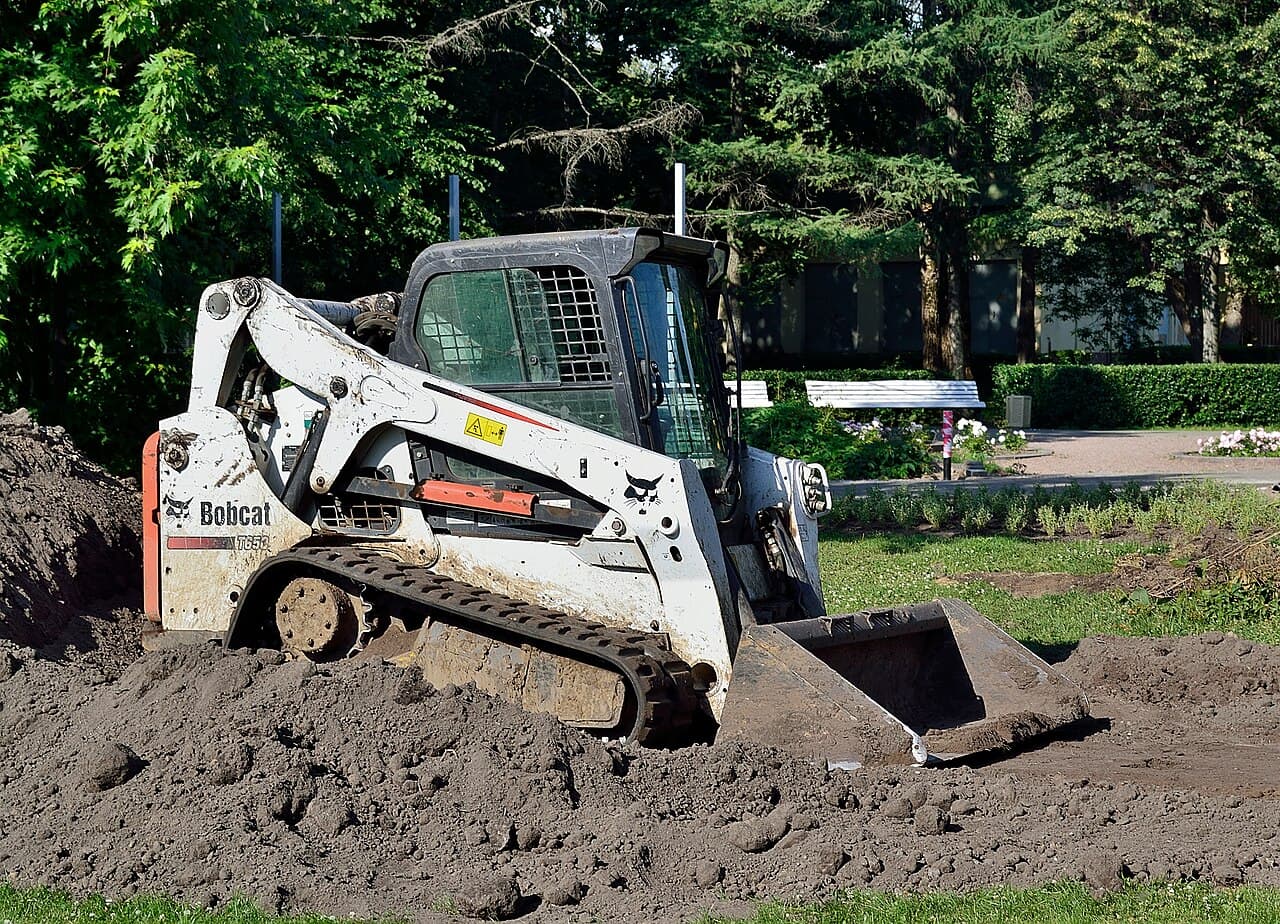
A small tracked loader, a skid steer or a mini excavator does most of this on a typical lot. The finished soil should stay clear of siding, wood trim, vents and window wells.
Where the water goes
Tilting the ground away from the house only moves the problem unless it has somewhere to end up. The district puts it plainly: "Whenever you are redirecting runoff, you must send it to a suitable outlet."[4] It describes a suitable outlet as land that can receive redirected runoff without erosion or sogginess, such as a rain garden, dry well, existing swale or gently sloping vegetated land that does not lead straight onto a neighbor's property.[1] Redirecting runoff without soaking it into the soil can harm neighboring properties.[4]
Fairfax County's flood program adds that regrading should aim to reestablish the grades on the approved site plan, and it notes that the county's Zoning Ordinance bars changing the existing contours of land in a way that obstructs, interferes with or changes its drainage.[5] Check your own locality's rules before reshaping a drainage path.
Permits, utilities and protected land
Regrading counts as digging. Virginia's utility damage prevention law defines excavation to include grading, trenching and digging,[6] so a locate request is needed before the machine arrives; see do I need to call 811 before digging in Virginia.
Large jobs also fall under erosion control rules. Virginia's erosion and stormwater law defines land disturbance to include the clearing, grading, excavating or filling of land.[7] Outside Chesapeake Bay Preservation Areas, the erosion control requirements apply to any activity that disturbs 10,000 square feet or more, and the locality may reduce that threshold to a smaller area.[8] In a Chesapeake Bay Preservation Area, the threshold drops to 2,500 square feet.[8] The law also exempts minor land-disturbing activities, including home gardens and individual home landscaping, repairs and maintenance work,[8] so whether a given regrade is covered is a question for your locality. Montgomery County, for example, requires a land disturbing permit when disturbing more than 10,000 square feet of land, including clearing, grading, excavation, transporting and filling.[9]
Near streams, wetlands and floodplains the rules tighten. Land disturbance is highly restricted in Chesapeake Bay Resource Protection Areas,[2] and disturbing a jurisdictional wetland in Virginia is prohibited without a permit from the Army Corps of Engineers Norfolk Office or the Virginia Department of Environmental Quality.[1]
If your home is in a newer development, ask before you pay anyone: in a new development under bond, the builder may be responsible for fixing drainage problems that arise as a result of inadequate grading.[2]
When to call a licensed pro
Hire one for anything beyond filling a small low spot by the downspout: a slope that runs toward the house, standing water, water in the basement or crawlspace, a large area, a steep lot, a drainage path that crosses a property line, or a lot near water. Virginia's Board for Contractors defines a landscape service contracting specialty that covers altering a land area by excavation, clearing and grading, including removing stumps and roots below grade.[10] Check the licence on DPOR's License Lookup before you sign.[11]
Ask for a written scope that says which areas are regraded, the slope you are aiming for, where the water ends up, how the soil is compacted and the lawn restored, and who calls 811 and pulls any permit. For what it costs, see how much yard grading costs in Virginia. If the yard floods even when the grade is right, read why a yard floods when it rains.
Loclis lists licensed Virginia businesses by category. Browse excavation and grading services or read more excavation answers. To get quotes for your own yard, describe the job once.
Common questions
- What slope should the ground have next to my house?
- The Northern Virginia Soil and Water Conservation District recommends ideally at least a 5% grade for ten feet around the house, a drop of at least six inches over those ten feet. Ground that tilts toward the house is called a negative grade and is the condition to fix.
- Can I just add dirt against the foundation myself?
- Filling a small low spot beside a downspout with clay-rich soil is ordinary yard care. Anything larger, or any change that sends water toward a neighbor, is a contractor's job. Keep soil below the siding and trim, and call 811 first if you will dig.
- Do I need a permit to regrade my yard?
- Often not for a small yard, but it depends on the area disturbed and your locality. Virginia's erosion control rules apply to activity that disturbs 10,000 square feet or more, or 2,500 in a Chesapeake Bay Preservation Area, localities may set lower limits, and minor home landscaping and repair work is exempt. Ask your county or city.
- Will regrading fix a wet basement?
- It can help when poor grading is the cause, but gutters, downspouts and groundwater matter too. The district says most wet basements are a result of water problems outside of the house, so the contractor should look at the roof water and the whole yard.
- Where does the water go after regrading?
- To a suitable outlet: land that can take it without erosion or sogginess, such as a rain garden, dry well, existing swale or gently sloping vegetated ground that does not lead straight onto a neighbor's property.
Sources
- [1] Glossary - Solving Drainage and Erosion Problems, Northern Virginia Soil and Water Conservation District, Fairfax County. Checked October 26, 2026.
- [2] Solving Drainage and Erosion Problems: A Guide for Homeowners, Northern Virginia Soil and Water Conservation District, Fairfax County. Checked October 26, 2026.
- [3] Gutters and Downspouts: Wetness or Erosion Problems, Northern Virginia Soil and Water Conservation District, Fairfax County. Checked October 26, 2026.
- [4] Control Heavy Runoff - Solving Drainage and Erosion Problems, Northern Virginia Soil and Water Conservation District, Fairfax County. Checked October 26, 2026.
- [5] Flood Proofing Practices: Approved List of Practices, Fairfax County Flood Mitigation Assistance Program, Northern Virginia Soil and Water Conservation District. Checked October 26, 2026.
- [6] Va. Code § 56-265.15, Definitions; calculation of time periods, Code of Virginia, Virginia General Assembly. Checked October 26, 2026.
- [7] Va. Code § 62.1-44.15:24, Definitions, Code of Virginia, Virginia General Assembly. Checked October 26, 2026.
- [8] Va. Code § 62.1-44.15:34, Regulated activities; submission and approval of a permit application; security for performance; exemptions, Code of Virginia, Virginia General Assembly. Checked October 26, 2026.
- [9] Construction & Land Development: Erosion and Sediment Control, Montgomery County, Virginia. Checked October 26, 2026.
- [10] 18VAC50-22-30, Definitions of specialty services, Virginia Administrative Code, Board for Contractors. Checked October 26, 2026.
- [11] License Lookup, Virginia Department of Professional and Occupational Regulation. Checked October 26, 2026.
Want a pro to handle it?
Describe the job once. Licensed local businesses send quotes, and you pay only when you book one.
Get a quote from a local pro