How much does it cost to paint trim and doors in Virginia?
Virginia has no standard price for painting trim and doors, and we found no dated primary source for one. The quote depends on how many doors and how much trim you have, their condition, the prep, the paint and, in a pre-1978 home, lead-safe rules. Get at least three written bids for the same list of work.
Free to ask. Local shops send quotes, and you pay only when you book one.
By Kasra Taheri, Founder, LoclisPublished
Researched and drafted with AI, then checked claim by claim against the sources listed below before it was published. Prices and rules change; the dates beside each source say when it was last checked.
Step by step
Read when to stop and call a pro, further down this page, before you start.
Step 1: List the doors and trim
Count the doors (both sides, edges and frames) and measure the baseboards, casings and any other trim, room by room.
Step 2: Note the condition
Mark gaps, nail holes, peeling spots and glossy finishes, since caulking, patching and priming are all part of the price.[1]
Step 3: Check the age of the house
If it was built before 1978, ask any painter whether they are lead-safe certified.[4]
Step 4: Write one scope
Say how many coats, which paint and sheen, and who supplies it, so every bid covers the same work.[2]
Step 5: Get at least three written bids
Compare them line by line and ask why any one is much lower.[2]
Step 6: Check the licence
For work valued at $1,000 or more, look up the contractor on DPOR.[2]
Step 7: Limit the deposit
Keep it to 10% of the total or $1,000, whichever is less, and sign only a complete written contract.[2]
What decides the price
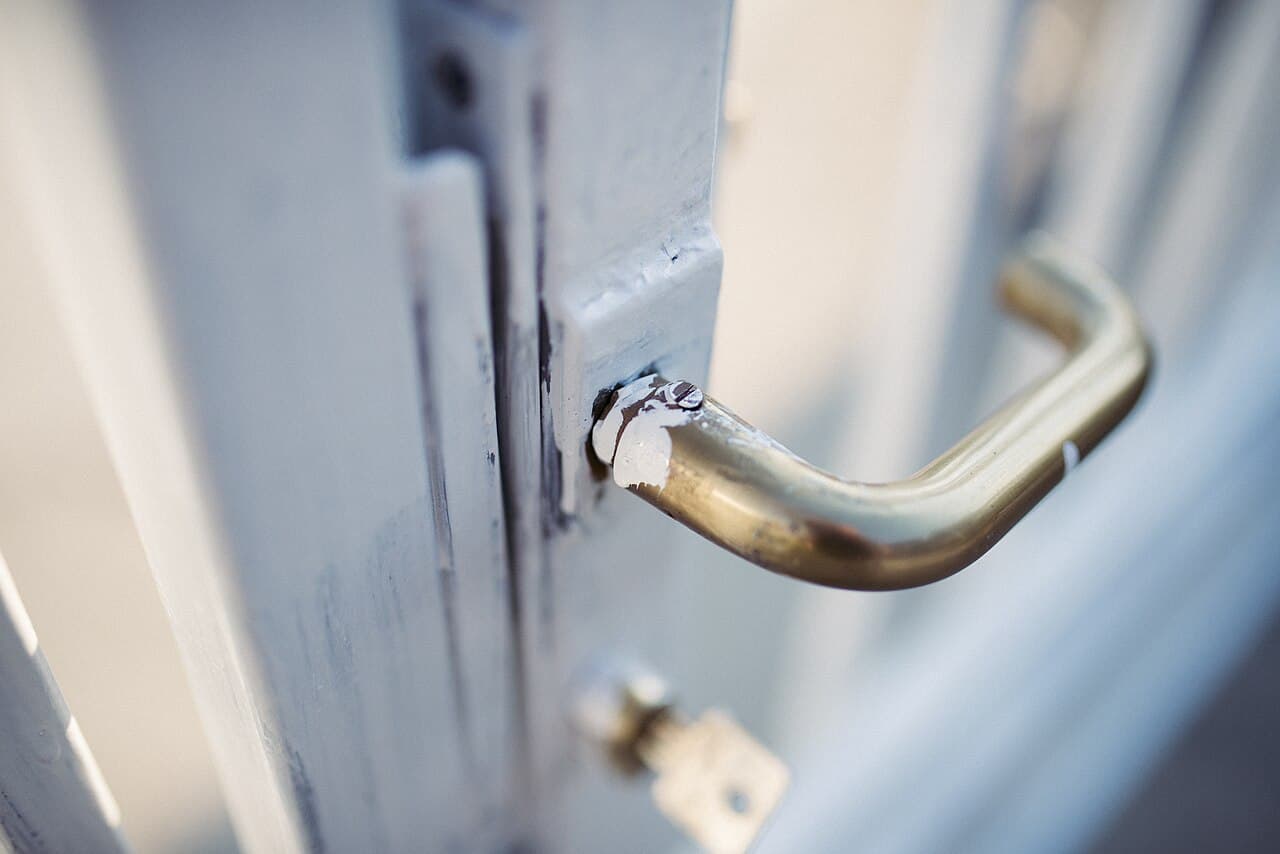
Virginia has no standard price for painting trim and doors, and no primary source we could find that publishes one with a date, so any single figure would be a guess. What you can do is know what moves the quote, and make every painter price the same list.
Trim and doors are priced by the amount of work, not by floor area. A quote usually turns on these things:
- How many doors, and how many sides. A slab door has two faces and four edges. A panel door has recessed panels, rails and stiles that all need a brush, so it takes longer than its size suggests.
- How much trim. Baseboards, window and door casings, crown molding and chair rail are measured in linear feet, and detailed profiles take longer to cut in.
- Frames as well as doors. Door frames are trim, and Benjamin Moore's painting order for a room runs from the top down: "crown molding, window frames, door frames, and finally baseboards."[1] Frames are a separate stretch of work from baseboards.
- The condition of what is there. Benjamin Moore says to fill gaps between the wall and trim with caulk and let it cure fully, and that all repairs should be primed before painting.[1] Every gap, nail hole and rough patch is labor.
- Prep before paint. Sherwin-Williams has you wash a door with a degreasing dish soap, sand it smooth and prime it if it has not been painted or primed, then paint the panels with an angle brush and roll the rest in thin, even layers, with at least four hours before a second coat.[5] A painter pricing the job is pricing all of that, twice.
- The paint. Benjamin Moore suggests a waterborne alkyd paint for trim, which it says "goes on smooth and cures to a hard, furniture-quality finish."[1] Ask which product is in the quote and what sheen it is.
- Color change. Going from dark to light, or the reverse, can mean primer and an extra coat.
- Furniture, floors and access. Moving furniture, protecting floors and working above stairs or tall windows add time.
Trim and doors are small surfaces with a lot of edges, so they are slow to prep and paint. Ask each painter to price them as separate lines from the walls.
Pre-1978 homes cost more to prepare
If the house was built before 1978, the painter's prep changes. EPA says that in general "anyone paid to perform work that disturbs paint in housing and child-occupied facilities built before 1978 must be certified in lead-safe work practices."[4] That applies to every firm, including sole proprietors.[4] Sanding and scraping old trim and doors is exactly the work it covers, and a certified firm must use lead-safe work practices, which can add to the prep and cleanup. Ask whether the price includes them.[4]
Get comparable quotes
The Board for Contractors says it is advisable to get at least three written bids or estimates "using identical plans and specifications so you can compare prices and contractors."[2] For trim and doors that means handing every painter the same list: which doors (both sides, edges and frames), which trim and where, whether caulking and patching are included, how many coats, which paint and sheen, and who supplies it.
The same guide warns about the low outlier: a bid "substantially lower than the others" probably indicates that the contractor has made a mistake or is not including all the work quoted by his or her competitors.[2] If one trim quote is half the others, check what it leaves out.
Licence and deposit
Virginia requires a contractor licence for work valued at $1,000 or more.[2] The Board for Contractors defines painting and wallcovering contracting to include "surface preparation, caulking, sanding, and cleaning preparatory to painting or coverings," inside and out.[6] A whole-house trim and door repaint can pass $1,000 quickly, so check the licence.
On deposits, the guide's rule of thumb is an initial deposit of no more than 10% of the total price or $1,000, whichever is less.[2] Virginia law requires all licensed contractors to provide a written contract for residential work, and you should never sign a blank or partially blank contract.[2]
Stop and call a pro if
- The house was built before 1978 and the paint is chipping or flaking. EPA says any renovation, repair or painting project in a pre-1978 home or building that has lead-based paint can easily create dangerous lead dust.[4] EPA recommends homeowners hire a lead-safe certified contractor who is certified and trained in lead-safe work practices.[3]
- The wood is soft, rotted or water-stained. That needs a carpenter before any painter.
- The paint is peeling in layers. That points to moisture or a failed coat that needs more than a light sanding.
Ways to keep the cost down
- Do the doors yourself and hire out only the hard trim. See how to paint interior doors without brush marks.
- Bundle trim and doors with a room repaint instead of calling a painter twice. One visit can save a second set-up and travel charge, so ask.
- Ask for a line-item price per room so you can drop a room later.
Not sure whether to split the job? Read should I hire a painter just for trim and doors. More are in painting answers, and you can browse the painting category.
When you are ready, describe the job and licensed local painters will quote it.
Common questions
- Is there a standard price for painting trim and doors in Virginia?
- No. We found no primary source that publishes a dated Virginia price, so the cost is set by the number of doors, the length of trim, its condition, the paint and the prep. Get written bids for an identical list of work.
- Why is painting trim more expensive than painting walls?
- Trim is small, detailed work done with a brush. Benjamin Moore's guide calls for caulking, sanding glossy finishes and priming repairs before paint, so the time per square foot is high.
- Do I need a licensed painter?
- In Virginia a contractor licence is required when the work is valued at $1,000 or more. A smaller job falls below that threshold, but a written contract is still wise.
- Does an older house cost more to paint?
- It can. In a house built before 1978, EPA's rule requires anyone paid to disturb painted surfaces to be certified in lead-safe work practices, and those practices can add to the prep and cleanup.
- How big a deposit is reasonable?
- The Board for Contractors' rule of thumb is no more than 10% of the total price or $1,000, whichever is less.
Sources
- [1] How to Paint Trim: 4 Steps for Painting Trim, Benjamin Moore. Checked October 27, 2026.
- [2] What You Should Know Before You Hire a Contractor, Virginia Board for Contractors, DPOR. Checked October 27, 2026.
- [3] Renovation, Repair and Painting Program: Do-It-Yourselfers, U.S. Environmental Protection Agency. Checked October 27, 2026.
- [4] Lead Renovation, Repair and Painting Program, U.S. Environmental Protection Agency. Checked October 27, 2026.
- [5] How to Paint Interior Doors, Sherwin-Williams. Checked October 27, 2026.
- [6] 18VAC50-22-30. Definitions of specialty services (Board for Contractors Regulations), Virginia Administrative Code, Virginia General Assembly. Checked October 27, 2026.
Want a pro to handle it?
Describe the job once. Licensed local businesses send quotes, and you pay only when you book one.
Get a quote from a local pro