How much does professional Christmas light installation cost in Virginia?
There is no single Virginia price. Quotes depend on how many feet of roofline you want lit, how high it is, whether the company supplies and stores the lights, and whether it takes them down. Get at least three written bids for the same design, and compare what each one includes.
Free to ask. Local shops send quotes, and you pay only when you book one.
By Kasra Taheri, Founder, LoclisPublished
Researched and drafted with AI, then checked claim by claim against the sources listed below before it was published. Prices and rules change; the dates beside each source say when it was last checked.
Step by step
Read when to stop and call a pro, further down this page, before you start.
Step 1: Measure what you want lit
Walk the house and note the linear feet of gutter or roofline, the number of storeys, and any trees, bushes or railings you want included.
Step 2: Write one design brief
List the color, bulb type, spacing and whether the lights are wired to a timer, so every company bids on the same job.
Step 3: Ask three companies for written bids
Send the same brief to each. The Board for Contractors advises getting "at least three written bids or estimates using identical plans and specifications".[1]
Step 4: Ask what each bid includes
Ask whether it covers the lights, installation, mid-season repairs, takedown and storage, and who owns the lights afterward.
Step 5: Look hard at the cheapest bid
The board warns: "Beware of any bid substantially lower than the others."[1] Find out what is left out.
Step 6: Put the agreement in writing
Get dates for install and takedown, the payment schedule and the cancellation terms before you pay.[1]
There is no single Virginia price for professional Christmas light installation. What you pay depends on a few things you can see from the driveway, and the only figure that counts is a written bid for your own house.
What drives the price
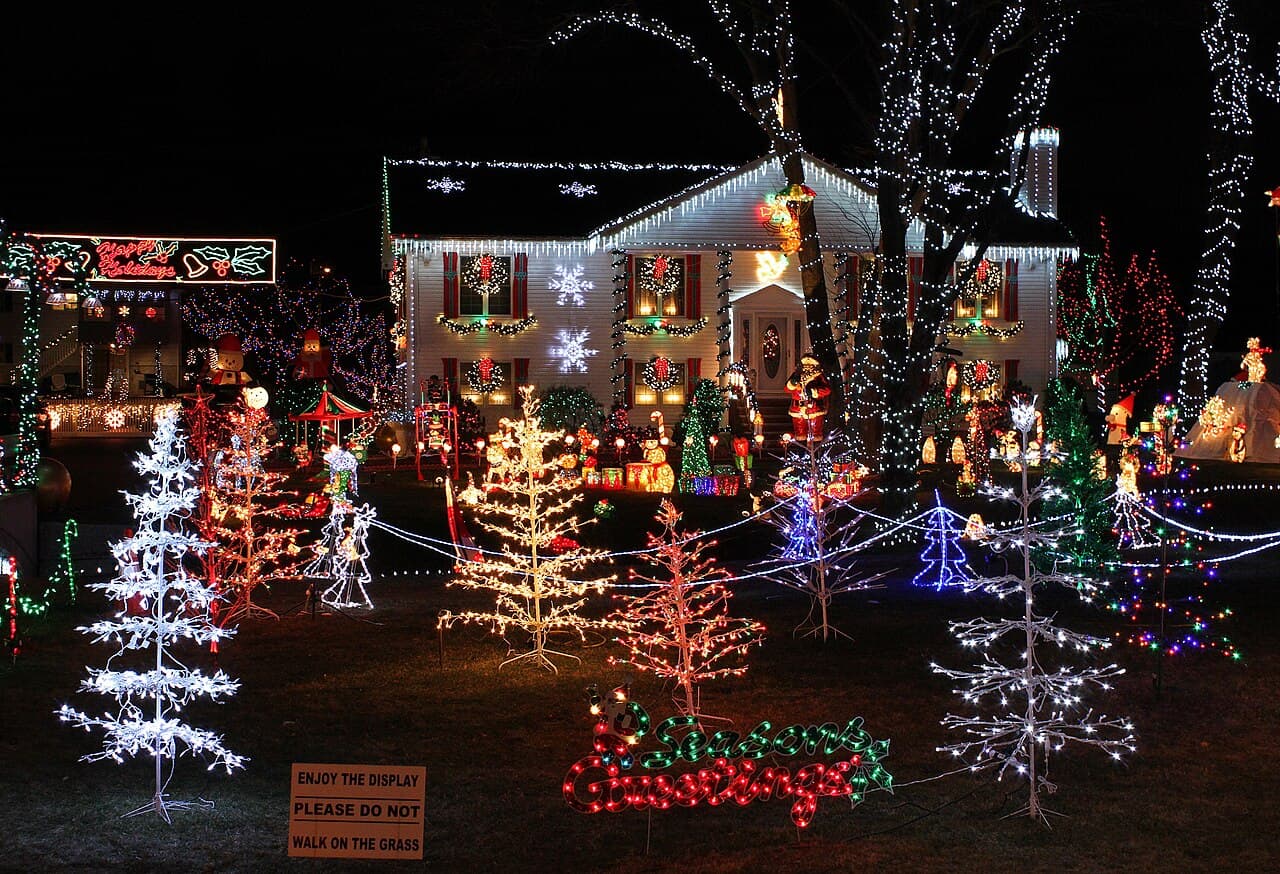
How much you want lit. Linear feet of gutter or roofline is the usual starting point, then trees, shrubs, railings, wreaths and window outlines. A plain eave costs less to light than a house with dormers, gables and a roof peak.
Height. A single-storey eave can be reached from a ladder. A second storey or a steep roof needs more equipment and more risk, and a company will charge for both. The same height is why we do not recommend doing it yourself: see how to hang lights along gutters.
Whose lights. Some companies supply commercial-grade lights and keep them, so you rent a display. Others sell you the lights, or hang the ones you own. Each is priced differently, and each has its own rules about repairs.
The service period. A bid might cover installation and takedown only, or also a mid-season visit to replace failed bulbs. Storage between seasons is another line.
Power. If the display needs an outdoor outlet where there is none, the new outlet is separate electrical work. Virginia defines a tradesman as someone who works for the public "in the trades of electrical, plumbing and heating, ventilation and air conditioning",[2] and an outlet is an electrician's job, not a lighting crew's.
How to get a price you can trust
The Virginia Board for Contractors recommends getting "at least three written bids or estimates using identical plans and specifications".[1] For lighting that means the same footage, the same lights and the same takedown date in every request. It also warns: "Beware of any bid substantially lower than the others."[1] A bid that is far under the rest usually leaves something out.
Check that the company is real. A license number on a card or advertisement "does not necessarily mean the contractor" is licensed, so look the number up with DPOR if one is given.[1]
Get everything agreed in writing: the design, the dates, the payment schedule and what happens if a string fails. The board's advice is blunt: "Never sign a blank or partially blank contract."[1]
Compare the bids
Put the bids side by side and answer these: Who supplies the lights? Is the takedown included, with a date? What happens if a string stops working in January? Is the price per season, or does it include next year? A bid that answers those clearly is usually better value than a lower one that does not.
Stop and call a pro if
- A bid asks for new wiring or an outlet. That is electrical work for a licensed electrician, not a lighting crew.[2]
- A company wants you to climb up to hang or fix part of the display. Overhead lines also set limits: no one may place a ladder "within 10 feet (3.1 meters) of any overhead high voltage line" without protection.[3]
- The company wants a large sum up front, or will not put the terms in writing. The Board for Contractors says a reputable contractor should be able to cover the cost of supplies without one.[1]
Getting started
Read whether hiring is worth it before you send the requests, and the guide to hanging lights along gutters if you are still thinking of doing it yourself. Browse holiday lighting or more snow and seasonal answers.
When you have your brief, describe the job and local businesses quote it.
Common questions
- Why is there no price per foot here?
- Because the prices we can find are undated or sold by lead-selling marketplaces, and neither is good enough to print. A written bid for your own house, at your own roofline, is the only number worth acting on.
- Why do two bids for the same house differ so much?
- Different jobs often hide inside the same words. One bid may include the lights, repairs and takedown, and another only the hanging. Compare line by line, and ask why a bid is much lower or higher than the others.
- Is it cheaper to buy my own lights?
- It can be if you already have good lights and a company will only hang them, but many installers will not warrant lights they did not supply. Ask each company how it handles customer-owned lights.
- Does the price include taking the lights down?
- Not always. Ask for takedown and storage to be written into the bid, with a date, since a bid that stops at install leaves you with a second job.
- Do I pay a deposit?
- A modest deposit is normal, but the Board for Contractors advises that the contract spell out the payment schedule and the cancellation terms, and a contractor should not need a large sum up front. Do not pay in full before the work is done.
Sources
- [1] What You Should Know Before You Hire a Contractor, Virginia Board for Contractors, DPOR. Checked October 27, 2026.
- [2] Va. Code § 54.1-1128, Definitions (Tradesmen), Code of Virginia, Virginia General Assembly. Checked October 27, 2026.
- [3] Va. Code § 59.1-408, Prohibited activities (Overhead High Voltage Line Safety Act), Code of Virginia, Virginia General Assembly. Checked October 27, 2026.
Want a pro to handle it?
Describe the job once. Licensed local businesses send quotes, and you pay only when you book one.
Get a quote from a local pro