How much does trenching cost per foot in Virginia?
There is no single Virginia price per foot, and we found no primary source that dates one, so no number is quoted here. Cost depends on length, depth, soil, access, the surface crossed, the line installed, the permit and locating private lines. Get at least three itemized written bids, a deposit of 10% or $1,000, whichever is less, and a contractor with the right Virginia licence.
Free to ask. Local shops send quotes, and you pay only when you book one.
By Kasra Taheri, Founder, LoclisPublished
Researched and drafted with AI, then checked claim by claim against the sources listed below before it was published. Prices and rules change; the dates beside each source say when it was last checked.
This is a job for a licensed pro in Virginia
This page explains what the work involves, the permits, what a licensed pro does and what drives the cost. It does not give step-by-step instructions, because this work needs a licence, a permit or both, and doing it wrong can injure someone. Before you hire, check the licence on Virginia's DPOR record.
There is no single per-foot price for trenching in Virginia, and a figure quoted without a look at your yard is a guess. We did not find a primary source that dates a Virginia per-foot rate, so this page does not invent one. What it does give you is the list of things that move the price, in roughly the order they matter, and what to put in a written quote so three bids can be compared line by line.
What drives the cost of a trench
Length and depth. Cost scales with how much soil is moved, so a longer, deeper trench costs more per foot as well as in total. Depth also changes the safety rules: federal rules require each employee in an excavation to be protected from cave-ins by an adequate protective system, unless the excavation is in stable rock or is less than 5 feet in depth and examination of the ground by a competent person provides no indication of a potential cave-in.[1] Shoring or a shield adds equipment and time.
What is in the ground. Clay, rock, roots and old fill slow a machine. So do existing lines. Virginia 811 says state law mandates a two-foot tolerance zone on either side of the marks, where only certain types of excavation are allowed, such as digging with hand tools.[2] Every crossing means slower hand digging.
Access. A fenced backyard a machine cannot enter, a steep slope or a run under a mature tree can mean a smaller machine or more hand work.
What the trench crosses. Lawn is the cheapest to restore. Concrete, asphalt, a patio or a driveway has to be cut, patched or replaced, and boring under a hard surface is a different method with a different price.
The line itself. The trench is often the smaller part of the bill. Pipe, conduit, wire, fittings, a tracer wire or warning tape, and the connections at both ends are priced separately. Virginia's building code requires a permit before installations or alterations involving a water supply and distribution system, a sanitary drainage system or electric wiring,[5] so permit fees and inspections belong on the list too.
Who does which part. Virginia's excavating specialty covers the construction, repair, improvement, or removal of water, gas, and sewer connections to residential, commercial, and industrial sites, subject to local ordinances, and its empty-conduit work is allowed only if each conduit system does not include installation of any conductor wiring or connection to an energized electrical system.[6] Wiring means a licensed electrician, so expect a second line item or a second quote when power is involved.
Locating private lines. Virginia 811 says using its services is always free,[2] but its notified utilities do not mark private lines such as those running from your home to a detached garage or shed, septic lines, propane lines and the sewer line between your house and the cleanout.[3] If your route touches them, a private locator is an extra cost to expect.
Distance and paperwork. The law says the area covered under each locate request shall not exceed one-third of a mile,[4] so a very long run needs more than one request and more coordination.
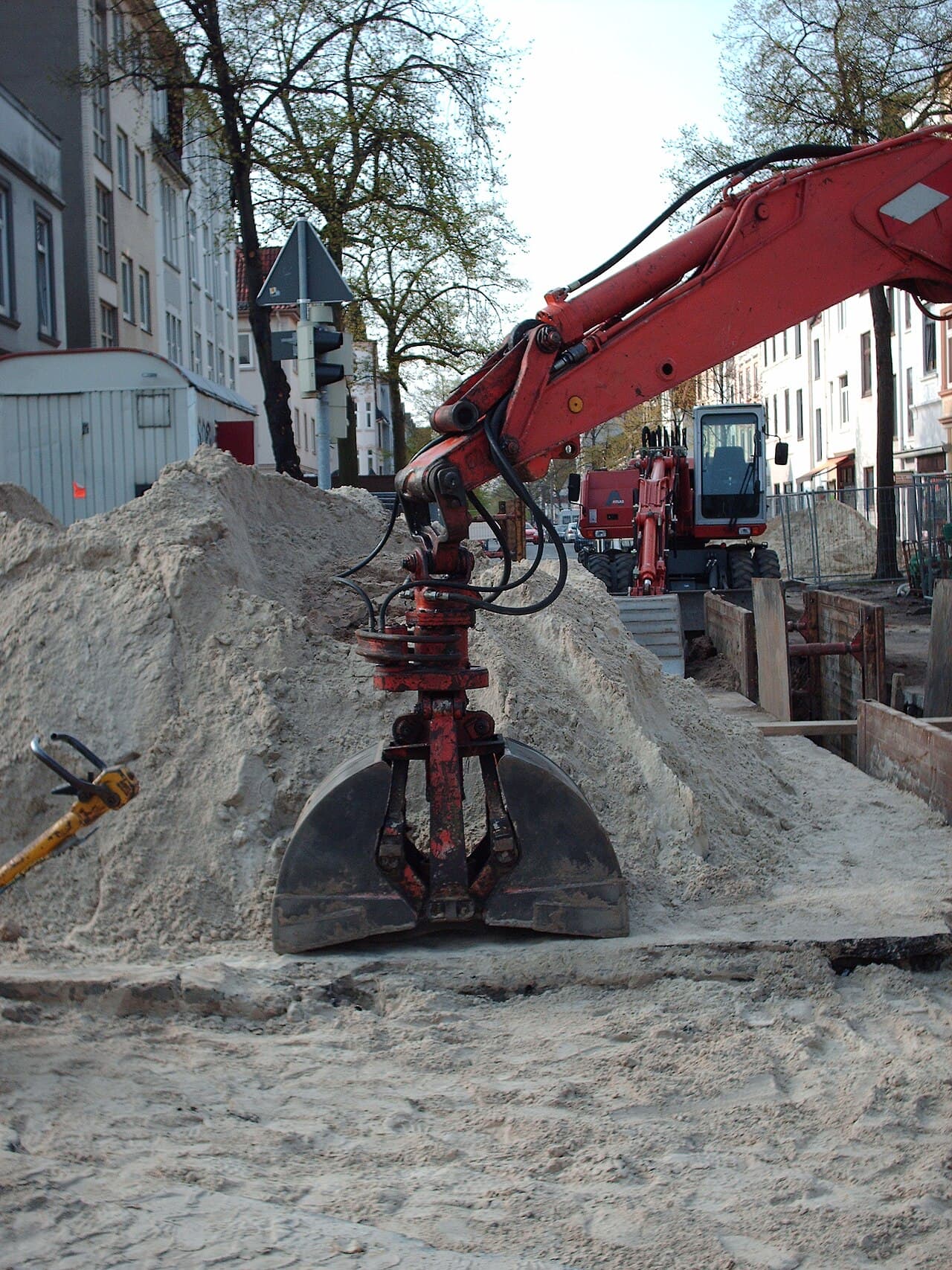
Getting a quote you can compare
Virginia's Board for Contractors advises getting at least three written bids, and an initial deposit of no more than 10% of the total price in most cases.[7] Its guide says to insist on a detailed written contract and to limit the deposit to 10% down or $1,000, whichever is less.[7] Ask each bidder to put in writing:
- the length, depth and width of the trench, and the route on a sketch of your lot
- the line, conduit or pipe being installed, its size and the material
- who requests the 811 markings and who hires a private locator
- what surface is restored, and to what standard, including grass seed or sod, gravel or paving
- who pulls the permit. The Board's guide says the contractor should apply for and obtain any necessary building permits, and that this should be spelled out in your contract.[7]
- what happens if the machine meets rock or an unmarked line, and how a change in the price is agreed
A bid that is far below the others often leaves out restoration, the permit, a locator or the wiring.
When to call a licensed pro
Trenching for a utility line is not a job to price by the foot and then do yourself: the cost of a mistake, a cut gas, water, electric or communications line or a collapsed trench, is far larger than any saving. Virginia requires a Class C licence for a single contract over $1,000 but less than $30,000, with higher classes above that.[8] Check the licence on DPOR before you sign.
For the full sequence of the work, read what trenching for a utility line involves and who is responsible for marking underground utilities in Virginia. Browse excavation services or read more excavation answers. To get prices for your own yard, describe the job once and licensed local businesses quote it.
Common questions
- Why won't a contractor quote a per-foot price over the phone?
- Because depth, soil, access, the surface being crossed and the line being installed change the price too much. A written quote after a site visit is the reliable number, and three of them let you compare.
- Is the trench or the line the bigger cost?
- It varies by job. The trench is the larger part for a long, deep run, but for a short run the pipe or conduit, connections, permit and restoration can outweigh it. Ask for each priced separately.
- Does Virginia 811 charge for marking my yard?
- No. Virginia 811 says using its services is always free. It does not mark private lines, so a private locator may be a separate cost.
- How much deposit should I pay a trenching contractor?
- The Board for Contractors guide says to limit the deposit to 10% down or $1,000, whichever is less, with a higher share possible only for special-order materials.
- Why is one bid so much lower than the others?
- It may leave out restoration, the permit, a private locator or the electrician. Put the same list of items to each bidder and compare the scope before the price.
Sources
- [1] 29 CFR 1926.652, Requirements for protective systems, Occupational Safety and Health Administration, U.S. Department of Labor. Checked October 27, 2026.
- [2] Homeowners FAQ, Virginia 811. Checked October 26, 2026.
- [3] Private Utilities Explained, Virginia 811. Checked October 26, 2026.
- [4] Va. Code § 56-265.17, Notification required prior to excavation or demolition; waiting periods; marking of proposed site, Code of Virginia, Virginia General Assembly. Checked October 26, 2026.
- [5] 13VAC5-63-80, Section 108 Application for permit (Virginia Uniform Statewide Building Code), Virginia Administrative Code, Department of Housing and Community Development. Checked October 27, 2026.
- [6] 18VAC50-22-30, Definitions of specialty services, Virginia Administrative Code, Board for Contractors. Checked October 26, 2026.
- [7] What You Should Know Before You Hire a Contractor, Virginia Board for Contractors, DPOR. Checked October 27, 2026.
- [8] Va. Code § 54.1-1100, Definitions, Code of Virginia, Virginia General Assembly. Checked October 27, 2026.
Want a pro to handle it?
Describe the job once. Licensed local businesses send quotes, and you pay only when you book one.
Get a quote from a local pro