How much does a water softener cost in Virginia?
The unit is only part of it. When we checked GE's own store on October 26, 2026, a discontinued 40,000-grain GE softener was on clearance at $569.00. Installation adds labour by a licensed plumber, a drain and outlet near the unit, a building permit for the water line work, and then salt and water for every recharge. Size it from a hardness test, then compare written quotes.
Free to ask. Local shops send quotes, and you pay only when you book one.
By Kasra Taheri, Founder, LoclisUpdated
Researched and drafted with AI, then checked claim by claim against the sources listed below before it was published. Prices and rules change; the dates beside each source say when it was last checked.
Step by step
Read when to stop and call a pro, further down this page, before you start.
Step 2: Test well water fully
On a well, have a certified lab test for iron and other problems too, since a softener is sized and chosen for your exact water.[4]
Step 3: Note your water use
Count the people in the house and note heavy uses such as a large tub or frequent laundry, because sizing depends on hardness and daily use.[3]
Step 4: Look at the space
Check that there is room near where the water line enters the house, with a drain and an unswitched outlet nearby, so the installer can price the job accurately.
Step 5: Get written quotes
Ask two or three licensed businesses for itemized written quotes that list the unit and its grain capacity, labour, bypass valve, drain work and any permit.
A water softener costs the price of the unit plus a plumbing installation, then a small, steady amount for salt and water. The unit is easy to price; the installation is what varies most from house to house, because it depends on where your water line enters, whether there is a drain and outlet nearby, and what your locality requires.
What the unit itself costs
Manufacturer list prices give a useful reference point. When we checked GE's own store on October 26, 2026, its 40,000-grain GXSH40V softener was marked Clearance and listed at $569.00, down from $649.00, and the same page said the model is no longer being manufactured.[1] A discontinued model on clearance is a snapshot of one price, not a guide to what a current unit costs.
The number in the name is grain capacity: how much hardness the unit removes between recharges. GE rates that model at 40,000 grains at a salt dose of 15.1 pounds, or 11,700 grains at 2.3 pounds.[2] A larger capacity or a more elaborate control generally raises the price, so compare quotes on the same capacity.
What sets the size, and so the price
Sizing comes from your water, not the box. Virginia Cooperative Extension says "The appropriate size of a softener depends on the level of hardness" and the daily water use in your household, among other factors.[3] If you are on a well, Extension goes further: "it is critical to have a water sample analyzed by a certified lab before purchasing any water treatment device."[4] If the test turns up problems beyond hardness, those may need other equipment as well, which changes the quote.
Testing is cheap next to the equipment. When we checked on October 26, 2026, the Virginia Household Water Quality Program's FAQ said of its well water test: "The cost is $70," and the results take about 4 weeks.[5] On city water, GE's manual says to "have the water tested by a water analysis laboratory or call your local water department" for the hardness figure.[2] There is more on deciding whether you need one at all in do I need a water softener in Virginia.
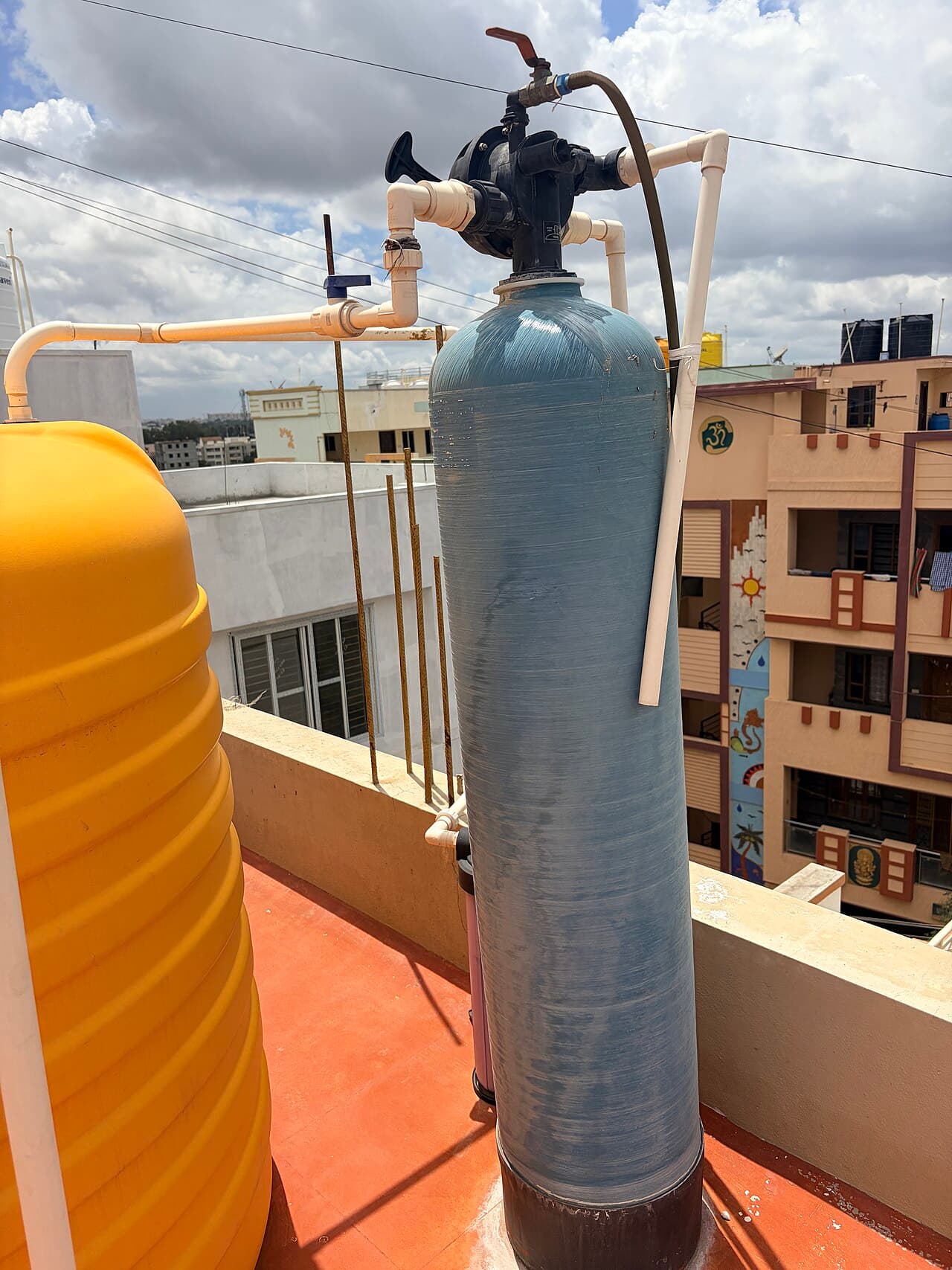
What drives the installation cost
GE's manual says to install the softener close to the water supply inlet, upstream of all other plumbing connections except outside water pipes.[2] What makes one job cost more than another:
- The drain. GE's manual says "A nearby drain is needed to carry away regeneration discharge" water, and its instructions say to leave an air gap of 1-1/2 inches between the end of the drain hose and the drain.[2] "Flexible drain hose is not allowed in all localities," so some jobs need a rigid drain line instead.[2]
- Power. GE's unit plugs into a grounded 120-volt outlet in a dry location.[2] No outlet nearby means an electrician as well.
- Pressure and expansion. GE's manual warns: "If daytime pressure is over 80 psi, nighttime pressure may exceed the maximum." It also says "If your home is equipped with a back flow preventer, an expansion tank must be installed in accordance with local codes and laws."[2] Either can add parts.
- Separating lines. GE says "Outside faucets should remain on hard water to avoid wasting conditioned water and salt."[2] Some households also keep a cold drinking line unsoftened. Both mean extra piping.
- Pipe type and access. Copper, PEX or older galvanized pipe, and a cramped crawlspace versus an open basement, change the hours.
Licences and permits in Virginia
Hire a licensed plumbing business. Virginia's Board for Contractors regulations list, under the plumbing classification, "Public/private water supply systems within or adjacent to any building, structure, or conveyance."[6] The Code of Virginia's contractor definitions, which put Class C jobs at over $1,000 but less than $30,000 for a single contract, also say "The Board shall require a master tradesmen license as a condition of licensure for electrical, plumbing, and heating, ventilation, and air conditioning contractors."[8] A home improvement licence alone does not cover the plumbing: the regulations say "The HIC specialty does not provide for electrical, plumbing, HVAC, or gas fitting functions."[7] Check any business on DPOR's licence lookup.[10]
On permits, the Virginia Uniform Statewide Building Code requires one for installations or alterations involving the water supply and distribution system.[9] Ask whether the quote includes the permit and inspection.
Running costs
After installation you buy salt and use some water. Extension notes that softener pellets typically come in 40-pound bags,[4] and GE's specification lists 37.0 gallons of water per recharge at the maximum salt dose.[2] Harder water and more people mean more recharges. "The most efficient water softeners use a flowmeter to determine regeneration cycle frequency,"[4] rather than recharging on a timer whether they need it or not. The salt schedule answer covers how fast a tank goes down.
Be wary of a low price on a device that does not soften. Extension notes that "no recognized agency in the United States has established protocol to assess the effectiveness of physical water treatment devices,"[3] such as magnetic units, while "a protocol has been established to assess the effectiveness of ion exchange water softeners (NSF/ANSI 44)."[3]
Stop and call a pro if
- The quote is for anything that cuts into the water line, adds a drain line, or moves the softener. That is licensed plumbing work.
- A seller will not size the unit from a water test or will not put the grain capacity, salt use and warranty in writing.
- Your water test shows iron or other problems beyond hardness. Ask the installer in writing what equipment is needed and in what order.
- You would need a new outlet. That is a job for a licensed electrician.
Getting quotes in Virginia
Loclis lists DPOR-licensed plumbing businesses with their licence number and class. Look up plumbers in Blacksburg, browse water softener services, or read more plumbing answers.
To compare prices for your house, describe the job once and licensed local businesses quote it.
Common questions
- Is a bigger softener always better?
- No. A softener is sized to your hardness and daily water use. Too small and it recharges constantly or runs out of capacity; much too large and you pay more up front for capacity you do not use. Ask the installer to show how they sized it from your hardness number and household.
- Can a handyman install a water softener in Virginia?
- Cutting a softener into the water line is plumbing work. Virginia's Board for Contractors regulations put public and private water supply systems in or next to a building under the plumbing contractor classification, and say the home improvement (HIC) specialty does not provide for plumbing functions. Check the licence on DPOR's lookup before you hire.
- Do I need a permit to install a water softener?
- Ask your local building department. The Virginia Uniform Statewide Building Code requires a permit for installations or alterations involving the water supply and distribution system, and a licensed plumber normally knows what the locality expects and pulls it as part of the job.
- What does a water test cost?
- When we checked on October 26, 2026, the Virginia Household Water Quality Program's FAQ listed $70 for its well water test, which includes hardness and iron, with results in about 4 weeks. On city water, ask your local water department for the hardness figure.
- Are magnetic or electronic conditioners a cheaper option?
- They may cost less, but Virginia Cooperative Extension says that with devices based mainly on magnetic or electrical technology, the hardness of the water is not changed by treatment. It notes that a protocol has been established under NSF/ANSI 44 to assess ion exchange softeners, while no recognized U.S. agency has one for physical treatment devices. Ask for independent test data before paying for one.
Sources
- [1] GE 40,000 Grain Water Softener, GXSH40V (product page), GE Appliances. Checked October 26, 2026.
- [2] Water Softening System Owner's Manual and Installation Instructions, GXSH40V and GXSH45V (49-6000299), GE Appliances. Checked October 26, 2026.
- [3] Virginia Household Water Quality Program: Hardness in Household Water (442-664), Virginia Cooperative Extension, Virginia Tech. Checked October 26, 2026.
- [4] Virginia Household Water Quality Program: Household Water Treatment (442-670), Virginia Cooperative Extension, Virginia Tech. Checked October 26, 2026.
- [5] Virginia Household Water Quality Program: Frequently Asked Questions, Virginia Cooperative Extension, Virginia Tech. Checked October 26, 2026.
- [6] 18VAC50-22-20, Board for Contractors Regulations: Definitions of license classifications, Virginia Administrative Code, Legislative Information System. Checked October 26, 2026.
- [7] 18VAC50-22-30, Board for Contractors Regulations: Definitions of specialty services, Virginia Administrative Code, Legislative Information System. Checked October 27, 2026.
- [8] Code of Virginia § 54.1-1100, Definitions (contractors), Code of Virginia, Legislative Information System. Checked October 26, 2026.
- [9] 13VAC5-63-80, Virginia Uniform Statewide Building Code: Section 108 Application for permit, Virginia Administrative Code, Legislative Information System. Checked October 26, 2026.
- [10] License Lookup, Virginia Department of Professional and Occupational Regulation. Checked October 26, 2026.
Want a pro to handle it?
Describe the job once. Licensed local businesses send quotes, and you pay only when you book one.
Get a quote for Plumbing Repair