How often should I add salt to a water softener?
Check the salt every two or three weeks until you know your household's pace, and top it up before it drops below about a quarter to a third full. How often that is depends on your water's hardness, how much water you use and your softener's settings. Use clean pellet, nugget or coarse solar salt, and keep the level lower in humid basements.
Free to ask. Local shops send quotes, and you pay only when you book one.
By Kasra Taheri, Founder, LoclisPublished
Researched and drafted with AI, then checked claim by claim against the sources listed below before it was published. Prices and rules change; the dates beside each source say when it was last checked.
Step by step
Read when to stop and call a pro, further down this page, before you start.
Step 1: Check on a schedule
Lift the salt lid every two or three weeks until you know how fast your household uses salt.[1]
Step 2: Refill before it is low
Add salt whenever the tank is below about one-third full; never let it run empty.[1]
Step 4: Lift bags safely
Use two or more people to move and lift full salt bags, as GE's manual instructs.[1]
Step 5: Do not overfill in humid spaces
In a damp basement or garage, keep the level lower and refill more often to avoid a salt bridge.[1]
Step 6: Mind the potassium line
If you use potassium chloride instead of salt, do not fill above the level your manual marks for it.[1]
Step 7: Reset the salt level
If your control tracks salt, set the salt level to the new mark on the brinewell scale each time you refill.[1]
Step 8: Probe for bridges now and then
Every few refills, push a broom handle gently down through the salt to make sure it is loose all the way to the bottom.[1]
Step 9: Close the lids
Put the brinewell cover and salt lid back on after every refill.[1]
Check the salt every two or three weeks at first, and refill before the tank drops below about a third full. After a couple of months you will know your household's rhythm. The exact pace depends on your water, your household and your softener, which is why the first few weeks of checking matter.
How often to check, and how low to let it go
GE and Whirlpool give the same rule: "Until you have established a refilling routine, check the salt every two or three weeks. Always add if less than 1/4 full."[1][2] GE's troubleshooting chart sets the bar a little higher, listing "Not enough salt—should be at least 1/3 full." among the most common problems when there is no soft water.[1] Refilling at around a third gives you a margin.
Running out is the one thing to avoid. In GE's words, "If the water softener uses all the salt before you refill it, you will experience hard water."[1]
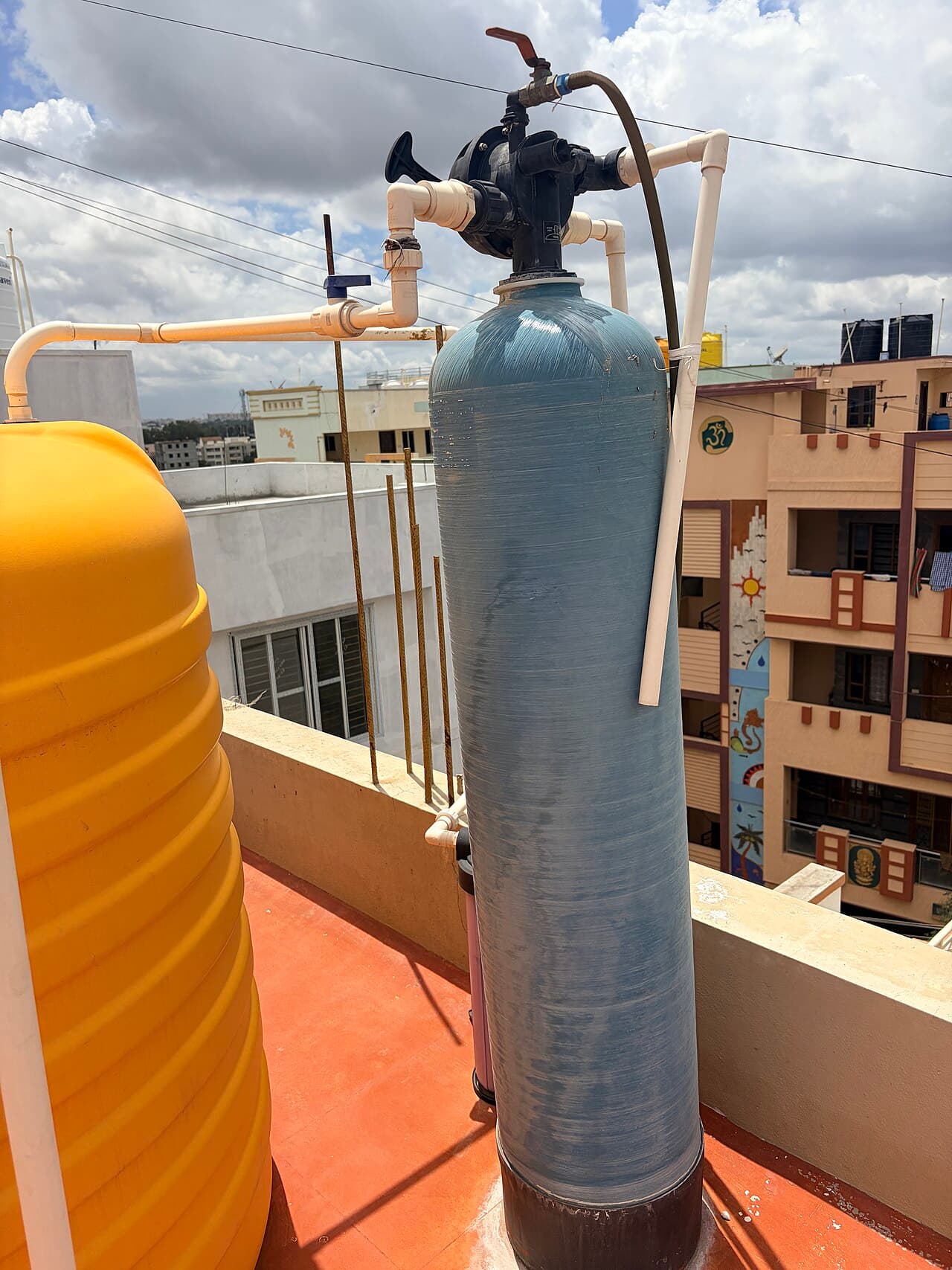
Why your schedule is different from your neighbour's
Salt use rises with three things: how hard your water is, how much softened water you use, and how much salt the softener uses per recharge. Harder water and more people mean more frequent recharges and more salt.
The softener's design matters too. Virginia Cooperative Extension notes that "The most efficient water softeners use a flowmeter to determine regeneration cycle frequency."[3] A flowmeter lets the control recharge according to the water actually used. The salt dose is a setting as well: GE rates its 40,000-grain model at 40,000 grains of hardness at a salt dose of 15.1 pounds, or 11,700 grains at 2.3 pounds,[1] so the same tank can last very different lengths of time depending on how it is programmed.
A correct hardness setting keeps salt use honest. If yours seems high, check the number on the control against your water's real hardness; why a softener is not softening explains how.
Let the softener tell you
Many newer controls estimate when you will run out. GE's display shows DAYS TO EMPTY, and its low-salt alarm sounds a beeper when DAYS TO EMPTY reaches 15 days or less.[1] The estimate needs time: "It takes a couple of months for the water softener to learn your water usage pattern."[1] It also needs you to tell it what you added: "Be sure to reset your salt level indicator each time you add salt to the system."[1]
Without a display, keep a note on the tank or your phone of the date and level each time you refill. After a few refills the pattern is obvious.
Buying and adding salt
Softener salt typically comes in 40-pound bags.[3] The manuals recommend "Nugget, pellet or coarse solar salts with less than 1% impurities." and advise against "Rock salt, high in impurities, block, granulated table, ice melting, ice cream making salts, etc."[1][2] GE warns that those salts "may contain dirt and sediments that might mush or cake, creating maintenance issues for the water softener."[1] If that has already happened, see how to clean a brine tank.
A full bag is heavy, and GE's instruction is to "Use two or more people to move and lift salt bags."[1] Pour slowly, keep salt out of the brinewell tube, and put the covers back.
If you are thinking of switching to potassium chloride to cut sodium, check the health side first. Virginia Cooperative Extension warns that "excess potassium in drinking water can also present health risks to certain segments of the population," including people with kidney disease (most at risk), heart disease, coronary artery disease, high blood pressure or diabetes, and some people on certain medications. Its advice: "Consult a physician if you are concerned about the levels of sodium or potassium in your drinking water."[5] Expect it to cost more, too: "Potassium chloride is generally more expensive and less available than sodium chloride."[5]
If you do use potassium chloride, follow its fill limit. GE's note: "if using potassium chloride (KCI), do not fill above level 4 on the brinewell decal."[1]
Humid basements and salt bridges
A salt tank in a damp basement or garage needs a lighter hand: "In humid areas, it is best to keep the salt storage level lower, and to refill more often to avoid salt “bridging”."[1][2] A bridge is a crust with a gap underneath that keeps salt from reaching the water. Every few refills, push a broom handle gently down through it; GE's manual says "Salt should be loose all the way to the bottom of the tank."[1]
Ways to use less salt
- Keep outside taps on hard water. Extension says "Water for outdoor use does not need to be softened,"[4] and GE's manual says "Outside faucets should remain on hard water to avoid wasting conditioned water and salt."[1]
- Set hardness accurately, not higher than your water needs.
- Fix leaks and running toilets, which push softened water down the drain.
Stop and call a pro if
- Salt use jumps suddenly without a change in household use. A valve stuck in recharge or a leak can be the cause.
- The brine tank fills with water or overflows.
- The water stays hard even with salt in the tank and no bridge.
- You want outside taps or a drinking line separated from the softener. That is re-piping, which is licensed plumbing work.
Getting help in Virginia
Loclis lists DPOR-licensed plumbing businesses with their licence number and class. Look up plumbers in Blacksburg, browse water softener services, or read more plumbing answers.
If your softener is eating salt or not keeping up, describe the problem once and licensed local businesses quote it.
Common questions
- How many bags of salt does a softener use a month?
- It depends on how hard your water is, how much water the household uses and how the softener is set, so there is no single number. Track it yourself: note the date and level each time you refill for the first couple of months, and you will know how many 40-pound bags to keep on hand.
- Should I fill the salt tank to the top?
- Not in a damp space. GE and Whirlpool's manuals both say that in humid areas it is best to keep the level lower and refill more often, because a full tank in humid air is more likely to form a salt bridge.
- Can I mix different kinds of salt?
- Stick to one clean type, such as pellets or nuggets with less than 1% impurities. Avoid rock, block and granulated salt, which can leave dirt and sludge in the tank. If you switch to potassium chloride, follow your manual's fill limit for it, and check with a physician first if anyone in the house has kidney or heart disease, high blood pressure or diabetes.
- My salt level has not gone down in weeks. Is that good?
- It can be, on an efficient demand-controlled softener in a small household. But if the water is also getting hard, suspect a salt bridge or a clogged nozzle and venturi, and work through the softener troubleshooting checks.
- Can I use less salt?
- Make sure the hardness setting matches your actual water, since a setting higher than needed can waste salt. Keeping outside faucets on hard water also saves salt. Some controls have a salt-saving or efficiency mode that recharges more often with smaller doses; your manual explains the trade-off.
Sources
- [1] Water Softening System Owner's Manual and Installation Instructions, GXSH40V and GXSH45V (49-6000299), GE Appliances. Checked October 26, 2026.
- [2] Installation and Operation Manual: Demand Controlled Water Softener, Models WHES20 and WHES30, Ecodyne Water Systems (Whirlpool water softeners). Checked October 26, 2026.
- [3] Virginia Household Water Quality Program: Household Water Treatment (442-670), Virginia Cooperative Extension, Virginia Tech. Checked October 26, 2026.
- [4] Virginia Household Water Quality Program: Hardness in Household Water (442-664), Virginia Cooperative Extension, Virginia Tech. Checked October 26, 2026.
- [5] Virginia Household Water Quality Program: Sodium and Chloride in Household Drinking Water (442-661), Virginia Cooperative Extension, Virginia Tech. Checked October 26, 2026.
Want a pro to handle it?
Describe the job once. Licensed local businesses send quotes, and you pay only when you book one.
Get a quote for Plumbing Repair