How often should a dryer vent be cleaned?
Clean the lint filter every load and have the vent and exhaust duct cleaned periodically. Federal guidance gives no fixed interval, but one major manufacturer says to inspect and clean the exhaust ducting at least once a year, and to have the dryer interior cleaned yearly by a qualified technician. Clean sooner if drying slows or the outdoor hood does not open.
Free to ask. Local shops send quotes, and you pay only when you book one.
By Kasra Taheri, Founder, LoclisPublished
Researched and drafted with AI, then checked claim by claim against the sources listed below before it was published. Prices and rules change; the dates beside each source say when it was last checked.
This is a job for a licensed pro in Virginia
This page explains what the work involves, the permits, what a licensed pro does and what drives the cost. It does not give step-by-step instructions, because this work needs a licence, a permit or both, and doing it wrong can injure someone. Before you hire, check the licence on Virginia's DPOR record.
There is no single federal interval, so the honest answer is a routine plus triggers. Clean the lint screen on every load, have the vent and exhaust duct cleaned periodically, and do not wait for the calendar if drying slows down. One major manufacturer sets the figure at once a year, and that is a sensible default for most households.
What the official guidance says
The Consumer Product Safety Commission tells owners to clean the dryer vent and exhaust duct periodically, and to check the outside dryer vent while the dryer is operating to make sure exhaust air is escaping.[1] It does not give a number of months. It also says lint can block the flow of air, cause excessive heat build-up, and result in a fire in some dryers.[1]
The U.S. Fire Administration is just as direct about the risk: you are at higher risk of a clothes dryer fire if you do not clean your lint filter and dryer vents.[2] It lists the back of the dryer, where lint can build up, as a place to clean, and says to check the venting system behind the dryer to make sure it is not damaged, crushed or restricted.[2]
For a number, look at your dryer's own manual. GE's owner's manual says to inspect and clean the exhaust ducting at least once a year to prevent clogging, and that the interior of the machine and the exhaust duct connection inside the dryer should be cleaned at least once a year by a qualified technician.[4] A yearly visit is a practical way to have both done together. Other makers may state something different, so check the manual for your model.
A simple schedule
- Every load: clean the lint filter. The U.S. Fire Administration says to clean it before and after each cycle and never to run the dryer without one.[2]
- Monthly: scrub the filter if you use dryer sheets. ENERGY STAR says they can leave a film on the filter that reduces air flow, and it suggests scrubbing it with a toothbrush once a month.[3]
- Once a year: have a professional clean the duct and the dryer's interior, or whatever interval your manual states.
- Any time: check the outdoor hood while the dryer runs. If the flap does not open, treat it as a problem now.
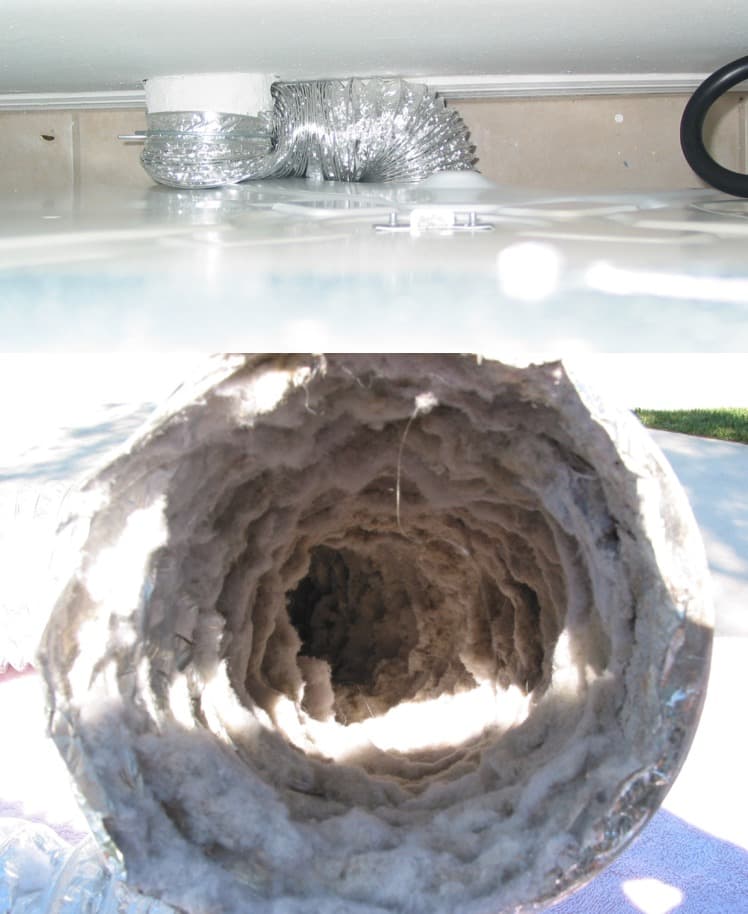
When to clean sooner
Your own household may justify a shorter interval than a year. The signs are the ones that mean airflow is falling:
- Clothing is still damp at the end of a typical drying cycle, or drying takes longer than normal. The Consumer Product Safety Commission says either may be a sign that the lint screen or the exhaust duct is blocked.[1] See why a dryer takes so long to dry clothes.
- Little or no air at the outdoor hood while the dryer runs.
- A dryer that feels hotter than usual on the outside, or a laundry room that smells of hot lint.
- Foil or plastic accordion duct, or a duct run with many bends. The Consumer Product Safety Commission says the flexible plastic or foil type can more easily trap lint and is more susceptible to kinks or crushing.[1]
A big household that runs the dryer daily puts more lint through the duct than a single person who does a few loads a week, so the first group should not stretch the interval. These are judgment calls rather than published rules, so when in doubt, have the airflow checked.
What to book
Ask the cleaner to clear the full run and confirm air leaves the house, and say whether you want the dryer's interior included. What a dryer vent cleaning includes explains the usual scope, how much dryer vent cleaning costs in Virginia covers pricing, and is professional dryer vent cleaning worth it helps you decide.
When to call a licensed pro
A routine cleaning calls for a careful, insured cleaner. Bring in a licensed professional when the job grows: a new vent through a wall or roof, replacing a long duct run, or any gas-dryer connection. GE's manual says gas dryers must be exhausted to the outside, and warns that plastic or other combustible ductwork can cause a fire.[4]
If the work is valued at $1,000 or more, a valid Virginia Contractor's License is required for the license category in which the contractor is to work.[5] The Board for Contractors also warns that unlicensed contracting is against the law.[5] Check any licence before you pay, using how to check whether a contractor is licensed in Virginia.
Loclis lists local businesses by trade. Browse chimney and venting services or read more chimney and venting answers.
To book a cleaning, describe the job once and local pros quote it.
Common questions
- Is there a legal requirement to clean a dryer vent?
- Not in the sources checked for this page. The Consumer Product Safety Commission advises cleaning the dryer vent and exhaust duct periodically, and a manufacturer's manual may set its own interval.
- How often should the lint filter be cleaned?
- Every load. The U.S. Fire Administration says to clean it before and after each cycle and never to run the dryer without one.
- Is once a year enough?
- For many homes, yes, and one major manufacturer states it for both the exhaust ducting and the dryer interior. Clean sooner if drying slows, the hood does not open, or the duct is foil or has many bends.
- Do I need cleaning if I live in a rental?
- The duct is part of the building, so ask your landlord or property manager who arranges it, and report slow drying or a blocked hood in writing.
- Does a new dryer reset the schedule?
- The duct stays the same when the dryer changes, so a dirty or foil duct should be cleaned or replaced when you install the new machine.
Sources
- [1] Overheated Clothes Dryers Can Cause Fires (Publication 5022), U.S. Consumer Product Safety Commission. Checked October 27, 2026.
- [2] Clothes Dryer Fire Safety, U.S. Fire Administration, FEMA. Checked October 27, 2026.
- [3] Clothes Dryers, ENERGY STAR, U.S. Environmental Protection Agency. Checked October 27, 2026.
- [4] Owner's Manual, Dryers (49-90052), GE Appliances. Checked October 27, 2026.
- [5] What You Should Know Before You Hire a Contractor, Virginia Board for Contractors, DPOR. Checked October 27, 2026.
Want a pro to handle it?
Describe the job once. Licensed local businesses send quotes, and you pay only when you book one.
Get a quote from a local pro