Why does my dryer take so long to dry clothes?
Slow drying usually means the dryer cannot push moist air out: a full lint screen, a crushed or lint-packed duct, or an outdoor hood that does not open. Check the screen and the hood first, and cut oversized loads. If those are clear, have the duct cleaned or the dryer serviced, since lint blockage is also a fire risk.
Free to ask. Local shops send quotes, and you pay only when you book one.
By Kasra Taheri, Founder, LoclisPublished
Researched and drafted with AI, then checked claim by claim against the sources listed below before it was published. Prices and rules change; the dates beside each source say when it was last checked.
This is a job for a licensed pro in Virginia
This page explains what the work involves, the permits, what a licensed pro does and what drives the cost. It does not give step-by-step instructions, because this work needs a licence, a permit or both, and doing it wrong can injure someone. Before you hire, check the licence on Virginia's DPOR record.
A dryer that takes more than one cycle to dry a load is often short of airflow, and lint blocking the filter or the exhaust duct is a leading suspect. Check the cheaper causes first: a full lint screen, an overloaded drum, or a duct that is crushed or clogged somewhere between the machine and the outdoor hood. A heating fault is also possible if none of those turns up anything.
The Consumer Product Safety Commission puts the symptom plainly: clothing is still damp at the end of a typical drying cycle or drying takes longer than normal, which may be a sign that the lint screen or the exhaust duct is blocked.[1] That matters beyond the laundry. Lint can block the flow of air, cause excessive heat build-up, and result in a fire in some dryers.[1]
Start with what you can see
Work through the no-cost causes before you call anyone. GE's owner's manual lists these for "clothes take too long": separate heavy items from lightweight ones, because large, heavy fabrics such as beach towels contain more moisture and take longer to dry, and do not put more than one washer load in the dryer at a time.[4] The same manual says drying times will vary with the size of load, the types of fabrics, the wetness of clothes and the condition of exhaust ducts.[4]
The lint screen comes next. The U.S. Fire Administration says to clean the lint filter before and after each cycle and never to use the dryer without one.[2] ENERGY STAR adds that dryer sheets can leave a film on the filter that reduces air flow, and it suggests scrubbing the filter with a toothbrush once a month.[3] A filter that looks clean can still be coated with that film, so hold it up to the light: if the mesh looks solid, it is blocking air.
Also check the washer. Clothes that come out of a weak spin start the dryer with extra water to remove, and that looks exactly like a dryer problem.
Then check the vent
With the dryer running, go outside and look at the vent hood. The Consumer Product Safety Commission says to check the outside dryer vent while the dryer is operating to make sure exhaust air is escaping, and that if it is not, the vent or the exhaust duct may be blocked.[1] The U.S. Fire Administration adds that the outdoor vent covering should open when the dryer is operating.[2] A flap that barely lifts, or stays shut, means the air has nowhere to go. GE's manual makes the same checks: ducting that is clean, free of kinks and unobstructed, and an outside wall damper that operates easily.[4]
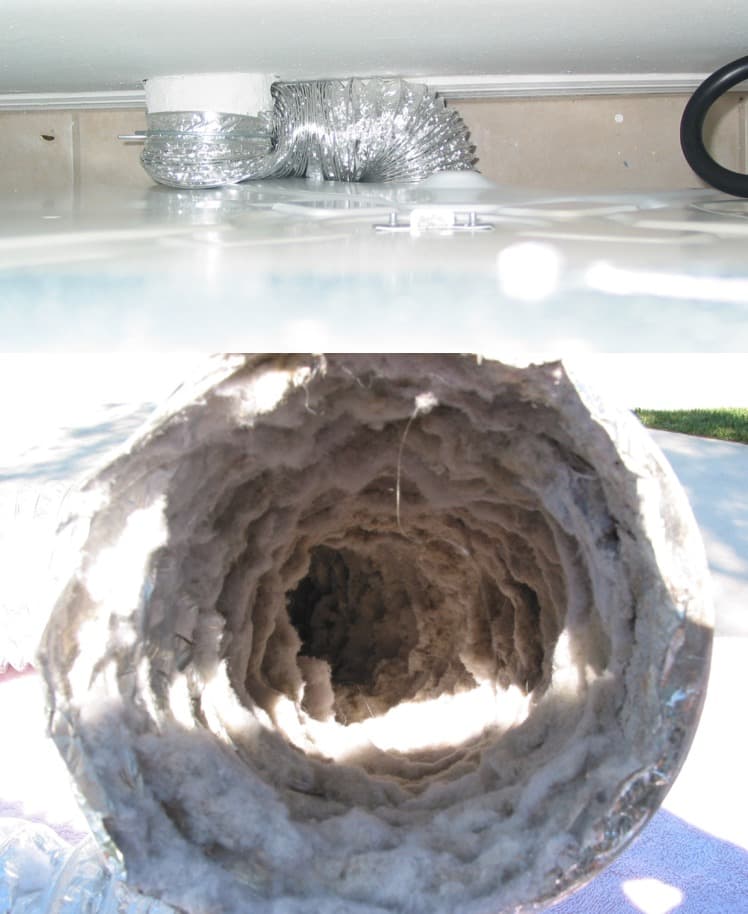
Then look at the duct behind the dryer. The aim is to check the venting system to make sure it is not damaged, crushed or restricted.[2] Pushing the dryer tight against the wall is a common way to crush it. The Consumer Product Safety Commission advises replacing plastic or foil, accordion-type ducting with rigid or corrugated semi-rigid metal duct, because the flexible plastic or foil type more easily traps lint and is more susceptible to kinks or crushing.[1]
What a long run does
Poor venting does not only slow drying. GE's manual says the dryer will use more energy and run longer if it is not vented to the specifications in its installation instructions.[4] Duct that is too long, has too many bends, or ends in a hood that is partly blocked costs you in time and in your electric or gas bill on every load.
When it is not the vent
If the filter is clean, the duct is clear and the hood opens wide, the cause is inside the machine: a failed heating part, a sensor, a worn belt or a tripped breaker. GE's manual notes that most electric dryers use two fuses or breakers, so make sure both are working.[4] Anything past that is an appliance-repair job. If you are weighing a repair against a new machine, see should I repair or replace a dryer.
What a professional does about it
When the duct is the problem, a vent cleaner clears lint from the whole path and confirms that air leaves the house. For what a visit covers, see what a dryer vent cleaning includes. For cost, see how much dryer vent cleaning costs in Virginia, and for whether it is worth paying for, is professional dryer vent cleaning worth it.
When to call a licensed pro
Call a professional when the filter and hood are clear and drying is still slow, when the duct is crushed or foil and needs replacing, or when the fix means a new vent run through a wall or roof. Gas dryers are a firmer line: leave any gas connection to a licensed professional. GE's manual warns that use of plastic or other combustible ductwork can cause a fire, and that punctured ductwork can cause a fire if it collapses or becomes otherwise restricted.[4]
Virginia law sets a dollar line for contractors. If the work is valued at $1,000 or more, a valid Virginia Contractor's License is required for the license category in which the contractor is to work.[5] The Board for Contractors also warns that unlicensed contracting is against the law.[5] Read how to check whether a contractor is licensed in Virginia before paying a deposit.
Loclis lists local businesses by trade. Browse chimney and venting services or read more chimney and venting answers.
If your dryer vent needs clearing, describe the job once and local pros quote it.
Common questions
- Is a slow dryer a fire risk?
- It can be. The Consumer Product Safety Commission says lint can block the flow of air, cause excessive heat build-up, and result in a fire in some dryers. Slow drying is an early warning, so deal with it promptly.
- Why is my dryer hot but the clothes stay damp?
- Heat is being made but the moist air is not leaving. A blocked lint screen, crushed duct or stuck outdoor hood is the usual reason, so check the screen and the hood while the dryer runs.
- Could the washer be the problem?
- Yes. Clothes that leave the washer wetter than usual take longer to dry. If only one load is slow, look at the load size and the washer spin before blaming the vent.
- Will cleaning the vent fix it?
- Often, if lint is the blockage. If the duct is crushed or the wrong type, it may need replacing, which a cleaner will usually quote separately.
- Can I run the dryer while I wait for a repair?
- Slow drying can be a sign of a blocked lint screen or exhaust duct, and the Consumer Product Safety Commission says lint buildup can lead to a fire in some dryers. It is better to have the vent looked at first than to keep running repeated cycles.
Sources
- [1] Overheated Clothes Dryers Can Cause Fires (Publication 5022), U.S. Consumer Product Safety Commission. Checked October 27, 2026.
- [2] Clothes Dryer Fire Safety, U.S. Fire Administration, FEMA. Checked October 27, 2026.
- [3] Clothes Dryers, ENERGY STAR, U.S. Environmental Protection Agency. Checked October 27, 2026.
- [4] Owner's Manual, Dryers (49-90052), GE Appliances. Checked October 27, 2026.
- [5] What You Should Know Before You Hire a Contractor, Virginia Board for Contractors, DPOR. Checked October 27, 2026.
Want a pro to handle it?
Describe the job once. Licensed local businesses send quotes, and you pay only when you book one.
Get a quote from a local pro