How often should a parking lot be sealcoated?
Reseal when the old coat has worn through, not on a fixed calendar. Applicators commonly recommend every 1 to 5 years. The signs are grey patches where the black coat has worn off, a gritty surface and new hairline cracks. Seal new pavement only after the cure time on the sealer's label.
Free to ask. Local shops send quotes, and you pay only when you book one.
By Kasra Taheri, Founder, LoclisPublished
Researched and drafted with AI, then checked claim by claim against the sources listed below before it was published. Prices and rules change; the dates beside each source say when it was last checked.
Step by step
Read when to stop and call a pro, further down this page, before you start.
Step 1: Inspect every spring
Walk the lot after winter with a site plan and mark grey worn patches, exposed stones, new cracks, oil spots and puddles.[5]
Step 2: Fill new cracks the same season
Have cracks cleaned and filled as soon as you find them, before water gets under the asphalt.[4]
Step 3: Clear oil and fuel spots
Ask for oil and grease spots to be treated before any sealer goes on, so the next coat bonds.[1]
Step 4: Fix drainage
Keep downspouts, planters and irrigation from running onto the pavement, and report ponding to the property owner or contractor.[1]
Step 5: Decide by wear, not by date
When grey asphalt shows through across the drive lanes and stalls, plan the next sealing for a warm, dry stretch.[5]
Step 6: Get written bids
Ask licensed contractors for itemised bids that name the product, the number of coats and the repair quantities.
Step 7: Plan the closure
Schedule phased sections, a cure period and a rain date, and tell tenants and customers where to park.[3]
Reseal when the coat has worn, not on a fixed date
Plan on resealing when the old coat has worn through, and expect that to be somewhere between every year and every five. The U.S. Geological Survey writes: "Applicators recommend reapplication of sealcoat from every 1 to 5 years."[5] That is a range, not a rule. A lot with delivery trucks, a drive-through or a lot of turning wears faster than a quiet rear lot.
Sealcoat is a protective film, not part of the structure. SealMaster says sealcoating prevents oxidation of the asphaltic binder and prevents weather damage.[3] Once the film is gone, the asphalt underneath ages faster.
Signs it is time
Friction from vehicle tires abrades sealcoat into small particles.[5] Light gray patches of asphalt show where sealcoat has been worn from the pavement.[5] Walk the drive lanes, entrances and turning areas first; they go first. Other signs are a rough or gritty surface where stones show through, a faded surface, and new hairline cracks.
New pavement waits
Do not seal fresh asphalt right away. SealMaster's FAQ says new asphalt should cure a minimum of 30 to 60 days,[3] and its E-Z Stir label asks for at least four weeks under ideal weather.[2] Follow the label of the sealer the contractor will actually use.
Repair before you seal
Sealer does not fix cracks. Since cracks allow surface water to enter the subgrade and further destroy the stability of the subgrade, sealing should be accomplished as soon as practical.[4] The same manual warns: "Efforts should be made to avoid a buildup of crack sealing material."[4] Cracks should be filled, and gas, oil or grease spots treated, before sealer goes on,[3] and treating oil spots promotes proper bonding of the next coat.[1] A lot with clusters of small cracks, sunken areas or standing water needs paving work first: see why parking lot asphalt cracks.
What a proper application looks like
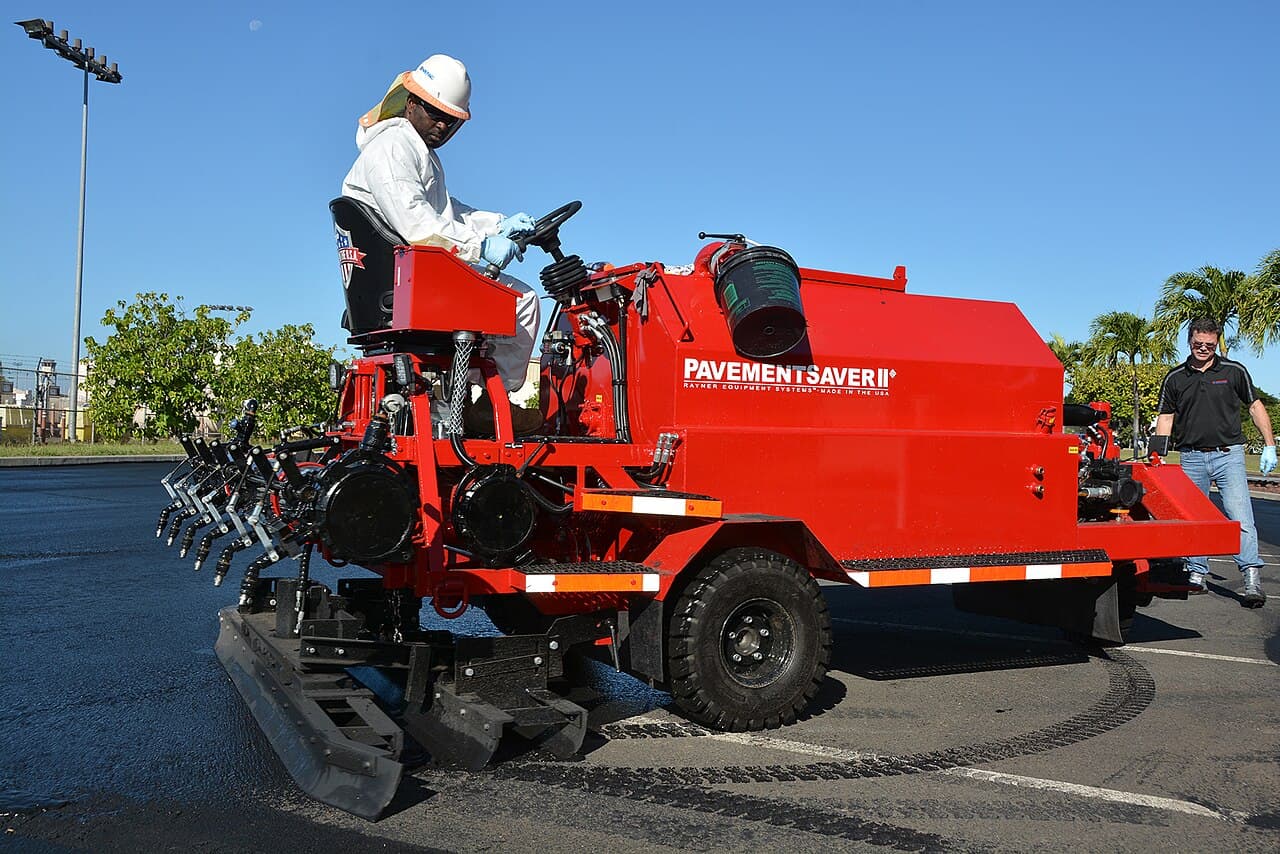
SealMaster's guidance is to apply two coats of sealer, and a third coat may go on high-traffic areas such as entrances, exits and drive lanes.[3] Sealer should be applied only at 50 degrees and rising for a 24 hour period, and not if rain is imminent within a 24 hour period.[3] SealMaster says to give the seal coat 24 hours after the final coat to cure before opening back up to traffic.[3] That is the reason for phased work, one section at a time, so the business stays open.
One more reason to keep the lot drained and the snow plow blade up: one manufacturer's product sheet says "Warranty not applicable for areas that have ponding water, poor drainage or snow removal damage."[1]
The product and the licence
Since July 1, 2025, no one in Virginia may apply a pavement sealant with more than one percent PAHs by weight.[7] Ask for the product name in the bid. Asphalt paving and sealcoating is its own licensing specialty, abbreviated PAV, and its definition names parking lots.[6] Check the licence on DPOR's lookup before you sign. For pricing, see what parking lot sealcoating costs in Virginia.
Stop and call a pro if
- The lot has alligator cracking, potholes or sunken areas. Those need repair before any sealer.
- Water stands after rain, which sealer will not cure.
- The surface is crumbling or the stones are loose across large areas; resealing a failing surface wastes money.
- A bid does not name the sealer, the number of coats or the repairs.
Find help in Virginia
Read more commercial answers and browse parking lot maintenance businesses. When you are ready, describe your lot once and licensed local businesses will quote it.
Common questions
- Is there a set schedule for sealcoating a parking lot?
- No. Applicators recommend reapplication of sealcoat from every 1 to 5 years, and traffic, sun and drainage move a lot toward one end of that range. Inspect each spring and reseal when grey, worn patches appear across the drive lanes and stalls.
- How long should new asphalt wait before sealing?
- SealMaster's FAQ says a minimum of 30 to 60 days, and its E-Z Stir label asks for at least four weeks under ideal weather. Check the label of the sealer being used.
- How long is the lot closed after sealing?
- SealMaster says to give the seal coat 24 hours after the final coat to cure before opening back up to traffic. Many contractors phase the work so half the lot stays open.
- What weather is needed?
- SealMaster says 50 degrees and rising for a 24 hour period, with no rain imminent within 24 hours. That limits the season, so book early in spring or fall.
- Does sealcoating fix cracks?
- No. Cracks should be filled, and gas, oil or grease spots treated, before sealer goes on. A lot with failing base needs paving repair first.
Sources
- [1] Black Jack Drive-Maxx 300 Blacktop Filler & Sealer product sheet (D-19), Gardner-Gibson. Checked October 28, 2026.
- [2] SealMaster E-Z Stir Pavement Sealer, SealMaster. Checked October 28, 2026.
- [3] Sealcoating FAQ, SealMaster. Checked October 28, 2026.
- [4] Flexible Pavement Distress Maintenance (Maintenance Operations Manual), Texas Department of Transportation. Checked October 28, 2026.
- [5] Coal-Tar-Based Pavement Sealcoat: Potential Concerns for Human Health and Aquatic Life (Fact Sheet 2016-3017), U.S. Geological Survey. Checked October 28, 2026.
- [6] 18VAC50-22-30, Definitions of specialty services (Board for Contractors Regulations), Virginia Administrative Code, Virginia General Assembly. Checked October 28, 2026.
- [7] Va. Code § 62.1-196.1, Prohibiting high-PAH pavement sealants; civil penalty, Code of Virginia, Virginia General Assembly. Checked October 28, 2026.
Want a pro to handle it?
Describe the job once. Licensed local businesses send quotes, and you pay only when you book one.
Get a quote from a local pro