How much does parking lot sealcoating cost in Virginia?
There is no published Virginia rate for sealcoating a parking lot, and a per-square-foot number without a date would be a guess. The price follows the lot's area, the crack filling and patching it needs, the number of coats, the sand and additives, and re-striping afterward. Get at least three itemised written bids for the same measured scope from licensed paving and sealcoating contractors.
Free to ask. Local shops send quotes, and you pay only when you book one.
By Kasra Taheri, Founder, LoclisPublished
Researched and drafted with AI, then checked claim by claim against the sources listed below before it was published. Prices and rules change; the dates beside each source say when it was last checked.
Step by step
Read when to stop and call a pro, further down this page, before you start.
Step 1: Measure and map the lot
Measure each paved section and mark the drive lanes, entrances and exits, parking stalls, and any areas with heavy truck traffic or oil stains.
Step 2: Note the damage
Walk the lot and note the cracks, potholes, sunken areas and patches, since each one adds repair work that a quote should list separately.[2]
Step 3: Write one scope for every bidder
Give each business the same measured area, the same repair list and the same striping and wheel-stop work, so the bids compare line by line.[7]
Step 4: Ask for three written bids
Collect at least three written bids or estimates using identical specifications.[7]
Step 5: Check the licence
Look each business up on DPOR's licence lookup and confirm it holds a licence that covers asphalt paving and sealcoating before you sign.[6]
Step 6: Confirm the product is legal
Ask for the sealer by name and confirm it is not a high-PAH product, which cannot be applied in Virginia.[3]
Step 7: Plan the closure
Agree on a date, a phased closure so tenants and customers can still park, and a rain date.
What drives the price
Area and layout. Sealer is sold and applied by area, so the measured square footage is the starting point. Islands, curbs, light poles, dumpster pads and narrow edges all slow a crew down because they cannot be sprayed or squeegeed in one pass.
Repairs before sealing. Sealer is a thin coating, not a filler. Cracks should be filled, and gas, oil or grease spots treated, before sealer goes on.[1] One manufacturer's driveway guide sorts the repairs by size: cracks up to half an inch wide get crack filler, holes up to an inch deep get a trowelled patch, and deeper holes get a pothole patch.[2] On a commercial lot those repairs are often the largest part of the bid, so each should be a separate line with a quantity. A lot with alligator cracking or sunken areas needs paving work first (see why asphalt cracks).
Coats, sand and application method. SealMaster's sealcoating FAQ says to apply two coats, with a third on high-traffic areas such as entrances, exits and drive lanes.[1] It adds that clean silica sand should be included in the mix design,[1] and that sealer can go on by brush, squeegee or specialized spray equipment.[1] Spraying is faster on a large open lot; one thin coat with no sand costs less and wears sooner.
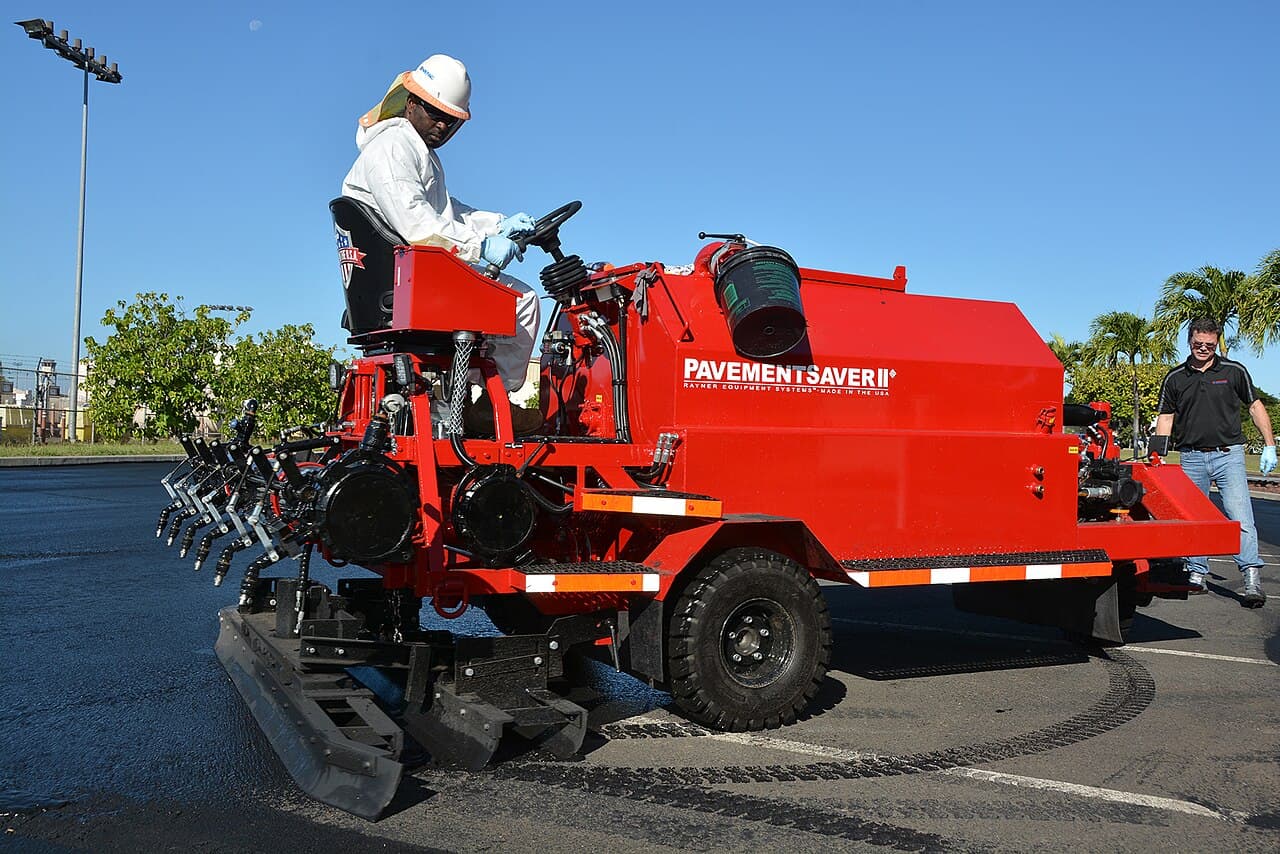
Weather and timing. Sealer should be applied only at 50 degrees and rising for a 24 hour period, and not if rain is imminent within a 24 hour period.[1] That narrows the calendar, and a contractor who has to return after a rain delay may charge for it.
Closure and cure time. SealMaster says to give the seal coat 24 hours after the final coat to cure before opening back up to traffic.[1] If you need the lot open for tenants or customers, phasing the work into sections adds mobilisation but keeps the business running.
Striping and extras. Stall lines, arrows, accessible spaces, fire lanes, stencils and wheel stops are usually a separate item, painted after the sealer cures. Ask who is responsible for re-creating the layout exactly, including accessible spaces and fire lanes.
The product has to be legal
Since July 1, 2025, no one in Virginia may apply a pavement sealant with more than one percent PAHs by weight.[3] A violation carries a civil penalty of $250.[3] The concern is environmental: the U.S. Geological Survey reports that coal-tar-sealcoat runoff can remain a risk to aquatic life for months after application.[4] A bid should name the sealer, and a contractor who cannot or will not is a reason to look elsewhere.
Licensing for commercial lots
Asphalt paving and sealcoating is its own licensing specialty, abbreviated PAV, and its definition names parking lots.[6] The contractor's class depends on the size of the contract. A Class C licence covers jobs where a single contract is over $1,000 but less than $30,000,[5] and a Class B licence covers a single contract of $30,000 or more but less than $150,000, and Class A starts at $150,000.[5] A large lot, or a contract that bundles sealing, patching and striping, can cross those lines. Look up the business on DPOR's licence lookup before you sign.
How to compare bids
Virginia's Board for Contractors advises owners to get at least three written bids or estimates using identical specifications.[7] It warns: "Beware of any bid substantially lower than the others."[7] A low number often means fewer coats, no repairs or an unnamed product. For each bid, ask for:
- the measured square footage and a sketch of what is included
- the sealer by product name, the number of coats, and whether sand is added
- crack filling and patching, with linear feet and square feet
- cleaning and oil-spot treatment
- striping, stencils and wheel stops, itemised
- the closure plan, the rain date, and what happens if weather delays the work
- the total, the payment schedule and the licence number and class
On payment, the Board's rule of thumb is an initial deposit of no more than 10% of the total price or $1,000, whichever is less.[7] It also says do not pay 100% of the bill until the job is 100% complete, and never pay cash.[7]
Stop and call a pro if
- The lot has alligator cracking, potholes, standing water or sunken areas; that is a repair or paving job to price before any sealer.
- The bid does not name the sealer, or the contractor offers a sealer that is high in PAHs.
- You cannot keep traffic off for at least 24 hours after the last coat, or cannot phase the work.
- A contractor asks for most of the money up front, or has no licence number.
Get quotes on Loclis
Read more commercial answers and browse parking lot maintenance businesses, including commercial snow plowing contracts. For the residential version, see how much driveway sealing costs. When you are ready, describe your lot once and local licensed businesses will quote it.
Common questions
- Why can't you give a price per square foot?
- Because no Virginia source publishes a dated rate for commercial lots, and a number from a content farm would be a guess. The area is only the starting point; repairs, coats, sand, access and striping move the total more than most owners expect. Written bids for a measured scope are the reliable figure.
- Does sealcoating include re-striping?
- Not unless the bid says so. Stalls, arrows, accessible spaces and fire lanes are usually a separate line item painted after the sealer has cured. Ask whether the price includes layout, paint, stencils and wheel stops, and who is responsible for matching the existing layout.
- Does the contractor need a licence for a parking lot?
- Yes. Virginia's asphalt paving and sealcoating specialty (PAV) names parking lots, and a single contract over $1,000 needs a licensed contractor. A Class B licence starts at $30,000 for a single contract. Check the number on DPOR's lookup before you sign.
- Can a contractor use coal-tar sealer in Virginia?
- Only if the product stays within the state limit. Since July 1, 2025 no one in Virginia may apply a pavement sealant with more than one percent PAHs by weight. Ask for the product name in the bid and the safety data sheet.
- How long is the lot closed?
- Plan on at least 24 hours after the last coat before traffic returns, per SealMaster's guidance, and longer if the weather is cool or damp. Many contractors phase the work, sealing half a lot at a time, which is worth asking about if you have tenants or customers.
Sources
- [1] Sealcoating FAQ, SealMaster. Checked October 27, 2026.
- [2] How to seal an asphalt / blacktop driveway, Gardner-Gibson. Checked October 27, 2026.
- [3] Va. Code § 62.1-196.1, Prohibiting high-PAH pavement sealants; civil penalty, Code of Virginia, Virginia General Assembly. Checked October 27, 2026.
- [4] Coal-Tar-Based Pavement Sealcoat: Potential Concerns for Human Health and Aquatic Life (Fact Sheet 2016-3017), U.S. Geological Survey. Checked October 27, 2026.
- [5] Va. Code § 54.1-1100, Definitions (Contractors), Code of Virginia, Virginia General Assembly. Checked October 27, 2026.
- [6] 18VAC50-22-30, Definitions of specialty services (Board for Contractors Regulations), Virginia Administrative Code, Virginia General Assembly. Checked October 27, 2026.
- [7] What You Should Know Before You Hire a Contractor, Virginia Board for Contractors, DPOR. Checked October 27, 2026.
Want a pro to handle it?
Describe the job once. Licensed local businesses send quotes, and you pay only when you book one.
Get a quote from a local pro