How do I adjust zero-turn mower steering?
Fix tire pressure first, because uneven pressure is the main reason a zero-turn drifts. If it still pulls, park it, stop the engine, push both steering levers fully forward and compare. If one travels farther, adjust that lever's travel stop with the bolt or eccentric your manual shows, then test in an open area.
Free to ask. Local shops send quotes, and you pay only when you book one.
By Kasra Taheri, Founder, LoclisPublished
Researched and drafted with AI, then checked claim by claim against the sources listed below before it was published. Prices and rules change; the dates beside each source say when it was last checked.
Step by step
Read when to stop and call a pro, further down this page, before you start.
Step 1: Park and make it safe
Park on level ground, disengage the blades, stop the engine, remove the key and let moving parts stop before you touch anything.[1]
Step 2: Check the tire pressure
Check the pressure in both drive tires and add air to the side the mower pulls toward, without going over the maximum printed on the tire.[1]
Step 3: Compare lever travel
With the engine off, push both steering levers to their full forward position and see whether one travels farther than the other.[1]
Step 5: Loosen, do not remove
Loosen the adjuster's fasteners just enough to move it, and do not remove them.[1]
Step 6: Change the travel a little
Move the adjuster in small steps so the two levers line up at full forward, then tighten the fasteners.[1]
Step 7: Repeat for reverse
If your mower has a separate reverse adjustment, pull both levers fully back, compare them and adjust the same way.[1]
Step 8: Test in the open
Drive forward with both levers fully forward in an open, unobstructed area and watch whether it holds a straight line.[2]
Check the tires first, then compare how far the two steering levers travel, and adjust the one that travels differently using the stop your manual shows. That sequence fixes most zero-turns that drift or feel uneven, and it needs only hand tools.
Ariens' manual puts it plainly: "The primary reason the unit may not track straight is incorrect or unbalanced tire air pressure."[1] Many a "steering problem" is a soft tire.
Before you start
Park on level ground and follow the maker's own rule: "Before making any inspections, repairs, adjustments, etc. disengage PTO, stop unit and engine, remove key, and allow moving parts to stop."[1] Virginia Cooperative Extension adds a general rule for any mower work: "Disconnect the spark or electric plug before troubleshooting or repairing the mower."[3] If you need to tilt or lift the mower, remember that a mower can tip over easily.[3]
Your operator's manual is the authority on your model. If you have lost it, the maker's website usually has the PDF by model number.
Step 1: tire pressure
Check both drive tires. The Ariens advice is to "Increase pressure on the side the unit tracks toward."[1] It also warns: "DO NOT exceed maximum recommended tire pressure."[1]
The right number varies. Husqvarna's MZ 54 manual, for example, says: "Recommended air pressure for the rear tires is 103 kPa / 1 bar / 15 psi."[2] Use the figure in your own manual, and never go past the maximum on the tire sidewall. Drive again. If it now tracks straight, you are done.
Step 2: compare the lever travel
With the engine off, "push the steering control levers to their full forward position. If one lever travels farther than the other, they need to be adjusted."[1] Look at them from behind the seat. You are checking whether the two levers stop at the same place.
Do the same pulling both fully back if your mower has a reverse adjustment.
Step 3: use the adjuster for your mower
Mowers do this differently, so match what you see to the manual.
Eccentric. On the Ariens EZR the eccentric sets how far the speed control arm moves. Ariens says to loosen the bolts: "Loosen bolts which attach the eccentric to the seat support. Do not remove the bolts."[1] Then "The thicker portion of the eccentric shortens the distance the steering control lever will travel forward."[1] And "The thinner portion of the eccentric lengthens the distance the steering control lever will travel forward."[1] Turn it a little, line the levers up, and retighten.
Slotted bolt for reverse. On some Ariens EZR units, a bolt on the frame sets reverse travel. "Slide the bolt down the slot to increase lever travel."[1] "Slide the bolt up the slot to decrease lever travel."[1]
Tracking bolt and knob. On the Husqvarna MZ 54, "The tracking bolt and tracking knob act as limiting devices for the motion control levers when in the full-forward position."[2] Its manual has you set both back, then turn the bolt in until the mower just starts to drift and bring it back straight with the knob.
Make small changes, one side at a time, and retest after each.
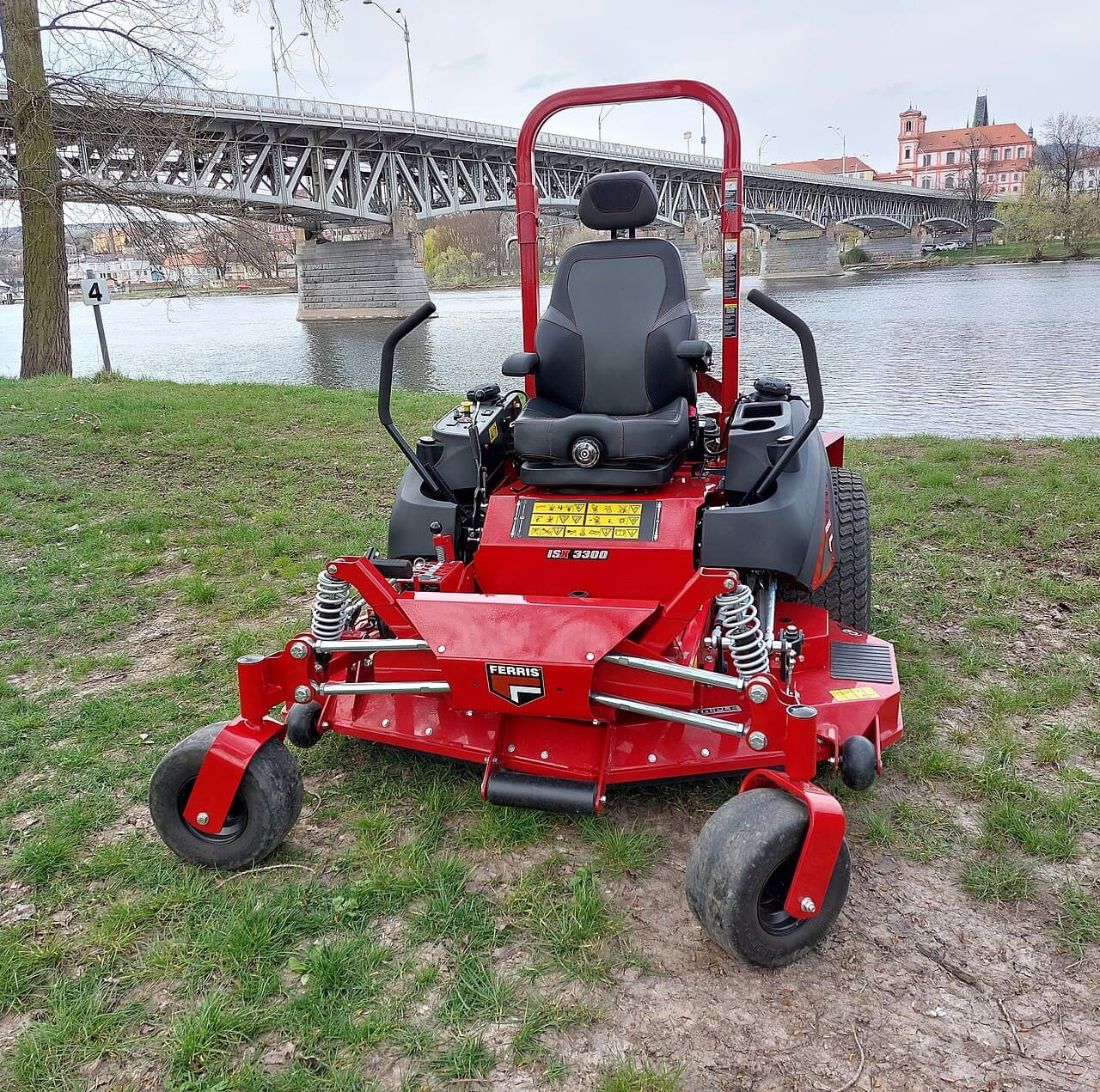
Step 4: test it properly
Test in a clear space. Husqvarna's manual says to "move unit to an open, unobstructed area such as an empty parking lot or open field."[2] Drive with both levers fully forward and watch the line. If it still pulls, change the travel a little more on the side it favors, and check the tires again after the mower has warmed up.
Stop and call a pro if
- A wheel creeps in neutral. That is a drive-system neutral setting, not lever travel. Ariens' manual says: "If transaxle does not set neutral, contact your Ariens Dealer for repair."[1]
- The parking brake does not hold. "If unit rolls with parking brake engaged, parking brake must be repaired."[1]
- The levers are bent, loose or binding, or the adjuster has no range left.
- One side drives weakly or not at all, which points to the belt or transaxle rather than lever travel.
- The job needs the mower raised with the engine running. Leave that to a shop.
Getting help in Virginia
If the mower still pulls after the adjustments, see what zero-turn service costs before you call a shop. Browse more lawn equipment repair answers or lawn mowing services.
When you are ready, describe the mower and the problem and local small engine shops can quote it.
Common questions
- Why does my zero-turn drift to one side?
- Start with tire pressure. Ariens' manual calls incorrect or unbalanced tire air pressure the primary reason a unit may not track straight, and says to increase pressure on the side it tracks toward without exceeding the maximum. If that does not fix it, the steering lever travel may be uneven.
- What tire pressure should a zero-turn run?
- It depends on the mower and the tire. Husqvarna's MZ 54 manual recommends 103 kPa / 1 bar / 15 psi for the rear tires. Check your own manual and the maximum printed on the tire sidewall, and never exceed that maximum.
- Is the adjustment the same on every brand?
- No. Ariens uses eccentrics and a slotted bolt on the frame, while Husqvarna's MZ 54 uses a tracking bolt and a tracking knob. The idea is the same: limit how far each lever can travel so both sides drive at the same speed. Follow the procedure in your operator's manual.
- Do I need to jack the mower up?
- Not for lever travel. The check is done with the engine off. Raising the drive wheels is used for neutral adjustments with the engine running, which is better left to a dealer unless you are experienced and your manual walks you through it.
- One wheel creeps when the levers are in neutral. Can I fix that the same way?
- No, that is a neutral setting on the drive system, not lever travel. Ariens' manual says that if the transaxle does not set neutral, contact your dealer for repair. Have a shop look at it.
Sources
- [1] EZR Zero Turn Mower, Owner/Operator Manual, Ariens Company. Checked October 27, 2026.
- [2] Operator Manual MZ 54 (967 696102-00), Husqvarna. Checked October 27, 2026.
- [3] Lawn Care: Rotary Mower Safety (BSE-42P), Virginia Cooperative Extension, Virginia Tech. Checked October 27, 2026.
Want a pro to handle it?
Describe the job once. Licensed local businesses send quotes, and you pay only when you book one.
Get a quote for Lawn Equipment