Why does my zero-turn mower pull to one side?
Most often it is uneven tire pressure. Ariens calls incorrect or unbalanced tire air pressure the primary reason a zero-turn may not track straight. Next is uneven steering lever travel, then a caster that does not turn freely or a brake or drive-system fault. Check the tires and lever travel yourself; a drive that creeps or drags needs a dealer.
Free to ask. Local shops send quotes, and you pay only when you book one.
By Kasra Taheri, Founder, LoclisPublished
Researched and drafted with AI, then checked claim by claim against the sources listed below before it was published. Prices and rules change; the dates beside each source say when it was last checked.
Step by step
Read when to stop and call a pro, further down this page, before you start.
Step 1: Park and make it safe
Park on level ground, disengage the blades, stop the engine, remove the key and let moving parts stop before you touch anything.[1]
Step 2: Check both drive tires
Measure the pressure in both drive tires and compare it with the figure in your operator's manual.[2]
Step 3: Raise the low side
Add air to the side the mower pulls toward, without going over the maximum printed on the tire.[1]
Step 4: Look at the tires themselves
Look for a tire that is worn, cut or visibly smaller than the other, and keep gasoline, oil and insect-control chemicals off the rubber.[1]
Step 5: Spin the casters
Push the mower slowly by hand with the engine off and watch that each front caster wheel swivels and turns freely.[2]
Step 6: Compare lever travel
With the engine off, push both steering levers fully forward and see whether one travels farther than the other.[1]
Step 7: Test in the open
Drive with both levers fully forward in a large clear area and see whether it holds a line before you change anything else.[2]
Start with the drive tires. Ariens' manual says it directly: "The primary reason the unit may not track straight is incorrect or unbalanced tire air pressure."[1] If that checks out, the next suspects are uneven steering lever travel, a caster that drags, and, less often, a brake or drive-system fault that a shop should handle.
Make it safe first
Park on level ground and follow the maker's own rule: "Before making any inspections, repairs, adjustments, etc. disengage PTO, stop unit and engine, remove key, and allow moving parts to stop."[1] Virginia Cooperative Extension adds: "Disconnect the spark or electric plug before troubleshooting or repairing the mower."[3] If you need to tilt or lift anything, remember that a mower can tip over easily.[3]
Cause 1: tire pressure
A zero-turn steers by driving each rear wheel at its own speed. A tire that is a few pounds softer is a little smaller, so that wheel travels less distance per turn and the mower curves toward it.
Check both drive tires with a gauge. Ariens' fix is "Increase pressure on the side the unit tracks toward."[1] and also "DO NOT exceed maximum recommended tire pressure."[1] Husqvarna gives the same first check: "If the mower is not tracking straight, check the air pressure in both rear tires."[2] Its MZ 54 figure is "Recommended air pressure for the rear tires is 103 kPa / 1 bar / 15 psi."[2] Other mowers differ, so use your own manual.
While you are there, look at the rubber. A worn, cut or mismatched tire changes the wheel's effective size. Ariens also advises: "Keep tires free of gasoline, oil, or insect control chemicals which can harm rubber."[1]
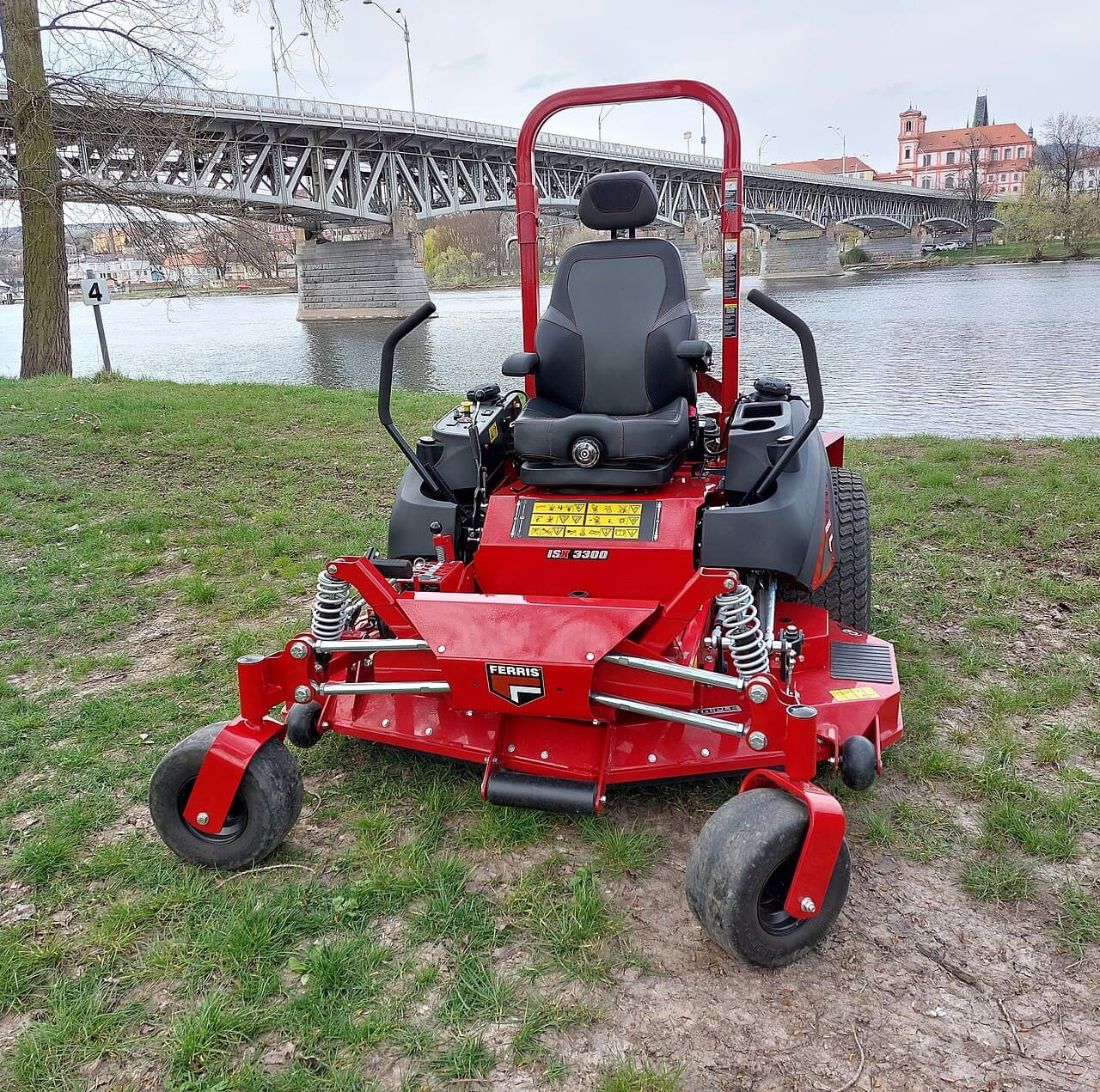
Cause 2: uneven lever travel
Each lever tells one side how fast to go. If the two levers do not reach the same place at full forward, the wheels will not run at the same speed. To check, "push the steering control levers to their full forward position. If one lever travels farther than the other, they need to be adjusted."[1] Do this with the engine off.
The adjustment itself depends on the brand: an eccentric, a slotted bolt, or a tracking bolt and knob. The step-by-step is in how to adjust zero-turn mower steering.
Cause 3: a caster that drags
The front casters swivel freely and go wherever the mower pushes them. One that is seized, packed with grass, or has a bent yoke can tug the front end sideways. Husqvarna's maintenance notes say, about the caster wheels, "Check that wheels turn freely."[2] Clean packed grass out of the yoke and see whether the wheel spins by hand.
Cause 4: something that is not tire or lever related
If the mower pulls only when you let go of the levers, or one drive wheel creeps in neutral, the problem is in the drive system. Ariens' manual says: "If transaxle does not set neutral, contact your Ariens Dealer for repair."[1] A dragging brake or a weak hydrostatic drive on one side shows up the same way, and neither is a driveway job.
Test it properly
Test in a clear space. Husqvarna's manual says to "move unit to an open, unobstructed area such as an empty parking lot or open field."[2] Drive with both levers fully forward, note which way it veers, and change one thing at a time so you know what worked. Slopes and side-hills make any zero-turn drift, so test on flat ground.
Stop and call a pro if
- A wheel creeps in neutral or the mower will not hold still. That is a drive-system setting, and the dealer should handle it.[1]
- The parking brake does not hold. "If unit rolls with parking brake engaged, parking brake must be repaired."[1]
- One side drives weakly or not at all after the tires and lever travel are equal.
- A lever is bent, loose or binding, or the adjuster has no range left.
- You see leaking fluid, or a tire or wheel is damaged.
Getting help in Virginia
If the mower still pulls after you have worked through these, see what zero-turn service costs in Virginia before you call a shop. Browse more lawn equipment repair answers or Virginia lawn mowing services if you would rather hand the lawn to someone while the mower is down.
When you are ready, describe the mower and what it does and local small engine shops can quote it.
Common questions
- Is it normal for a zero-turn to drift a little?
- A slight drift on a slope is normal, because the mower is heavy and the drive wheels have no steering linkage to hold a line. A mower that wanders on flat ground with both levers fully forward is telling you something is unequal, and tire pressure is the first thing to check.
- What tire pressure should the drive tires have?
- It depends on the mower and tire. Husqvarna's MZ 54 manual says "Recommended air pressure for the rear tires is 103 kPa / 1 bar / 15 psi." Use the figure in your own manual and never exceed the maximum printed on the tire sidewall.
- I fixed the tires and it still pulls. What next?
- Compare how far each steering lever travels. Ariens says that if one lever travels farther than the other, they need to be adjusted. The method differs by brand, and our guide to adjusting zero-turn steering walks through the common ones.
- Can a dull blade or a bad deck make the mower pull?
- Not usually. Blades and deck height affect the quality of the cut, not the line the mower drives. If the cut is uneven rather than the path, look at the deck instead.
- One wheel drives harder than the other even in neutral. Is that the same problem?
- No. That points to the drive system rather than tires or lever travel. Ariens says that if the transaxle does not set neutral, you should contact your dealer for repair, so have a shop look at it.
Sources
- [1] EZR Zero Turn Mower, Owner/Operator Manual, Ariens Company. Checked October 28, 2026.
- [2] Operator Manual MZ 54 (967 696102-00), Husqvarna. Checked October 28, 2026.
- [3] Lawn Care: Rotary Mower Safety (BSE-42P), Virginia Cooperative Extension, Virginia Tech. Checked October 28, 2026.
Want a pro to handle it?
Describe the job once. Licensed local businesses send quotes, and you pay only when you book one.
Get a quote for Lawn Equipment