How do I choose paint colors for my house?
Start with the colors your floors, counters and furniture already have, then narrow to two or three paint colors. Test each as a large painted sample in the actual room, on at least two coats, and look at it in morning, midday and lamp light. Pick the sheen last. If you are still stuck after that, a color consultant can help.
Free to ask. Local shops send quotes, and you pay only when you book one.
By Kasra Taheri, Founder, LoclisPublished
Researched and drafted with AI, then checked claim by claim against the sources listed below before it was published. Prices and rules change; the dates beside each source say when it was last checked.
Step by step
Read when to stop and call a pro, further down this page, before you start.
Step 1: Read the room's fixed colors
Note the colors of the floors, countertops, fireplace surround, rugs and furniture, since these narrow which color families will work.[1]
Step 2: Choose a mood and a palette
Decide how the room should feel, and keep colors in the same half of the color wheel for a harmonious palette.[3]
Step 3: Collect display chips
Pick up free chips and stack them to compare warm and cool undertones.[2]
Step 4: Buy sample pots
Buy paint samples for your two or three favorites from a local paint retailer.[1]
Step 5: Brush out two coats
Brush at least two coats onto the wall or onto white foam core board.[2]
Step 6: Move the sample around
Carry the foam board to different walls so you can see it in different lighting.[2]
Step 7: Check at different times of day
Look at the sample in morning, midday, evening and under lamps.[1]
Step 8: Hold it against the trim
Compare the sample with the trim, ceiling and floor colors it will sit beside.
Step 9: Choose a sheen
Match the sheen to the room: matte hides flaws, eggshell suits high-traffic rooms.[3]
Step 10: Commit and buy
Buy the paint once one sample still looks right after a couple of days.
Start with the room, then test in your own light
Choose the colors your floors, counters and furniture already point to, narrow to two or three candidates, and test each as a big painted sample in the actual room for a couple of days. That order works because the colors in these items will help determine which paint color families will work best in your room,[1] and because a chip in a store tells you very little about how a color behaves at home.
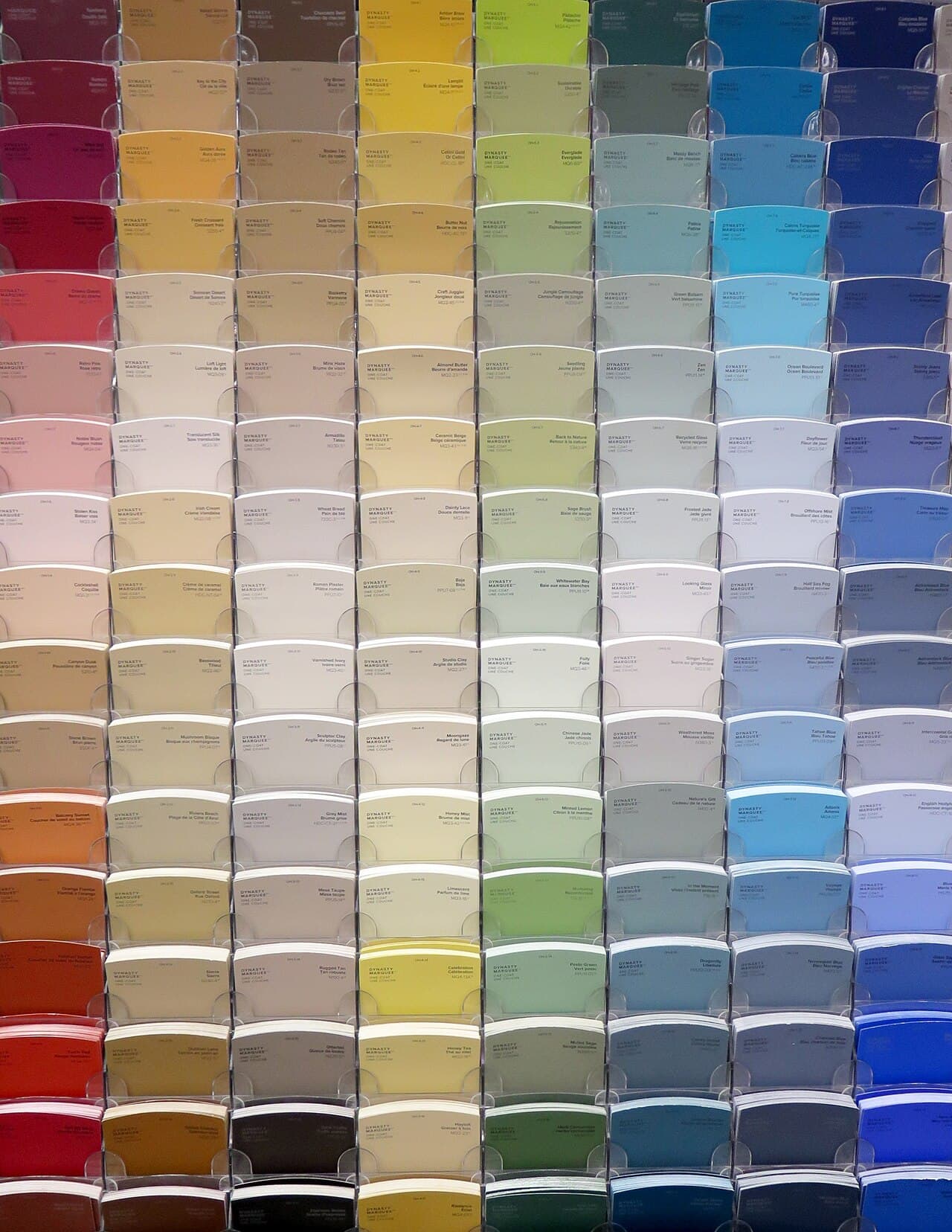
Work out your color family
Look at what cannot change. Hardwood floors, countertops, a fireplace surround, area rugs and furniture all carry color, and the colors in these items will help determine which paint color families will work best in your room.[1] A honey-toned oak floor, for example, usually pulls toward warm whites and creams; a gray-brown tile may sit better with a cooler neutral.
Then decide on the mood. Quiet and restful rooms (bedrooms, studies) usually suit softer, lower-contrast colors; kitchens and entries can take more contrast. If you are painting several rooms, keep the palette related. Creating a palette within the same half of the wheel tends to be more harmonious.[3] Warm reds, yellows and oranges sit on one side; cool lavenders, blues and greens on the other.[3]
Collect chips, then graduate to big samples
Free display chips are the cheap first pass. Layering and observing helps you compare nuances in warm vs. cool colors and undertones.[2] Tape or stack your favorites and drop the ones that look wrong next to your floor.
Chips are too small to trust, so move on to a real sample. Benjamin Moore's advice is that the best way to test color in different lighting conditions is to buy paint samples from your local Benjamin Moore retailer.[1] Their 8 oz. sample pots cover approximately one 2'x2', two-coat area.[2] Two coats matter: brush out at least two coats to get the most accurate color depiction.[2]
You have two ways to apply it. Brush directly on your wall, especially if your wall is white or a light neutral—the new color won't compete against your existing one.[2] Or paint a board, which lets you carry the color around. Consider using a white foam core board, so you can move the color around the room throughout the day to see it in different lighting.[2] Peel-and-stick samples work on the same principle, and you can wrap around edges to understand how the color looks in light and dark corners.[2]
Watch it all day
Light changes a color more than most people expect. Natural and artificial light can impact the appearance of color, so viewing it at different times of the day in all lighting conditions is crucial.[1] Look in the morning, at midday, in the evening with lamps on, and at night with overhead lights. Direct midday sun will brighten up any hue, while artificial light adds a warm glow to wall color.[3]
Check the sample on the wall where it will actually live, next to the trim and floor, and from the doorway you walk in through. A color that is perfect on the sunny wall may turn gray on the shaded one. Rooms that face different directions can need different answers, even in the same palette.
Pick the sheen before you commit
Sheen changes how a color reads. Higher gloss adds dimension and levity to any room,[3] but shiny finishes look best on smooth, clean surfaces (spackled, sanded, etc.),[3] and matte or flat paints are most forgiving of imperfections.[3] Eggshell is the perfect middle ground between a matte look and higher gloss durability, making it a go-to, all-purpose finish for high-traffic areas.[3] Use caution with flat paint where walls get scrubbed: stains are harder to remove from low-sheen paint.[4]
Liquid samples are usually eggshell, so judge sheen separately from the color. If you test an exterior color, remember that liquid samples are formulated for interior use only, so use white foam board instead.[2]
Do not forget ceilings and trim
Painting trim in glossy white is a classic choice,[3] and a white ceiling keeps most rooms bright. Whatever you pick, hold your wall sample against the actual trim color. A cool white trim beside a warm wall can look dingy, and a creamy trim beside a gray wall can look yellow.
Stop and call a pro if
- The walls are peeling or chipping in a house built before 1978. Approximately three-quarters of the homes in the United States built before 1978 still contain some lead-based paint,[5] and any renovation, repair or painting project in a pre-1978 home or building that has lead-based paint can easily create dangerous lead dust.[5] Do not sand or scrape; ask a lead-safe certified painter.
- You cannot narrow it down. If you are choosing colors for a whole house and keep going in circles, a color consultant can save a repainting. See whether a paint color consultant is worth it.
- The job needs ladders over a stairwell or high walls. Hire a painter for the painting rather than the choosing.
Getting help in Virginia
For prices, see how much a color consultation costs in Virginia and how much it costs to paint a room. Loclis lists painters you can compare by area: browse painting pros or more painting answers.
When you have a color picked, describe the room once and local painters quote it.
Common questions
- How many colors should I use in one house?
- There is no set number. A common approach is one main wall color for connected rooms, with trim and ceiling in white and one or two accent colors in rooms you want to feel different. Keeping colors in the same half of the color wheel tends to be more harmonious.
- Do I need to buy a sample if I already have a chip?
- Yes, if the color matters to you. A small chip looks different from a painted wall, and color changes with natural and artificial light. A sample brushed on in two coats and checked at different times of day is the reliable test.
- What is the safest color if I cannot decide?
- A soft neutral that picks up the color of your floors and counters is the lowest-risk choice, but test it anyway. Neutrals have undertones that can lean warm or cool, which shows up on the wall in your light.
- Does sheen change how the color looks?
- Yes. Higher gloss adds dimension, and matte or flat paint is most forgiving of imperfections, so the same color can look different in each. Test the color first, then choose the sheen for the room's use.
- Can I choose the same color for the whole house?
- You can, and it is a safe way to make rooms feel connected, but each room's light is different, so test the sample in every room. A color that looks right in a sunny living room may read darker in a hallway.
Sources
- [1] How to Choose Interior Paint Colors, Benjamin Moore. Checked October 27, 2026.
- [2] Tips on How to Sample Paint Colors, Benjamin Moore. Checked October 27, 2026.
- [3] The Color Handbook: A Guide to Selecting Paint Color, Benjamin Moore. Checked October 27, 2026.
- [4] Choosing an Interior Paint Finish: Sheen and Gloss 101, Benjamin Moore. Checked October 27, 2026.
- [5] Lead Renovation, Repair and Painting Program, U.S. Environmental Protection Agency. Checked October 27, 2026.
Want a pro to handle it?
Describe the job once. Licensed local businesses send quotes, and you pay only when you book one.
Get a quote from a local pro