How do I clean under a mower deck?
Shut off the engine and disconnect the spark plug wire, or remove the battery on an electric mower, before your hand goes near the blades. Then scrape the caked clippings off the underside of the deck with a putty knife, and finish with a brush or the deck wash port if your mower has one. Dry the deck before storing it.
Free to ask. Local shops send quotes, and you pay only when you book one.
By Kasra Taheri, Founder, LoclisPublished
Researched and drafted with AI, then checked claim by claim against the sources listed below before it was published. Prices and rules change; the dates beside each source say when it was last checked.
Step by step
Read when to stop and call a pro, further down this page, before you start.
Step 1: Stop the mower and park it level
Turn off the engine and let the blade come to a complete stop.[3] Park on flat ground with the mower cool.
Step 2: Disable the engine
Disconnect the spark plug wire on a gas mower, or remove the battery on an electric mower, before your hand goes near the blades.[1]
Step 3: Tip the mower the right way
Follow your owner's manual for which side to tilt up, so oil and fuel do not run into the air filter or carburetor, or use ramps or a lift if the manual allows.
Step 4: Scrape off the clippings
Use a putty knife or plastic scraper to peel the caked-on grass off the underside of the deck.[1] Work with gloves on, away from the blade edges.
Step 5: Clear the chute and corners
Scrape out the discharge chute opening and the corners where clippings pack in tightest.
Step 7: Dry the deck
Let the deck air-dry or wipe it, because damp clippings left on metal hold water and cause rust.[1]
Step 8: Reconnect and check
Put the mower back on its wheels, reconnect the spark plug wire or battery, and make sure guards and shields are in place.[2]
Disable the mower first, then scrape
Park the mower on level ground with the engine off and cool, disconnect the spark plug wire (or take out the battery on an electric mower), then scrape the packed clippings off the underside of the deck with a putty knife. Brush or blow off what is left and let the deck dry before you put the mower away.
The order matters. Whenever your hand goes near the blades always disconnect the spark plug for gas-powered or remove the battery for electric mowers.[1] Virginia Cooperative Extension gives the same two rules in its mower safety list: turn off the engine before cleaning the area under the deck,[2] and disconnect the spark or electric plug before troubleshooting or repairing the mower.[2]
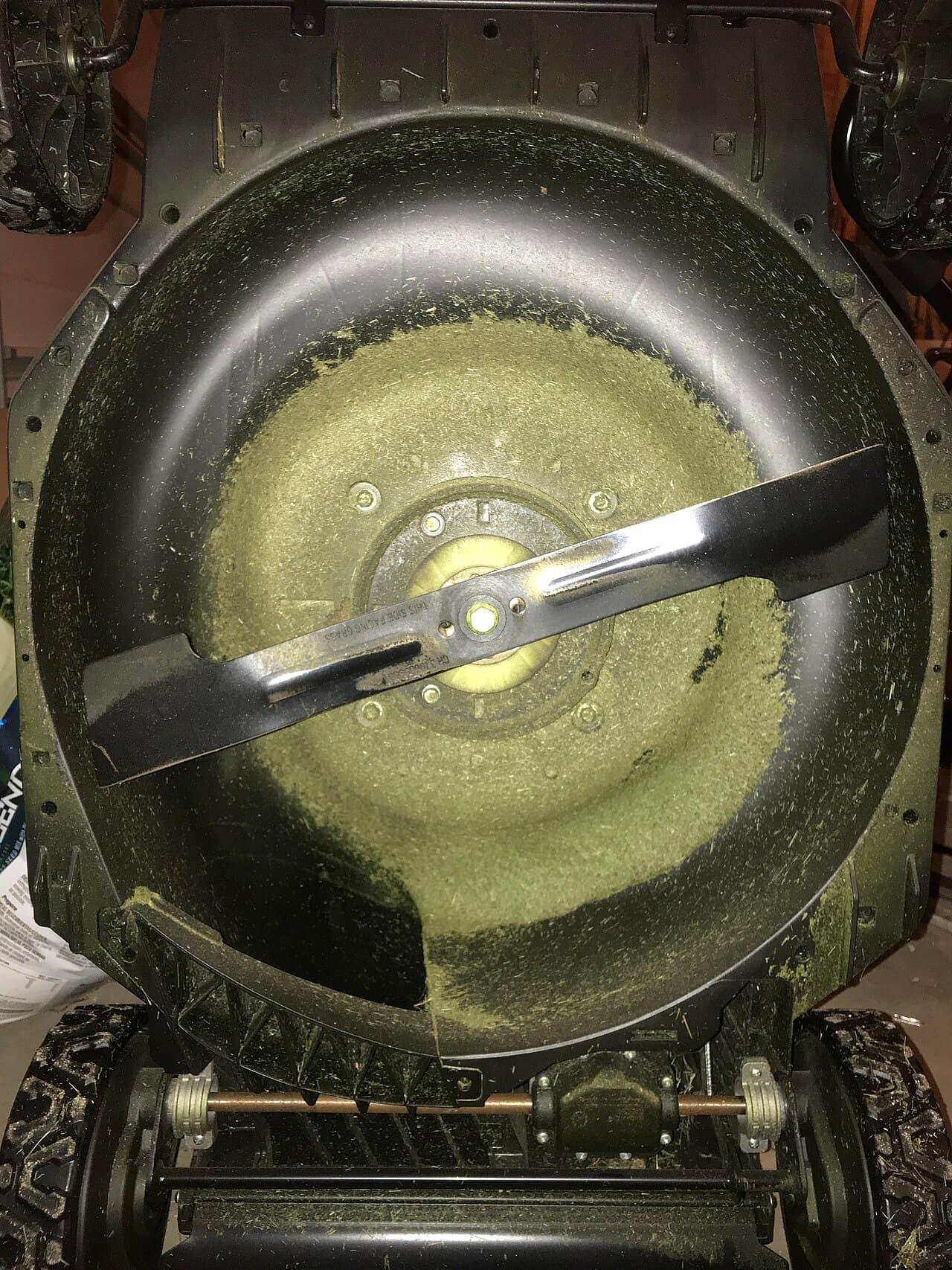
Why it is worth doing
Grass clippings stuck to the bottom of the mower deck hold water causing the metal to rust and shortening the lifespan of the equipment.[1] A packed deck also cuts worse, because the grass cannot flow under the deck and out. Wet clippings will probably clog the discharge chute, ultimately could jam the rotary blade and shut down the engine.[3]
Before you reach under
- Shut the engine off and wait for the blade to stop. The blade must come to a complete stop before you attempt to clear the jam.[3] If you try to clear the chute while the blade rotates, your fingers could be amputated.[3]
- Let the engine cool, particularly if you just finished mowing.
- Disconnect the spark plug wire. On a gas mower, tuck the boot away from the plug so it cannot touch it.
- Wear sturdy gloves and closed shoes. Blade edges are sharp even when the blade is dull.
Getting the deck in reach
On a walk-behind, tip the mower onto its side with the air filter and carburetor facing up, so oil and fuel do not run into them. Your owner's manual shows the correct side for your model. On a riding mower or zero-turn, raise the deck to its service position or use a lift or ramps as the manual describes; do not crawl under a machine held up only by a jack.
Scrape, then rinse or brush
Routinely inspect underneath the mower for accumulated clippings. Scrape this off using a putty knife.[1] A plastic scraper works too and is gentler on paint. Start with the thickest build-up near the discharge opening, then work around the blade area, staying clear of the edges.
For the loose material, use a leaf blower or air compressor to blow off clippings, dust, and debris.[1] Some mowers are equipped with a port to hook up a garden hose to clean off underneath a mower deck.[1] If yours has one, follow the manual's instructions for it rather than improvising. Without a wash port, avoid pointing a hose up into the engine, belt or electrical parts.
Finish by letting the deck dry in the sun, or wipe it down, before you set the mower back on its wheels.
While you are down there
Look at the blade for nicks, bends or a loose bolt, and at the deck for holes where rust has eaten through. A dull or damaged blade is better handled by sharpening or replacing it than by pushing on. Make sure all guards and safety shields are in place when you finish,[2] and never disengage any safety switches or devices.[2]
Stop and call a pro if
- The blade is bent, cracked or the bolt is loose or stripped. Do not run the mower until it is replaced.
- The deck is rusted through or cracked at the blade housing or spindle mounts.
- The blade will not turn freely or the spindle wobbles. Bearings and spindles on riding decks are a shop job.
- You cannot safely raise the deck. If there is no lift or service position you trust, have a shop do it.
- The mower has fuel or oil leaking once tipped.
Getting help in Virginia
For related deck problems, read how to tune up a lawn mower and how to sharpen lawn mower blades. Loclis lists local shops and technicians: see lawn care near you or more lawn equipment answers.
When you are ready, describe the mower once and local repair businesses quote it.
Common questions
- How often should I clean under my mower deck?
- After mowing is the best habit. University of Illinois Extension says it is important to clean off the mower after mowing, and to routinely inspect underneath for accumulated clippings. At minimum, scrape the deck whenever the cut gets ragged or clippings start piling up in the chute.
- Can I just spray the deck with a hose?
- Only if your mower has a wash port and you follow the manual. Some mowers are equipped with a port that hooks up to a garden hose to clean underneath the deck. Without one, scraping and brushing is safer for the engine, and you should dry the deck afterward so it does not rust.
- Why is disconnecting the spark plug necessary if the engine is off?
- Because turning the blade by hand can still turn the engine over, and a stray start would put your hand next to a spinning blade. Pulling the spark plug wire (or the battery on an electric mower) removes that possibility.
- Which way should I tip a mower to clean the deck?
- Check the owner's manual for your model. The usual goal is to keep the air filter and carburetor side facing up so oil and fuel do not run into them. Many riding mowers and zero-turns are cleaned with the deck raised to its service position instead of tipping the machine.
- Does a dirty deck really matter?
- Yes. Caked clippings hold moisture against the metal and shorten the life of the deck, and they can also clog the discharge chute and stall the engine. A clean deck also lets clippings move out cleanly, which helps the cut.
Sources
- [1] Mower Maintenance, University of Illinois Extension. Checked October 27, 2026.
- [2] Lawn Care: Rotary Mower Safety (BSE-42P), Virginia Cooperative Extension, Virginia Tech. Checked October 27, 2026.
- [3] Power Lawn Mowers (Publication 5126), U.S. Consumer Product Safety Commission. Checked October 27, 2026.
Want a pro to handle it?
Describe the job once. Licensed local businesses send quotes, and you pay only when you book one.
Get a quote for Lawn Equipment