How do I tune up a lawn mower?
A tune-up is five small jobs: change the oil, the air filter and the spark plug, sharpen and balance the blade, and start with fresh fuel. Disconnect the spark plug wire before any work. Oil and air filter are typically yearly, spark plugs about every two years. If it still will not run well afterwards, take it to a shop.
Free to ask. Local shops send quotes, and you pay only when you book one.
By Kasra Taheri, Founder, LoclisPublished
Researched and drafted with AI, then checked claim by claim against the sources listed below before it was published. Prices and rules change; the dates beside each source say when it was last checked.
Step by step
Read when to stop and call a pro, further down this page, before you start.
Step 1: Disconnect the spark plug
Pull the spark plug wire off the plug, or remove the battery on an electric mower, before any work.[2]
Step 2: Check and change the oil
On level ground, check the dipstick, and change the oil if it is a year old or the hours are up.[1]
Step 3: Change the air filter
Fit a clean or new air filter at least once per year.[1]
Step 4: Change the fuel filter if it is due
Fuel filters are typically changed on an annual basis.[1]
Step 5: Replace the spark plug
Fit the exact plug the manual names, set the gap, and thread it in by hand.[1]
Step 6: Sharpen and balance the blade
Remove the blade, sharpen it, balance it and refit it to the torque in the manual.[1]
Step 7: Scrape the deck
Scrape caked clippings from under the deck with a putty knife.[1]
Step 8: Add fresh fuel
Fill with fresh gasoline, and add stabilizer if the mower will sit.[4]
Step 9: Reconnect and test
Reattach the plug wire, start the mower, and check for leaks and smooth running.
The tune-up in one pass
A mower tune-up is five small jobs done in one sitting: fresh oil, a clean or new air filter, a fresh spark plug, a sharp and balanced blade, and clean fuel. Most need only a basic socket set. Read your owner's manual first, because it sets the exact oil, plug and torque for your engine. The schedule below is written for homeowner mowers with light to moderate use, so heavy use calls for more.[1]
Do the safety step before everything else. Virginia Cooperative Extension says: "Disconnect the spark or electric plug before troubleshooting or repairing the mower."[2] Its blades rotate at a high speed of 2,000 to 4,000 revolutions per minute,[2] so a mower that cannot start cannot hurt you. Never refuel the mower when its engine is hot or running.[2]
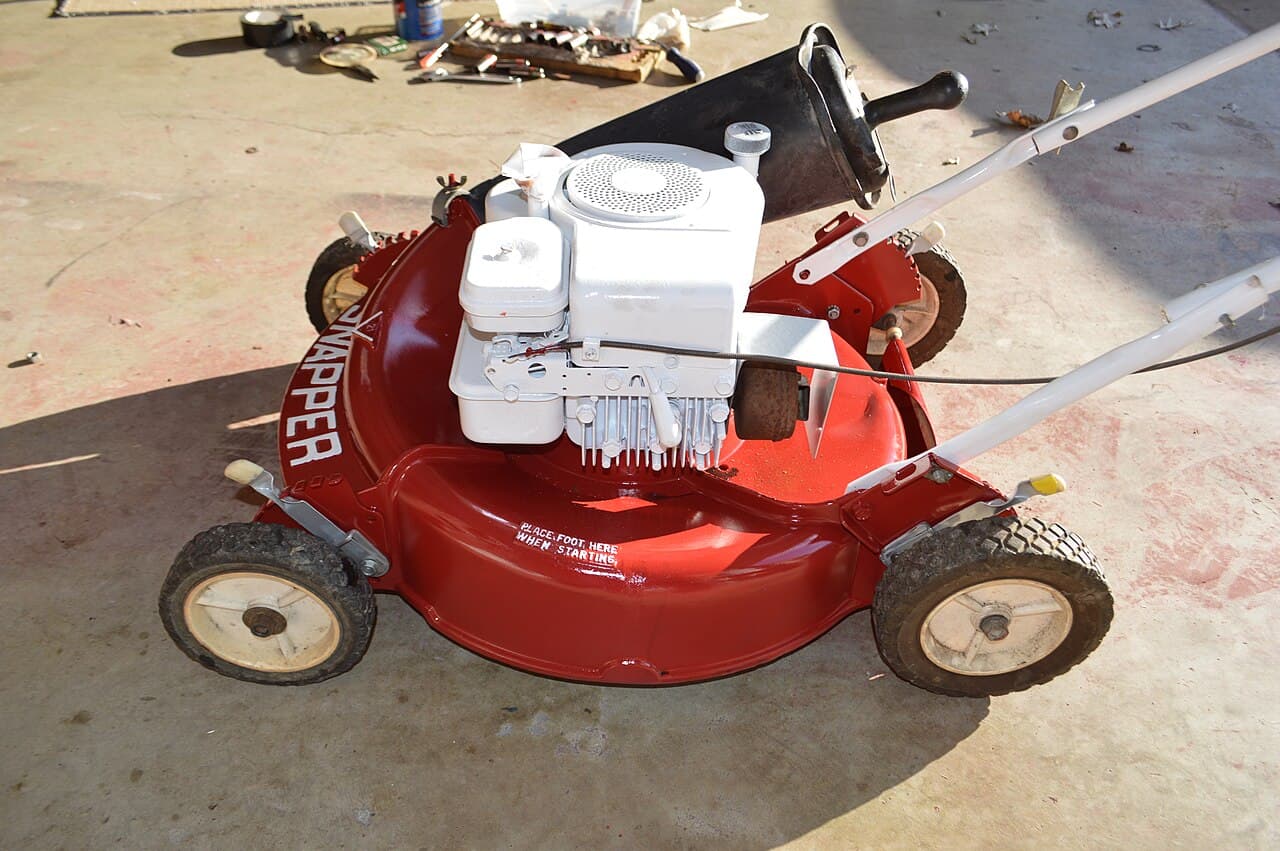
Oil
For most residential lawnmowers, oil is typically changed every year.[1] If your mower has an hour gauge and you mow a lot, follow the hours the manufacturer specifies instead. Check the level before you start the engine: park the mower on a level surface, remove the dipstick, and wipe it clean with a rag, then reinsert it and read it.[3]
Briggs & Stratton lists SAE 30 as best for warmer temperatures (above 40°F), and says that below 40°F (4°C) the use of SAE 30 will result in hard starting.[3] Use what your engine's manual names. Used oil is not trash: take it to a recycler or a county drop-off.
Air filter, fuel filter and spark plug
Air filters keep dust from entering the engine, and they are often inexpensive and an easy method to keep your mower engine running smoothly.[1] Change one at least once per year.[1] Fuel filters are typically changed on an annual basis.[1]
Push mowers often will have one spark plug, while riding mowers will have two.[1] Inspect the plug for clean contacts and no scoring. Typically, spark plugs are changed every two years.[1] Buy the exact plug the manual names, set the gap it gives, thread it in by hand so it does not cross-thread, and make the final tightening with a spark plug socket.[1]
The blade
Dull blades tear grass and leave ragged wounds that take longer to heal.[1] With the spark plug wire off, remove the blade, sharpen or replace it, and balance it, because an unbalanced blade can create a slight wobble that causes strain on a mower and may result in an uneven cut.[1] Refit it with a torque wrench to the number in your manual.[1] The details are in how to sharpen lawn mower blades. A mower can tip over easily,[2] so tilt it the way your manual shows, and turn off the engine before cleaning the area under the deck.[2]
Fuel and the deck
Most gasoline sold today is gasoline with 10 percent ethanol, and engines that are rarely or seasonally used, such as lawnmowers or chainsaws, are especially prone to difficulties.[4] Add fuel stabilizer if the equipment will be idle for more than a few weeks.[4] Start the season with fresh gasoline.
Finish by cleaning the deck. Grass clippings stuck to the bottom of the mower deck hold water causing the metal to rust and shortening the lifespan of the equipment.[1] Scrape the underside with a putty knife, with the plug wire still off.
Stop and call a pro if
- It still will not start or runs roughly after fresh fuel, a clean filter and a new plug. The carburetor, ignition or valves may need a shop's tools.
- There is a fuel or oil leak you cannot trace to a loose cap or drain.
- The mower shakes hard after the blade is back on. A bent blade or a bent crankshaft is not a home fix.
- A riding mower has a belt, transmission, steering or electrical fault. These are shop jobs; see riding mower repair costs.
- A safety switch or guard is damaged. Never disengage any safety switches or devices.[2]
Getting help in Virginia
If you would rather not do it yourself, read whether to take the mower to a shop each year and what servicing costs. Loclis also has more lawn equipment answers and a list of local pros at lawn equipment repair.
When you are ready, describe the mower once and local repair shops quote it.
Common questions
- How often should I tune up my mower?
- Once a year for a typical homeowner mower. University of Illinois Extension says oil is typically changed every year, air and fuel filters at least yearly, and spark plugs about every two years. Heavy use calls for the hours the manufacturer specifies.
- Do I need to change the oil if I barely used the mower?
- Plan on yearly for most residential mowers, or by the hours the manufacturer specifies if you use it heavily. Check the level before every start.
- What do I do first?
- Disconnect the spark plug wire, or remove the battery on an electric mower. Virginia Cooperative Extension says to disconnect the spark or electric plug before troubleshooting or repairing the mower.
- Why will my mower not start after a tune-up?
- Usually the plug wire is not back on, the fuel is stale, or a part is not seated. Seasonally used engines are especially prone to fuel trouble. If fresh fuel and a new plug do not help, a shop should look at the carburetor and ignition.
Sources
- [1] Mower Maintenance, University of Illinois Extension. Checked October 27, 2026.
- [2] Lawn Care: Rotary Mower Safety (BSE-42P), Virginia Cooperative Extension, Virginia Tech. Checked October 27, 2026.
- [3] What type and how much oil for my lawn mower?, Briggs & Stratton. Checked October 27, 2026.
- [4] Fuel Ethanol: Hero or Villain?, Penn State Extension. Checked October 27, 2026.
Want a pro to handle it?
Describe the job once. Licensed local businesses send quotes, and you pay only when you book one.
Get a quote for Lawn Equipment