How do I hydroseed a lawn myself?
Rent or buy a small hydroseeder and plan the job for late summer to mid-fall if you are growing fescue. Test the soil, work in lime and starter fertilizer, and till 4 to 6 inches deep. Fill the tank about three-quarters with water, add mulch first, then seed, fertilizer and tackifier, spray an even green coat, and water lightly and often until the grass is up.
Free to ask. Local shops send quotes, and you pay only when you book one.
By Kasra Taheri, Founder, LoclisPublished
Researched and drafted with AI, then checked claim by claim against the sources listed below before it was published. Prices and rules change; the dates beside each source say when it was last checked.
Step by step
Read when to stop and call a pro, further down this page, before you start.
Step 1: Pick the season
For tall fescue and other cool-season grasses, plan the job for late summer to mid-fall, the best time to establish them in Virginia.[1]
Step 2: Test the soil first
Send a soil sample to your Extension office a few weeks ahead, because many Virginia soils are very acid and need lime.[1]
Step 3: Clear and grade the area
Rake out rocks, roots and debris, and shape the surface so water drains away from the house and does not pond.
Step 5: Buy the right seed
Choose a Virginia-recommended blend and buy enough for the rate on the bag; Virginia Tech's rate for tall fescue is 6 to 8 pounds per 1,000 square feet.[2]
Step 6: Check the forecast
Spray on a calm, dry day; hydromulch should not go down in rain or wind, and it needs at least 24 hours to dry before a storm.[7]
Step 7: Start with water
Fill the tank about three-quarters full of water and let the engine run for 30 seconds before adding anything.[9]
Step 8: Load mulch first
Add the mulch before the seed and fertilizer, then the seed, fertilizer and tackifier, and top off the tank with water.[9]
Step 9: Mix until smooth
Let the machine agitate until every clump of mulch is gone, typically a minute or two, then start spraying.[9]
Step 10: Spray an even coat
Work in steady, overlapping passes until the soil is evenly green; an even coat close to the right amount matters more than technique.[10]
Step 11: Trim the edges
Near walks and siding, close the gun partway, hold it close to the ground and point it away from surfaces you want to keep clean.[10]
Step 12: Flush the machine
Run clean water through the tank, pump and hose as soon as you finish, before leftover mulch dries and clogs the machine.
Step 13: Water lightly and often
Keep the seedbed moist with light, frequent watering until the grass is up, without so much water that seed washes away.[1]
Step 14: Mow at about 3 inches
Start mowing when the new grass reaches about 3 inches, with a sharp blade and firm soil underfoot.[1]
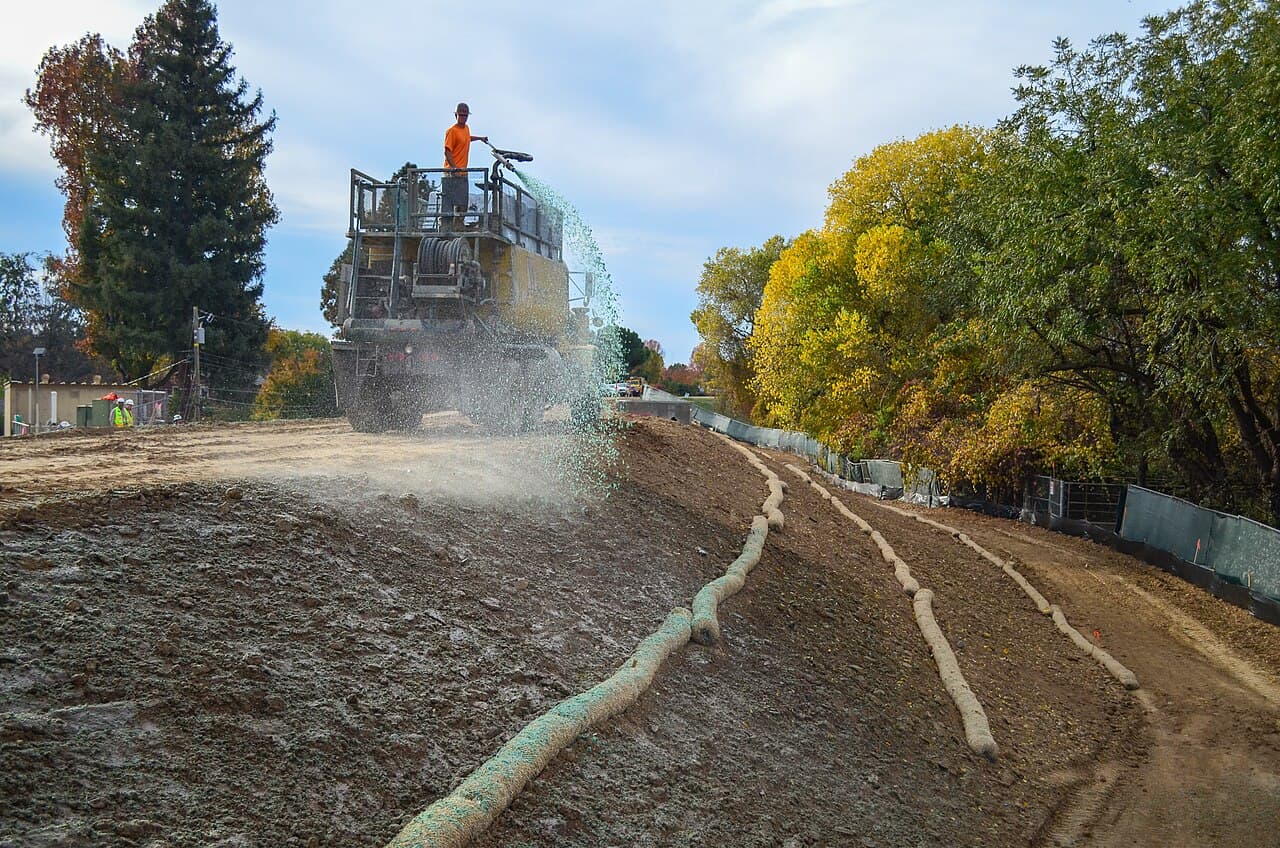
Yes, you can hydroseed your own lawn if you have the right season, a properly prepared seedbed and a small hydroseeder. The machine mixes water, paper or wood-fiber mulch, seed, fertilizer and a tackifier into a green slurry and sprays it through a hose. Contractors' trucks carry a large tank, typically 1,000 to 3,000 gallons, mounted on a truck or trailer.[7] Homeowner-sized machines are much smaller, but they work the same way. The mix dries into a crust that lets water soak in while holding the soil in place,[7] which is why hydroseeding works well on bare, sloped or irregular ground.
Most of the result depends on the season and the soil preparation. The spraying is the easy part.
Pick the right season
Late summer to mid-fall is the best time to establish cool-season grasses such as tall fescue, Kentucky bluegrass and the fine fescues.[1] Warm days and cool nights suit germination, and the seedlings have months to root before their first summer. Spring is the secondary time for planting.[3]
Bermudagrass and zoysiagrass are different: warm-season grasses are ideally established in late spring to mid-summer,[3] and warm-season grasses seeded as permanent cover need soil temperatures of at least 55°F for germination and establishment.[5] Spraying warm-season seed in October wastes it.
Prepare the soil before you rent anything
Start with a soil test from your county Extension office. Many Virginia soils are very acid and need lime,[1] and lime takes weeks to months to work, so test early. Spread the lime on the soil, not in the tank: lime is hard on the pump and is better spread on its own.[8]
For a new lawn, tilling 4 to 6 inches deep before seeding is desirable.[1] Tilling lets you mix in the lime and fertilizer the test calls for. A starter fertilizer is higher in phosphorus than nitrogen and potassium, typically in a 1:2:1 or 1:2:2 ratio,[1] and up to 1 pound of phosphorus per 1,000 square feet can be justified at establishment even without a soil test.[1] After tilling, rake the surface smooth, pick out rocks and roots, and make sure water runs away from the house.
What goes in the tank
- Seed. A hydroseeder takes ordinary lawn seed. Virginia Tech's recommended seeding rates are 6 to 8 pounds of tall fescue, 2 to 3 pounds of Kentucky bluegrass, 4 to 6 pounds of perennial ryegrass and 3 to 5 pounds of fine fescue per 1,000 square feet.[2] Measure the lawn, work out the total seed, and split it evenly across your tank loads.
- Mulch. Paper mulch is the best choice for jet-agitated machines, while wood mulch retains more water but needs longer mixing, and 100% wood mulch is not recommended for any jet machine.[8] Use the type the rental machine is set up for.
- Fertilizer. The starter fertilizer can go in the tank or be spread on the soil beforehand.
- Tackifier. Tackifier works like a glue that holds mulch and seed in place even in heavy rain, and it lubricates the system to help prevent clogs.[8]
Leave weed preventers out of the plan for now. Most crabgrass preventers also stop grass seed from germinating,[6] so do not apply one to the area before or right after seeding.
Spraying day
Pick a calm, dry day. Do not spray in rain or wind or just before a storm, and allow at least 24 hours of drying time before rain.[7] Load the tank in order: water first, then mulch, then seed, fertilizer and tackifier, then top it off, as in the steps above. Spray in overlapping passes until the soil has an even green coat with no bare streaks. The green dye shows you where you have been. Trim the edges last.
Rinse the machine as soon as you finish, before any mulch left in the hose dries.
After spraying
Keep the seedbed moist with light, frequent watering until the grass is up. Avoid heavy watering, which can wash away or drown the seed.[1] Newly seeded lawns need more frequent watering for the first three to four weeks[3] than an established lawn, then gradually less often and deeper. Keep people, pets and vehicles off the area. In warm, moist soil, tall fescue usually germinates in 4 to 7 days,[4] while most Kentucky bluegrass cultivars need 10 to 14 days.[4]
Mow for the first time when the grass reaches about 3 inches. Hold off on weed control: broadleaf weed killers usually cannot go on until the new grass has been mowed at least twice.[1] The full routine is in how to care for a newly hydroseeded lawn, and if nothing appears after a few weeks, see why hydroseed is not growing.
Stop and call a pro if
- The area is a steep bank or slope where you cannot stand and walk safely, or where runoff has already cut gullies.
- The yard needs real grading, fill or topsoil to drain away from the house. That is equipment work, and the grade should be right before any seed goes down.
- The lot is part of a new-construction site under an erosion and sediment control plan. Virginia's minimum standards require that permanent or temporary soil stabilization shall be applied to denuded areas within seven days after final grade is reached on any portion of the site.[11]
- The area is several thousand square feet or more and you would need many tank loads from a small machine. A contractor with a large unit can spray it in one visit. Our guide to what hydroseeding costs in Virginia covers what to ask for in a quote.
For more lawn guides, browse the lawn and landscaping answers or see hydroseeding services and lawn and landscaping businesses around Blacksburg. If you would rather have it sprayed for you, describe the job once and local businesses quote it.
Common questions
- Can I hydroseed without a machine?
- Not in the usual sense. Hydroseeding means pumping a slurry of water, mulch, seed, fertilizer and tackifier through a hose, which takes a tank with an agitator and a pump. Without one, the closest equivalent is spreading seed by hand or with a spreader on a tilled seedbed and covering it lightly with straw.
- Do I need to put lime in the hydroseeder?
- No. Spread lime separately, based on a soil test, and work it into the soil before you spray. One hydroseeder maker advises against lime in the tank because it can cause excessive pump wear.[^turbo-materials]
- How much seed goes in the tank?
- Work back from the area you are covering. Virginia Tech's recommended rate for tall fescue is 6 to 8 pounds per 1,000 square feet, so measure the lawn, work out the pounds of seed for the whole job, and divide it across the number of tank loads.
- When will hydroseeded tall fescue come up?
- Tall fescue usually germinates in 4 to 7 days in warm, moist soil. Most Kentucky bluegrass cultivars take 10 to 14 days, so a fescue and bluegrass mix comes up in stages.
- Can I hydroseed in spring in Virginia?
- Yes, but it is the second choice for cool-season grass. Spring seedlings have less time to root before summer heat, and the crabgrass preventer many people put down in spring will also stop the new seed.
Sources
- [1] Fall Lawn Care (430-520), Virginia Cooperative Extension, Virginia Tech. Checked October 27, 2026.
- [2] Maintenance Calendar for Cool-Season Turfgrasses in Virginia (430-523), Virginia Cooperative Extension, Virginia Tech. Checked October 27, 2026.
- [3] Summer Lawn Management: Watering the Lawn (430-010), Virginia Cooperative Extension, Virginia Tech. Checked October 27, 2026.
- [4] Selecting Turfgrass for Virginia (SPES-748), Virginia Cooperative Extension, Virginia Tech. Checked October 27, 2026.
- [5] Temporary Grassing Options for Winter Soil Stabilization (SPES-743), Virginia Cooperative Extension, Virginia Tech. Checked October 27, 2026.
- [6] SMART Lawns (revised March 2022), Virginia Cooperative Extension, Henrico County Office. Checked October 27, 2026.
- [7] Stormwater Best Management Practice: Mulching (EPA-832-F-21-028V), U.S. Environmental Protection Agency. Checked October 27, 2026.
- [8] Hydroseeding Materials, Turbo Technologies, Inc. (Turbo Turf). Checked October 27, 2026.
- [9] Mixing a load, Turbo Technologies, Inc. (Turbo Turf). Checked October 27, 2026.
- [10] Spraying Techniques, Turbo Technologies, Inc. (Turbo Turf). Checked October 27, 2026.
- [11] 9VAC25-875-560. Erosion and sediment control criteria, techniques, and methods: minimum standards, Virginia Administrative Code. Checked October 27, 2026.
Want a pro to handle it?
Describe the job once. Licensed local businesses send quotes, and you pay only when you book one.
Get a quote from a local pro