How do I keep downspouts from clogging?
Keep leaves out of the gutters, where downspout clogs usually start: clean them at least once a year, more often under trees, and fit a strainer or guard at each outlet. Clear the bottom elbow when it slows, check extensions and buried lines for crushing or blockage, and consider larger downspouts where clogs keep coming back.
Free to ask. Local shops send quotes, and you pay only when you book one.
By Kasra Taheri, Founder, LoclisPublished
Researched and drafted with AI, then checked claim by claim against the sources listed below before it was published. Prices and rules change; the dates beside each source say when it was last checked.
Step by step
Read when to stop and call a pro, further down this page, before you start.
Step 1: Watch a rain
During a steady rain, check that every downspout runs freely at the bottom and that no gutter spills over near an outlet.
Step 2: Clean the gutters on schedule
Scoop out the gutters at least once a year, and more often if trees overhang the house.[1]
Step 3: Set the ladder safely
Stand the ladder on firm, level ground with its base out one-fourth of the height to the gutter, and skip the job in winds over 20 miles per hour.[7]
Step 4: Clear the outlet
Lift the leaves and grit out of the opening where the gutter drains into the downspout, so nothing is left to wash down.
Step 6: Open the bottom elbow
If a downspout is slow, remove the screws holding the bottom elbow, pull it off, and clear the packed debris by hand.[2]
Step 7: Flush it with a hose
Run a garden hose down from the top or up from the bottom until water flows through cleanly, then refit the elbow.
Step 8: Check extensions and buried lines
Make sure each extension is connected, not crushed or clogged, and still carrying water where you want it.[4]
Step 9: Clean pop-up outlets
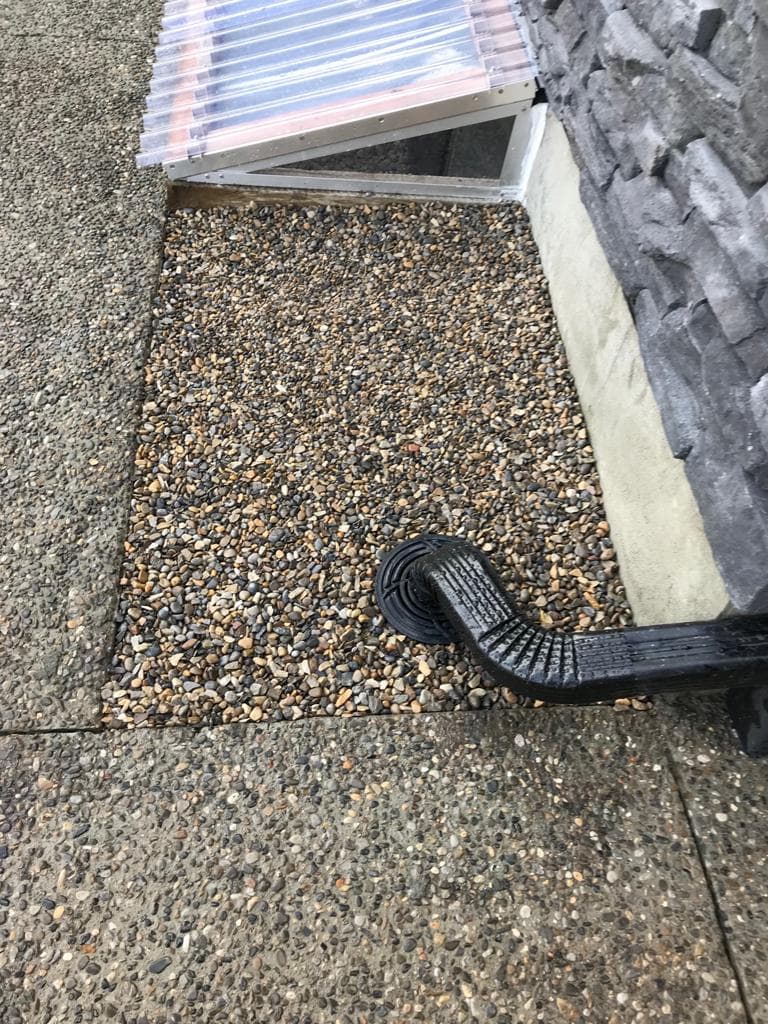
Clear debris from the cover and cap of each pop-up emitter and check the pipe beneath it.[5]
Step 10: Empty standing water weekly
Check gutters and extensions once a week in warm months and tip out any water sitting in them.[6]
A downspout clogs when more debris reaches it than the water can carry through. So the work is mostly upstream: keep leaves out of the gutters and off the outlets, clear the bottom elbow before a slow downspout becomes a blocked one, and keep the extension or buried line at the bottom open. For many houses, a check in late spring and another after the leaves drop is enough.
Stop the debris in the gutter
Leaves, seed pods and grit sit in the gutter until a rain washes them toward the nearest outlet, and then down. Fairfax County's Northern Virginia Soil and Water Conservation District says gutters should be cleaned at least once a year, and more often if you have trees close to the house,[1] and adds that gutter guards can reduce how often you need to clean.[1] Virginia Cooperative Extension makes the same point: "Use screens or regularly clean out gutters to prevent leaves and debris from clogging them and restricting water flow."[4]
The cheapest protection is at the outlet itself. Amerimax lists a strainer among the parts of its gutter system,[2] a cage that sits over the opening and holds leaves in the gutter, where they are easy to scoop out, instead of letting them into the pipe. A strainer needs clearing itself, so check it whenever you are up there. For whole-gutter protection, read whether gutter guards are worth the money and why gutter guards keep clogging.
Keep screens away from the bottom of the downspout. The Building America Solution Center, run for the U.S. Department of Energy, says flap valves are preferred over screens at the bottom of a downspout, because screens need regular cleaning to keep the downspout from clogging.[3]
Clear a slow downspout before it blocks
Clogs often pack in where the pipe turns: the elbow under the gutter and the elbow at the bottom. Amerimax's instructions explain how the parts go together: each downspout and elbow has one crimped end, the larger end of one piece fits over the smaller end of the next, and sheet metal screws hold downspouts and elbows together.[2] So the bottom elbow usually comes off with a screwdriver or drill, and you can pull the plug out by hand.
After that, run a garden hose down from the top, or push it up from the bottom, until water flows freely. A hand-cranked drain snake can loosen a stubborn plug in a straight section; work it gently so you do not dent or split the pipe. Refit the elbow with its crimped end pointing down, so water flows over the joint instead of into it, and put the screws back.
Size the downspouts for the roof
A downspout that is too small for the roof above it backs up in every hard rain and catches debris that a larger one would pass. The Building America rule of thumb is to allow 1 square inch of downspout cross-section for every 100 square feet of roof area,[3] and Amerimax notes that a 2-by-3-inch downspout drains 186 gallons per minute and a 3-by-4-inch one drains 434.[2] Amerimax recommends larger or more downspouts for wide roof areas, heavy downpour areas, and gutter systems that overflow.[2] The Building America guide says to place downspouts at least 20 feet apart but no more than 50 feet apart.[3] If one downspout clogs every season while the rest stay clear, it may be carrying too much roof. For more, see why gutters overflow.
Keep the bottom end open
The extension or buried line at the bottom clogs too, and a blocked line backs water up until it spills at the house. Virginia Cooperative Extension says to check periodically that the fittings and connections are secure, and that the extension pipe is not crushed or clogged.[4] For lines that end in a pop-up emitter, NDS, the maker, warns that "a clogged pop-up emitter can potentially back up the entire drainage system",[5] and says to clear debris from the cover and cap and check the drain pipe underneath.[5] It also suggests an elbow with a weephole to drain residual water and help prevent it freezing.[5]
Water left sitting has a second cost. The Fairfax County Health Department names roof gutters and downspout extensions among the places that hold standing water,[6] and advises you to check your yard once a week for standing water and dump it out.[6]
Work safely at the gutter
Clearing the top of a downspout is ladder work. Virginia Commonwealth University's ladder program says to pull the base out so its distance from the wall is one-fourth the height to the point of support,[7] and says not to use a ladder outdoors in winds over 20 miles per hour.[7] Look up first: Virginia's Overhead High Voltage Line Safety Act forbids work that puts a person or a ladder within 10 feet of any overhead high voltage line.[8] For the full routine, read how to clean gutters safely from a ladder.
Stop and call a pro if
- The gutters are on a second storey, or reaching the outlet means standing on the roof.
- A power line runs near the gutter or the downspout.
- A buried line stays blocked after you have cleared the downspout and the outlet. It may be crushed or full of roots, and it needs a camera, jetting or digging up.
- The downspout or its joints are split, crushed or pulling off the wall.
- Gutters still overflow when clean, which points to downspouts too small or too few for the roof.
For gutter cleaning on a schedule, read how often gutters should be cleaned or browse gutter cleaning businesses. You can also see exterior pros around Blacksburg and the other exterior answers. If the downspouts need more than a cleaning, describe the repair once and licensed local businesses quote it.
Common questions
- How often should downspouts be cleaned?
- Along with the gutters, at least once a year, and more often under trees, which is the schedule Fairfax County's soil and water district gives for gutters. Watch each downspout during a rain between cleanings: a slow trickle at the bottom, or a gutter spilling near the outlet, means a clog is building.
- Where do downspouts usually clog?
- Often at the top, where leaves collect over the gutter outlet, and at the elbows, where the pipe changes direction and debris packs in. Buried lines and their outlets clog too. Clearing the outlet and the bottom elbow fixes most slow downspouts.
- Do bigger downspouts clog less?
- They pass more water and more debris. Amerimax rates a 2-by-3-inch downspout at 186 gallons per minute and a 3-by-4-inch one at 434, and recommends larger or more downspouts for wide roofs and gutters that overflow. A larger downspout still clogs if leaves are allowed to pile up over the outlet.
- Should I put a screen at the bottom of the downspout?
- Usually not. The Building America Solution Center, run for the U.S. Department of Energy, prefers flap valves to screens at the bottom of a downspout, because screens need regular cleaning to keep the downspout from clogging. Stop debris at the top of the downspout instead.
- Why does water stand in my downspout extension?
- Either the extension is clogged, crushed or blocked at its outlet, or it does not slope downhill along its whole length. Standing water there also breeds mosquitoes: the Fairfax County Health Department lists downspout extensions among the places to check weekly and empty.
Sources
- [1] Gutters and Downspouts: Wetness or Erosion Problems, Northern Virginia Soil and Water Conservation District, Fairfax County. Checked October 26, 2026.
- [2] Installing Metal Gutter Systems, Amerimax Home Products. Checked October 26, 2026.
- [3] Gutters and Downspouts, Building America Solution Center, Pacific Northwest National Laboratory, U.S. Department of Energy. Checked October 26, 2026.
- [4] Stormwater Management for Homeowners Fact Sheet 1: Rooftop Redirection (Disconnection), Virginia Cooperative Extension. Checked October 26, 2026.
- [5] Pop-Up Drain Emitters, NDS. Checked October 26, 2026.
- [6] Get Rid of Standing Water, Fairfax County Health Department. Checked October 26, 2026.
- [7] Portable Ladder Safety Program, Virginia Commonwealth University, Safety and Risk Management. Checked October 26, 2026.
- [8] Va. Code § 59.1-408, Prohibited activities (Overhead High Voltage Line Safety Act), Code of Virginia, Virginia General Assembly. Checked October 26, 2026.
Want a pro to handle it?
Describe the job once. Licensed local businesses send quotes, and you pay only when you book one.
Get a quote for Roofing