Who installs underground downspout drains?
Landscape and drainage contractors do most buried downspout lines, and many gutter companies and home improvement contractors do them too. In Virginia, a job over $1,000 needs a business with a DPOR contractor licence whose specialty fits the work. Whoever you hire should submit the Virginia 811 locate request, use solid pipe sloped away from the house, and sign a written contract.
Free to ask. Local shops send quotes, and you pay only when you book one.
By Kasra Taheri, Founder, LoclisPublished
Researched and drafted with AI, then checked claim by claim against the sources listed below before it was published. Prices and rules change; the dates beside each source say when it was last checked.
Step by step
Read when to stop and call a pro, further down this page, before you start.
Step 1: Watch the water first
In a steady rain, note where each downspout empties, where water collects, and which way the ground slopes, so you can describe the problem.
Step 2: Decide where the water should go
Pick a low spot at least 10 feet from the house that drains well and slopes away from the house.[8]
Step 3: Ask two or three businesses to quote
Send the same description to each: how many downspouts, how long each run is, and what is in the way.
Step 4: Check each licence
On DPOR's License Lookup, confirm the licence is current and that its class covers the price you were quoted.[1]
Step 5: Ask who calls 811
Confirm the contractor will submit the Virginia 811 locate request and wait for the positive response before digging.[6]
Step 6: Point out private lines
Show the crew any sprinkler lines, invisible fence or feeds to a shed, because Virginia 811 will not mark them.[7]
Step 7: Get it in writing
Sign a contract that states the dates, total price, payment schedule and materials before any money changes hands.[4]
Step 8: Look before it is covered
Ask to see the open trench, the solid pipe and its slope before backfill, then run a hose into each downspout and watch the outlet.
Most underground downspout drains are put in by landscape and drainage contractors. Many gutter companies and home improvement contractors do them as well, especially when the job is a few short runs from the downspouts to the lawn. What matters more than the trade name on the truck is that the business is licensed for the size of the job, plans the line the way a buried drain should be built, and handles the utility locate before anyone digs.
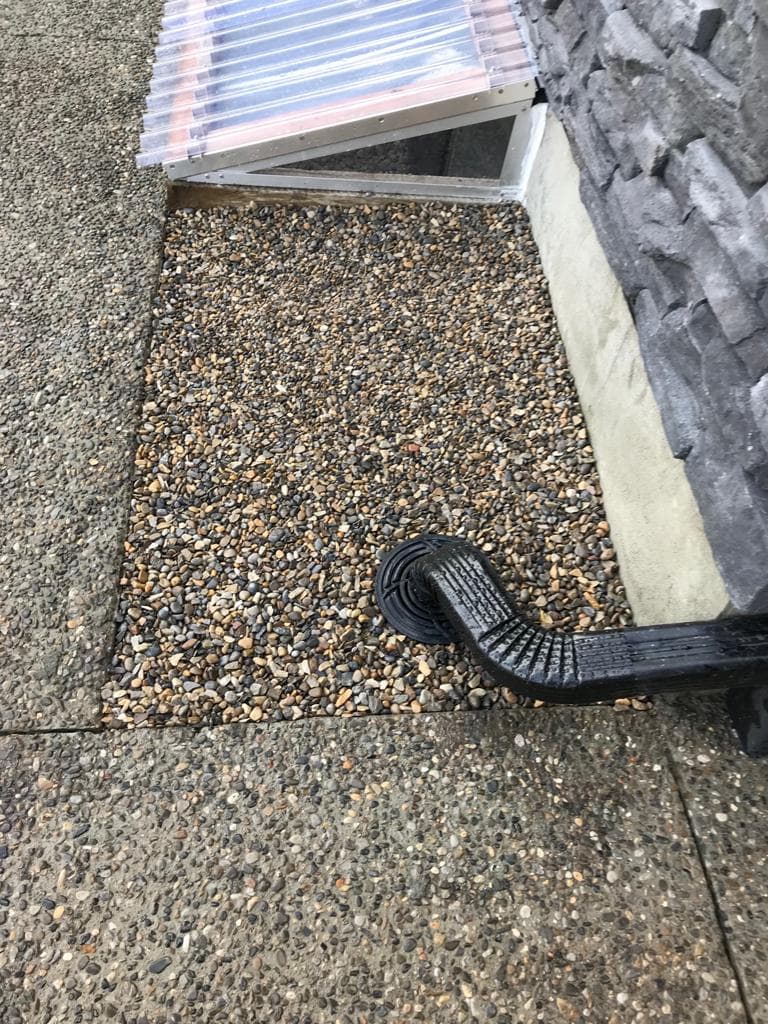
The trades that do this work
Landscape and drainage contractors. Virginia's Board for Contractors has a Landscape Service Contracting specialty covering the alteration or improvement of a land area "by means of excavation, clearing, grading," among other work.[3] A buried downspout line is trenching and grading, so this is the usual fit, and the right call when the water has to go a long way, the yard needs regrading, or the line ends in a dry well or rain garden.
Gutter companies and home improvement contractors. The Home Improvement Contracting specialty covers repairs or improvements to dwellings and townhouses, and it excludes electrical, plumbing, HVAC and gas fitting.[3] The same regulation says the HIC specialty, like the broader building classifications, also provides for landscape service work,[3] so a gutter company or general home improvement contractor holding it can take on short buried lines as part of a gutter job.
Soil and water conservation districts. These do not install anything, but they help you pick the right fix. In Fairfax County, the Northern Virginia Soil and Water Conservation District visits properties for its cost-share programs and gives each visitor a list of designers and installers.[9] Other districts run similar programs; ask yours.
The licence to look for
The Virginia Department of Professional and Occupational Regulation (DPOR) explains: "Contractor licenses consist of two parts: the class of license (A, B, or C), which determines the monetary value of contracts/projects that may be performed, and the classification/specialty, which determines what type of work is allowed."[1] Under Virginia Code § 54.1-1100, a Class C licence applies where "a single contract or project" is "over $1,000 but less than $30,000",[2] and Class B covers $30,000 or more but less than $150,000.[2] Check both parts on DPOR's License Lookup: the class should cover the price you were quoted, and the specialty should cover the work.
What a good installer will build
Ask each bidder to describe the line. The answer should match what the Building America Solution Center, run for the U.S. Department of Energy, recommends: non-perforated, smooth or corrugated plastic pipe, connected and sealed to the downspout,[8] sloped at least 0.5 inch per foot away from the home for at least 10 feet,[8] and never tied into the perforated foundation drain, which would soak the foundation.[8] The far end should come out on ground that slopes away, at a pop-up outlet, or in an underground catchment system, such as a dry well, at least 10 feet from the foundation.[8]
A bidder who wants to use perforated pipe right beside the house, or to connect roof water to the footing drain, is describing a different job.
The utility locate
Digging in Virginia starts with a locate request, and when you hire the work out it is the contractor's job. Virginia 811's homeowner FAQ says: "Your contractor is responsible for contacting Virginia 811."[6] Confirm it was done before the crew digs.
The locate does not find everything. Virginia 811 lists private lines it will not mark, including lines to a detached garage or shed, invisible pet fences, and septic and propane lines,[7] and it notes that the water line from the meter to the house is private and will not be marked.[7] Show the crew where yours run.
The contract and your rights
For residential work, Board for Contractors rules require a legible written contract, signed by both sides before work starts or payment is taken.[4] It must state when work is to begin and the estimated completion date, the total cost, the amounts and schedule of progress payments including the down payment, and a listing of specified materials and work.[4] For a buried downspout line, that listing should name the pipe, the outlets and the lawn repair.
If a salesperson sold you the job at your home, Virginia's Home Solicitation Sales Act generally lets the buyer cancel until midnight of the third business day after the day on which the buyer signs.[5] Cancel in writing.
Stop and call a pro if
These are signs the job is bigger than a downspout line, and you need someone who handles that problem:
- Water is coming into the basement or the foundation is cracking. The Fairfax district warns that "Wet basements and wall or foundation cracking can have serious consequences"[10] and should be handled right away.
- The yard stays wet for months. The district says that is commonly caused by leaks from damaged water pipes or other sources or naturally occurring high groundwater,[11] which no downspout line will fix.
- A hole or sinkhole has opened along the foundation. The district's advice: "Never enter a sinkhole that is deeper than chest height."[12]
- The house is new and the subdivision is still under bond. The district notes the builder may be responsible for fixing drainage problems caused by inadequate grading.[10]
To price the job, read how much it costs to bury downspouts in Virginia; to do the above-ground version yourself, see how to extend a downspout away from the foundation. Browse downspout and drainage businesses, drainage and French drain specialists, excavation pros around Blacksburg or the other exterior answers. When you are ready, describe the downspout job once and licensed local businesses quote it.
Common questions
- Should I call a gutter company or a landscaper to bury downspouts?
- Either can do it. A gutter company is handy when the downspouts themselves need work or moving. A landscape or drainage contractor is the better fit when the line is long, the yard needs regrading, or the water has to go to a dry well or rain garden. Ask each one how many buried lines it has done and what outlet it uses.
- Does a downspout drain installer need a licence in Virginia?
- For a job over $1,000, the business needs a Virginia contractor licence. A Class C licence covers a single contract over $1,000 and under $30,000, and DPOR licences also carry a specialty that sets what kind of work is allowed. Look the business up on DPOR's License Lookup before you sign.
- Who is supposed to call 811, me or the contractor?
- The contractor. Virginia 811's homeowner FAQ says your contractor is responsible for contacting Virginia 811, and that you should confirm it has done so before digging starts. Tell the crew about private lines too, such as an invisible pet fence or a feed to a shed, because Virginia 811 does not mark those.
- Can the installer connect my downspouts to the footing drain?
- It should not. The Building America Solution Center, run for the U.S. Department of Energy, says not to connect the gutter drain pipe to the perforated foundation drain, because that soaks the foundation. Roof water belongs in its own solid pipe to an outlet away from the house.
- Can I cancel if I signed with a door-to-door salesperson?
- Virginia's Home Solicitation Sales Act gives a buyer in a home solicitation sale the right to cancel until midnight of the third business day after signing, by written notice to the seller. It does not apply in every case, such as some emergency requests, so read the notice of cancellation in your contract.
Sources
- [1] Board for Contractors, Virginia Department of Professional and Occupational Regulation. Checked October 26, 2026.
- [2] Va. Code § 54.1-1100, Definitions (Contractors), Code of Virginia, Virginia General Assembly. Checked October 26, 2026.
- [3] 18VAC50-22-30, Definitions of specialty services (Board for Contractors Regulations), Virginia Administrative Code, Virginia General Assembly. Checked October 26, 2026.
- [4] 18VAC50-22-260, Filing of charges; prohibited acts (Board for Contractors Regulations), Virginia Administrative Code, Virginia General Assembly. Checked October 26, 2026.
- [5] Va. Code § 59.1-21.3, Cancellation of sale (Virginia Home Solicitation Sales Act), Code of Virginia, Virginia General Assembly. Checked October 26, 2026.
- [6] Homeowners FAQ, Virginia 811. Checked October 26, 2026.
- [7] Private Utilities Explained, Virginia 811. Checked October 26, 2026.
- [8] Gutters and Downspouts, Building America Solution Center, Pacific Northwest National Laboratory, U.S. Department of Energy. Checked October 26, 2026.
- [9] Conservation Assistance Programs, Northern Virginia Soil and Water Conservation District, Fairfax County. Checked October 26, 2026.
- [10] Solving Drainage and Erosion Problems: A Guide for Homeowners, Northern Virginia Soil and Water Conservation District, Fairfax County. Checked October 26, 2026.
- [11] Wet Yard, Solving Drainage Problems, Northern Virginia Soil and Water Conservation District, Fairfax County. Checked October 26, 2026.
- [12] Sinkhole, Solving Drainage and Erosion Problems, Northern Virginia Soil and Water Conservation District, Fairfax County. Checked October 26, 2026.
Want a pro to handle it?
Describe the job once. Licensed local businesses send quotes, and you pay only when you book one.
Get a quote for Roofing