How do I keep a finished basement dry?
Keep water away from the foundation, give any water that gets in a way out, and control humidity. That means clean gutters, downspouts that discharge away from the house, soil sloping away from the walls, a working sump pump with a battery backup, and a dehumidifier. Seepage, a failing pump or regrading near the foundation are jobs for a licensed pro.
Free to ask. Local shops send quotes, and you pay only when you book one.
By Kasra Taheri, Founder, LoclisPublished
Researched and drafted with AI, then checked claim by claim against the sources listed below before it was published. Prices and rules change; the dates beside each source say when it was last checked.
This is a job for a licensed pro in Virginia
This page explains what the work involves, the permits, what a licensed pro does and what drives the cost. It does not give step-by-step instructions, because this work needs a licence, a permit or both, and doing it wrong can injure someone. Before you hire, check the licence on Virginia's DPOR record.
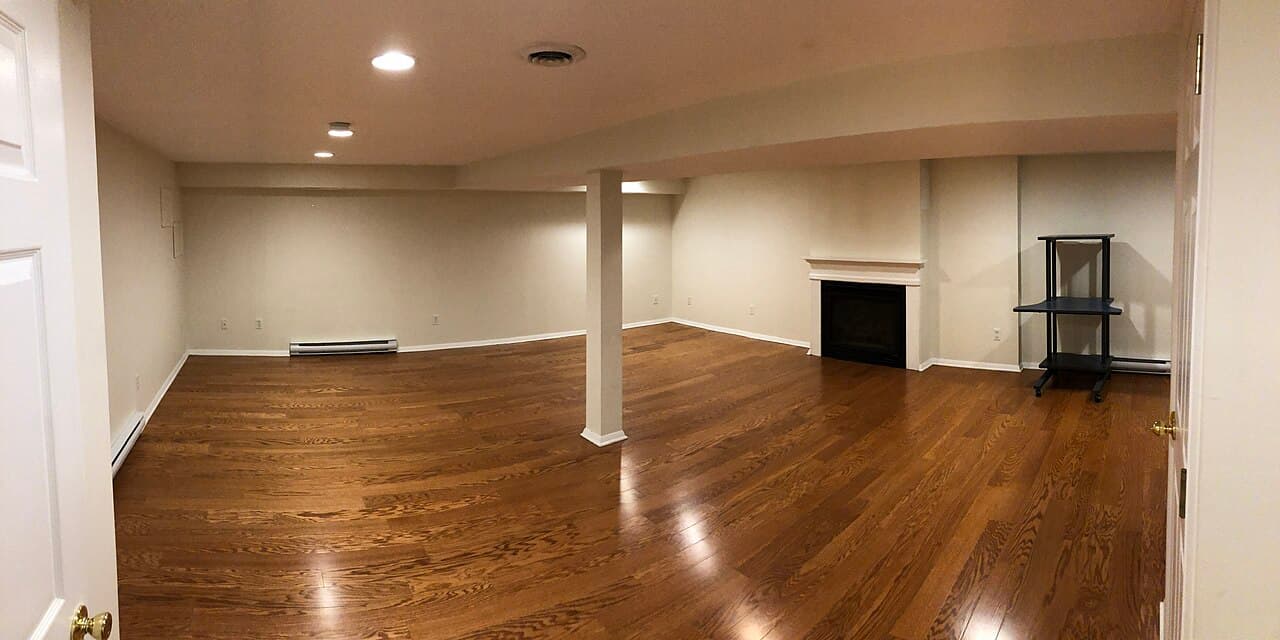
A finished basement stays dry when water is kept out of the foundation, any water that does get in has a way to leave, and humid air is controlled. Finishes can't do that job: drywall, carpet and trim only hide a wet basement, and they give mold something to grow on. Most of the work is outside the house, and most of it is routine upkeep.
Start outside: roof water and grading
Roof runoff is the biggest source of water at the foundation. The Northern Virginia Soil and Water Conservation District says that when it rains hard, an average sized home can experience hundreds of gallons of runoff coming from the roof. If downspouts and sump pumps are not set up correctly, it can cause foundation problems, erosion or wet spots in the yard.[1]
The same district gives these targets:
- Land around your house should slope away from foundation walls.[1] Ideally, a 5% grade should be maintained for a distance of ten feet around your home.[1]
- Gutters should be cleaned free of debris at least once a year.[1] Trees close to the house call for more often.
- Downspout or sump pump extensions (non-perforated corrugated plastic pipes) can be attached to the downspouts to direct flow further from the house.[1]
Soil settles against a foundation over the years, so the slope that was right when the house was built may not be right now. Regrading is excavation work, and a contractor should locate underground utilities first. Treat any new gap or low spot along the wall as a signal to look further.
Inside: the sump pump and the drain system
If your basement has a sump pit, the pump is the last line of defence, so it earns regular attention. Wayne's manual says: The pump should be inspected 3-4 times per year for pump movement or buildup of debris on the switch or float.[2] It also warns: In damp areas, GFCI breakers may trip, effectively shutting off the sump pump.[2] A pump that stops because its outlet tripped is a common failure. The manufacturer's test is simple: Pour a bucket of water into the pit to make sure the pump starts automatically.[2]
Power loss is when pumps matter most, because storms cause both. Ready.gov's flood checklist says to declutter drains and gutters, and to consider a sump pump with a battery.[3] A plumber or drainage contractor can size a battery backup to your pit and check the discharge line. Replacing a pump, adding a pit or running a discharge line is work for a licensed contractor, not a weekend project.
Control humidity all year
Even a dry foundation lets humid air in during Virginia summers. EPA's moisture guide says to keep indoor humidity below 60 percent (ideally between 30 and 50 percent) relative humidity, and to use air conditioners and/or de-humidifiers when needed.[4]
Plan for the dehumidifier when you design the room. ENERGY STAR notes that some portable models come with a fitting that allows you to hook a hose directly to the bucket, which can then be directed into a floor drain or sump pump.[5] If the space has temperatures that typically fall below 65 degrees (F), you may want to consider buying a product that is specified for use at lower temperatures.[5] A whole-home unit is a job for an HVAC contractor, and is best specified in the finishing plan so the drain and ductwork are in place before the walls close.
Check the basics before you finish
Moisture and gas problems are easier to deal with before the walls are covered. The Virginia Department of Health says: The lowest livable level of the structure should always be tested because that is where the highest radon levels in the structure are typically found.[6] On the result, the EPA says The EPA recommends homes be fixed if the radon level is 4 pCi/L (picocuries per liter) or more.[7]
Our guide on what finishing a basement involves explains the order of the work, and what it costs covers how moisture and radon fixes affect a bid. Because a finish usually needs permits, see whether you need a permit to finish a basement.
Habits that keep it dry
- Look at the pit, the floor along the walls and the lower drywall edge after every major storm.
- Watch for a smell. If the room starts to smell musty, see why a basement smells musty.
- Keep a humidity meter in the room and note any reading that stays above the range above.
- Keep flood insurance in mind. Ready.gov's flood page is blunt: Homeowner’s insurance policies do not cover flooding.[3] It typically takes up to 30 days for a policy to go into effect.[3]
When to call a licensed pro
Call one for seepage through walls or the floor slab, a pump that cycles constantly or fails, regrading near the foundation, a new sump pit or interior drain, exterior waterproofing, a whole-home dehumidifier, or any wiring for new outlets or a pump circuit. These are drainage, plumbing, electrical and HVAC jobs, and in Virginia each has its own licensing rules.
Class C covers single jobs over $1,000 but under $30,000, Class B covers $30,000 up to but not including $150,000, and Class A covers $150,000 or more.[8] The Board for Contractors requires a master tradesman licence as a condition of licensing electrical, plumbing, and heating, ventilation and air conditioning contractors.[8] DPOR recommends getting at least three written bids on identical plans and specifications, so you can compare both the prices and the contractors.[9] See more remodeling answers or browse remodeling services.
To have a pro assess your basement's drainage, describe the job once and local contractors will quote it.
Common questions
- What is the most important thing to do?
- Manage roof water. Clean gutters, extend downspouts away from the house and keep the soil sloping away from the foundation.
- How often should I check the sump pump?
- Wayne's manual says the pump should be inspected 3-4 times per year for pump movement or buildup of debris on the switch or float.
- Do I need a battery backup?
- Ready.gov says to consider a sump pump with a battery, since storms often cut power when the pump is needed most.
- Does homeowner's insurance cover a flooded basement?
- Ready.gov says homeowner’s insurance policies do not cover flooding, and a flood policy typically takes up to 30 days to take effect.
- What humidity should I aim for?
- EPA suggests keeping indoor humidity below 60 percent, ideally between 30 and 50 percent relative humidity.
Sources
- [1] Gutters and Downspouts: Wetness or Erosion Problems, Northern Virginia Soil and Water Conservation District, Fairfax County. Checked October 28, 2026.
- [2] Submersible Sump Pumps: Operating Instructions and Parts Manual (600002W-001 J, 06/25), Wayne Water Systems. Checked October 28, 2026.
- [3] Floods, Ready.gov, Federal Emergency Management Agency. Checked October 28, 2026.
- [4] A Brief Guide to Mold, Moisture and Your Home, U.S. Environmental Protection Agency. Checked October 28, 2026.
- [5] Dehumidifiers, ENERGY STAR, U.S. Environmental Protection Agency. Checked October 28, 2026.
- [6] Radon Testing and Mitigation, Virginia Department of Health. Checked October 28, 2026.
- [7] What is EPA's Action Level for Radon and What Does it Mean?, U.S. Environmental Protection Agency. Checked October 28, 2026.
- [8] Code of Virginia § 54.1-1100, Definitions (contractors), Virginia General Assembly, Legislative Information System. Checked October 28, 2026.
- [9] What You Should Know Before You Hire a Contractor, Virginia Board for Contractors, DPOR. Checked October 28, 2026.
Want a pro to handle it?
Describe the job once. Licensed local businesses send quotes, and you pay only when you book one.
Get a quote from a local pro