How do I restore faded outdoor furniture?
Wash off the mildew and dirt first, because that often is most of the dullness. On wood, scrub with a dilute household bleach and detergent solution (never with ammonia), rinse, let it dry, sand lightly, then stain. Cleaning does not add colour, so a pigmented stain is what brings back the colour. Paint on weathered wood tends to peel.
Free to ask. Local shops send quotes, and you pay only when you book one.
By Kasra Taheri, Founder, LoclisPublished
Researched and drafted with AI, then checked claim by claim against the sources listed below before it was published. Prices and rules change; the dates beside each source say when it was last checked.
Step by step
Read when to stop and call a pro, further down this page, before you start.
Step 1: Work out what the furniture is made of
Wood, metal, plastic resin and wicker each fade differently. This guide covers wood; for other materials check the manufacturer's care instructions before using bleach or abrasives.
Step 2: Test whether the dark patches are mildew
Put a drop or two of liquid household bleach on a discoloured spot; if the dark colour bleaches out in a few seconds it is mildew, and if not it is probably dirt, extractives bleed or iron stain.[1]
Step 3: Mix a mild cleaning solution
Use one part household bleach to five parts water with a little powdered detergent, or an oxygen-bleach cleaner, and never mix bleach with ammonia.[1]
Step 4: Scrub and rinse
Wearing gloves and eye protection, scrub gently with a bristle brush or sponge, then rinse thoroughly with a garden hose.[1]
Step 5: Let the wood dry fully
Leave the furniture in a shaded, airy spot until the wood is completely dry before sanding or finishing.
Step 6: Sand off the loose grey surface
Sand with the grain until the furniture feels smooth and shows fresh wood, because loosely attached fibres cannot hold paint.[1]
Step 7: Check old paint before sanding it
If the furniture is old and painted, do not sand or scrape it dry until you know whether the paint contains lead.[2]
Step 8: Apply a pigmented penetrating finish
Brush on an exterior penetrating stain or water-repellent finish in the colour you want, wipe off any excess, and let it cure as the label directs.[1]
Wash first, then refinish. Much of what looks like fading on outdoor wood is mildew and dirt, and a scrub with a mild bleach solution often brings the surface back. What cleaning cannot do is put colour back: the Forest Products Laboratory is blunt that cleaning wood does not add color,[1] and that if you want to restore color, stain the wood.[1] So the job is clean, dry, smooth, then stain.
Why outdoor wood fades
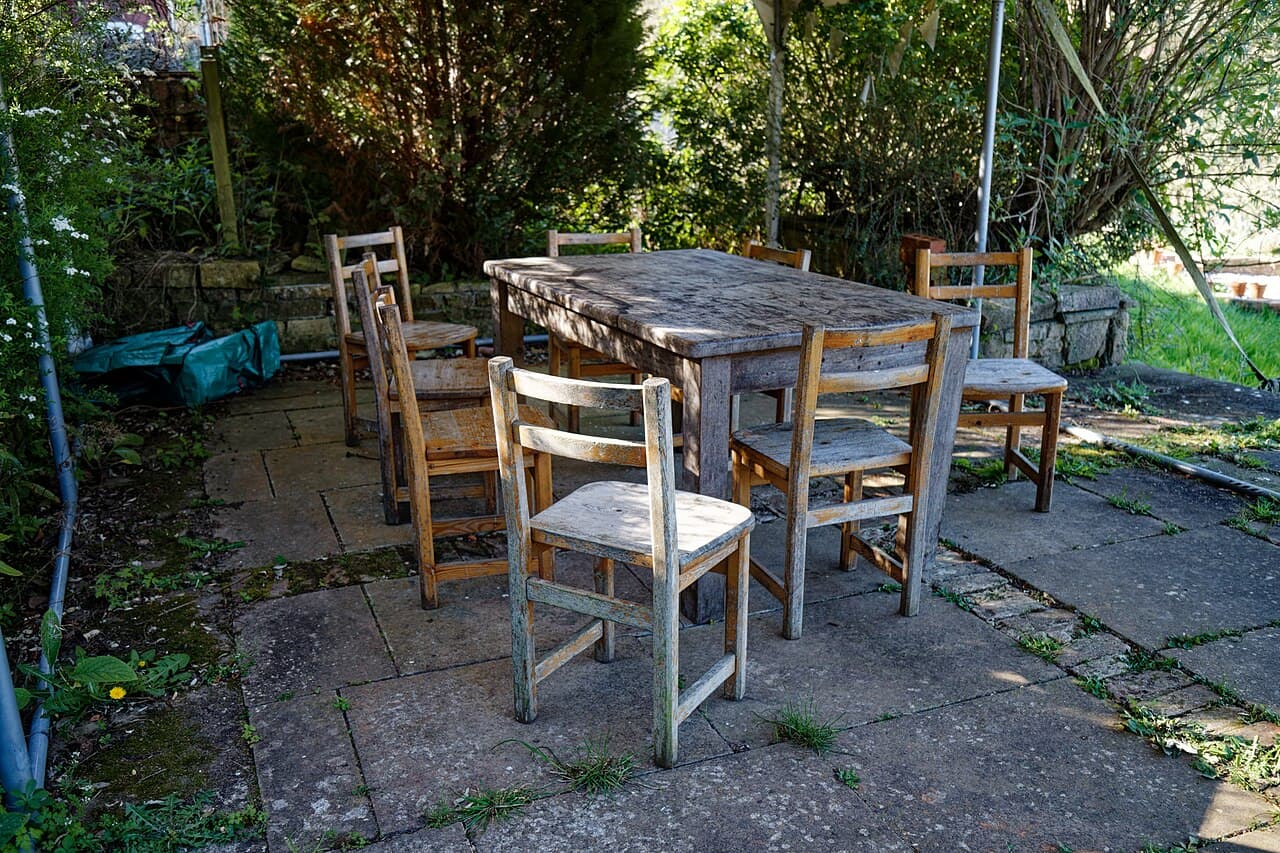
Weathered wood has a silvery gray appearance because weathering removes colored components from the surface.[1] Sun, damp and mildew do the damage together, which is why the same chair can be grey on the sunny arm and black under the seat.
Step 1: clean off the mildew
Start by finding out what the dark patches are. To test for mildew, apply a drop or two of liquid household bleach (5% sodium hypochlorite) to the discolored area; the dark color of mildew will usually bleach out in a few seconds.[1] If the stain stays, it is probably dirt, extractives bleed or an iron stain.
For mildew, the guidance is a dilute household bleach solution with a little detergent. One part household bleach to five parts water should be adequate.[1] Use powdered detergent: do not use liquid detergent because it may contain ingredients that react with bleach to give toxic fumes.[1] The warning that matters most is this one: do not mix bleach with ammonia or with any detergents or cleansers that contain ammonia.[1]
Oxygen bleaches are likely to do less damage to the wood than chlorine-based bleaches,[1] so an oxygen-bleach deck and furniture cleaner is a reasonable alternative. Wear gloves and eye protection, scrub gently with a bristle brush and rinse thoroughly with a garden hose. If you use a pressure washer, keep the pressure low to avoid damaging the wood.[1]
A brightener containing oxalic acid is the wrong tool for black patches: oxalic acid removes extractives bleed and iron stains, but it is not effective for removing mildew.[1]
Step 2: dry and sand
Let the furniture dry completely in a shaded, airy spot. Then sand with the grain. Badly weathered wood having loosely attached fibers on the surface cannot hold paint,[1] so the aim is to get down to firm, fresh-looking wood. On oily woods such as teak, water may bead on the surface; this is expected for oily woods, such as teak,[1] and a few passes with sandpaper is often sufficient to remove the surface contaminant causing the problem.[1]
Work outdoors or with the dust collected, and wear a dust mask. If the piece is painted and old, stop before you sand. The federal ban on lead-containing paint covers furniture articles for consumer use that bear lead-containing paint, but only on products manufactured after February 27, 1978,[3] so an older chair may have lead in its paint. EPA warns that projects that create even a small amount of dust can pose health risks to your family.[2] Chemical strippers need care too: dust caused by mechanical stripping methods and fumes given off by chemical strippers can be toxic.[1]
Step 3: put colour and protection back
Choose a pigmented exterior stain in the shade you like. A penetrating finish lasts longer on sunburned wood than on fresh wood,[1] while any film-forming finish such as paint is prone to peeling on wood that has weathered in the sun. Refinish the cleaned surface as soon as it has dried using a finish containing a mildewcide.[1]
Brush it on in thin coats along the grain, wipe off puddles, and follow the label for drying time before the furniture goes back in use.
Stop and call a pro if
- The wood is soft, crumbly or spongy. That is rot, not fading, and sanding and stain will not fix a weak joint or leg.
- The piece is an antique or has sentimental value. A furniture restorer can clean and refinish without sanding away character.
- Old paint may contain lead. Do not dry-sand or scrape a painted piece made before 1978 until you know what is in it.
- The furniture is metal with flaking rust, or woven resin that is cracking. Those need different repairs and often a shop.
Getting help in Virginia
If it is cheaper to hire it out, see what outdoor furniture repair costs in Virginia and whether patio furniture is worth repairing. Browse outdoor furniture repair requests or read more furniture repair answers.
When you are ready, describe the piece once and local repairers can quote it.
Common questions
- Will bleach bring the colour back to grey wood?
- It removes mildew, which reveals the wood's own colour, but it does not add any. The Forest Products Laboratory says weathered wood looks silvery gray because weathering removes coloured components from the surface, and that if you want to restore colour, you stain the wood.
- Can I use a pressure washer on outdoor wood furniture?
- Only gently. The Forest Products Laboratory says that if using a power-washer you should keep the pressure low to avoid damaging the wood. A garden hose and a brush are safer for furniture.
- Should I paint or stain faded wood furniture?
- On bare, weathered wood a penetrating stain is the safer choice. The Forest Products Laboratory says any film-forming finish, paint included, will be prone to peeling on sunburned wood, while a penetrating finish lasts longer on it.
- Is it safe to mix bleach with another cleaner to get the mildew off?
- No. Never mix bleach with ammonia or with any cleaner that contains ammonia, and do not use liquid detergent with it. Use powdered detergent, or switch to an oxygen-bleach cleaner.
- What about teak and other oily woods?
- Oily woods such as teak can repel finishes. If water beads on the surface, a few passes with sandpaper is often enough to remove the contaminant causing the problem.
- Does oxalic acid cleaner remove mildew?
- No. Oxalic acid removes extractives bleed and iron stains, but it is not effective for removing mildew, so use it for rust-coloured marks and a mildew cleaner for black or green patches.
Sources
- [1] Chapter 16: Finishing Wood, Wood Handbook (FPL-GTR-282), USDA Forest Service, Forest Products Laboratory. Checked October 27, 2026.
- [2] Protect Your Family from Sources of Lead, U.S. Environmental Protection Agency. Checked October 27, 2026.
- [3] 16 CFR Part 1303, Ban of lead-containing paint and certain consumer products bearing lead-containing paint, Consumer Product Safety Commission, Electronic Code of Federal Regulations. Checked October 27, 2026.
Want a pro to handle it?
Describe the job once. Licensed local businesses send quotes, and you pay only when you book one.
Get a quote for Furniture