Is it worth repairing patio furniture?
Usually yes when the frame is sound and the problem is a worn finish, mildew or a loose joint, because cleaning and refinishing cost little next to new furniture. It is usually not worth it for rotted wood, a cracked or rusted-through frame, or a cheap set. Compare a written repair quote with the price of a comparable replacement.
Free to ask. Local shops send quotes, and you pay only when you book one.
By Kasra Taheri, Founder, LoclisPublished
Researched and drafted with AI, then checked claim by claim against the sources listed below before it was published. Prices and rules change; the dates beside each source say when it was last checked.
Step by step
Read when to stop and call a pro, further down this page, before you start.
Step 1: Check that the frame is sound
Sit on each chair and push on each joint. Wobble that tightens with a new screw is minor; a frame that flexes or a leg that gives is not.
Step 2: Test dark patches for mildew
Put a drop or two of liquid household bleach on a discoloured spot; if the dark colour bleaches out in a few seconds it is mildew, which is a cleaning job and not damage.[1]
Step 3: Probe for rot
Press a screwdriver tip into dark, soft or damp-looking wood, especially at leg bottoms and joints, where decayed wood will feel soft and crumble.
Step 4: Look at the finish
A grey, faded or flaking surface on sound wood is a refinishing job, not a reason to replace the piece.[1]
Step 5: Check old paint
If the piece is old and painted, do not sand it dry until you know whether the paint contains lead.[2]
Step 6: Price a comparable replacement
Look up what similar new furniture would cost, and add delivery and your time assembling it.
Step 7: Get a written repair quote
Ask a repairer for an itemised quote covering the repair, finishing and any pickup, and compare it with the replacement price.
Step 8: Decide on the whole picture
Weigh the quote, the quality of the original, its sentimental value and how long a repaired piece is likely to last outdoors.
It is usually worth repairing patio furniture when the frame is sound and the trouble is on the surface: a faded finish, mildew, a loose screw or joint. It is usually not worth it when the frame is rotted, cracked or rusted through, or when the set was inexpensive to begin with. The way to settle it is to find out which kind of damage you have, then compare a written repair quote with the price of a comparable replacement.
Repair: the cases that usually pay off
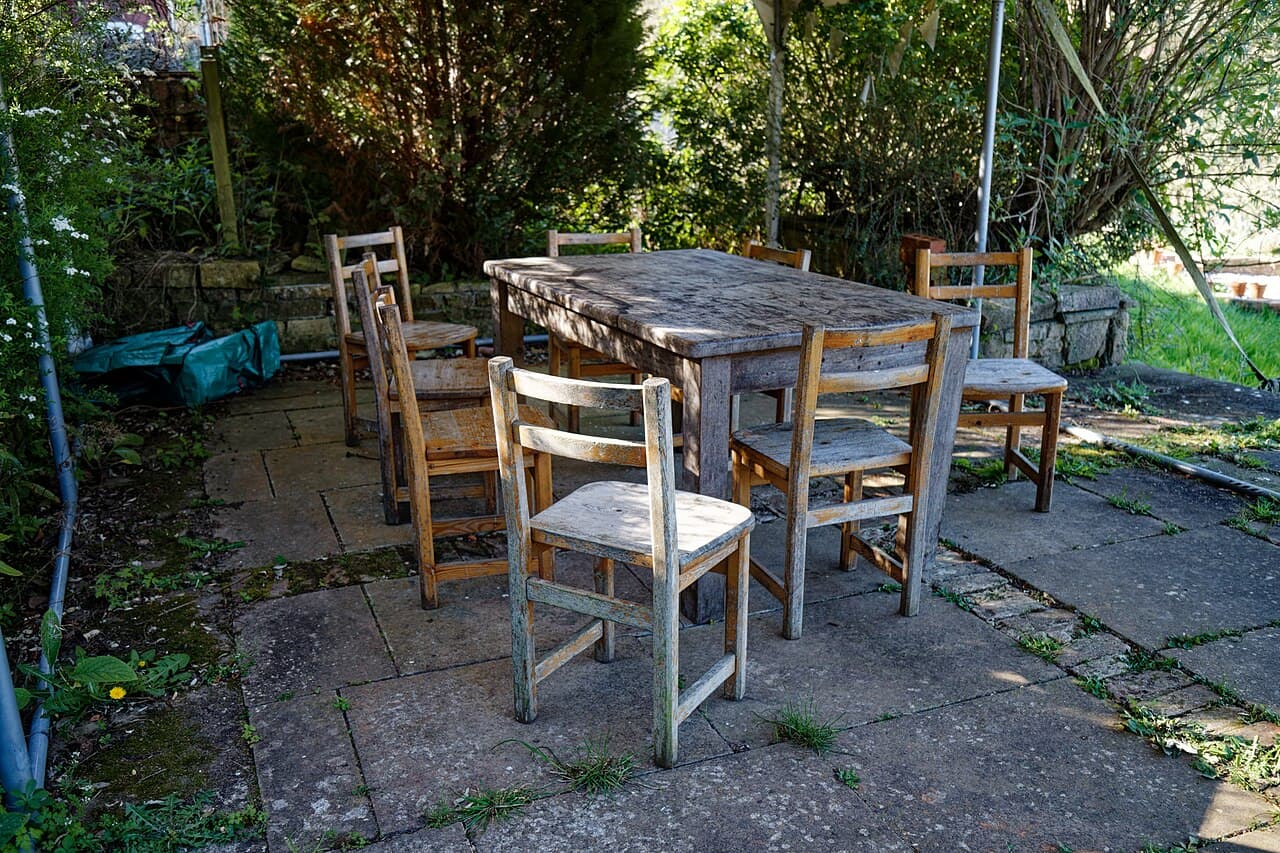
Faded, grey or dirty wood. This looks worse than it is. Weathered wood has a silvery gray appearance because weathering removes colored components from the surface,[1] and cleaning plus a new finish fixes it. If you want to restore color, stain the wood.[1] Our guide on how to restore faded outdoor furniture covers the method.
Dark patches. Mildew does not decay wood directly,[1] so black or green spots on the surface are not a sign the piece is finished. To test, apply a drop or two of liquid household bleach (5% sodium hypochlorite) to the discolored area; the dark color of mildew will usually bleach out in a few seconds.[1]
Loose joints and fasteners. Tightening a screw or re-gluing a joint is the cheapest repair there is, and worth doing before anything else.
Good furniture that is worth keeping. A solid, well-built frame is worth keeping, because the surface is the part that wears out first and the finish is the cheaper part to renew.
Replace: the cases that usually do not
Rot. Decayed wood does not hold paint,[1] so rotted parts have to be cut out and rebuilt, not refinished. Wood that is soft or crumbly, especially at leg bottoms and joints, is a warning. One small patch may be repairable; widespread softness is not worth the labour.
A cracked or rusted-through frame. If a chair frame has failed at a weld or joint, the repair is skilled work, and you are trusting it with a person's weight.
Cheap sets. If a repairer's quote approaches the cost of a new set of similar quality, replacement is the better buy, unless the piece has value to you beyond price.
How to decide with a quote
Ask a repairer for a written, itemised quote: the repair, any refinishing, materials, and pickup and delivery or a house call. Compare it with a comparable new set, including delivery and your own time to assemble it. Then weigh the original quality and how much you like the piece.
Check the paperwork when the job is done. Virginia's Consumer Protection Act lists, among prohibited practices, misrepresenting that repairs, alterations, modifications, or services have been performed or parts installed.[4] A written quote and an invoice that lists what was done protect you.
If the repair needs a price, see what outdoor furniture repair costs in Virginia.
Old painted pieces
An older painted piece needs a pause before anyone sands it. The federal ban covers furniture articles for consumer use that bear lead-containing paint, but only on products manufactured after February 27, 1978,[3] so an earlier piece may have lead in its paint. EPA says projects that create even a small amount of dust can pose health risks to your family.[2] Ask a pro how they will handle it.
Stop and call a pro if
- The frame is cracked, split or soft. A chair or bench has to carry a person, and a weak repair can fail under them.
- The piece is an antique or an heirloom. Have a restorer assess it before anything is sanded, stripped or glued.
- You would have to strip old paint on a piece made before 1978. Ask how the lead question will be handled first.
- A metal frame needs welding. That is a job for a welder, not a refinishing kit.
Getting help in Virginia
Browse outdoor furniture repair requests or read more furniture repair answers.
When you are ready, describe the repair once and local furniture repairers can quote it.
Common questions
- Is it cheaper to repair or replace patio furniture?
- It depends on the damage and the original quality. Cleaning and refinishing sound furniture usually costs a fraction of new, but a quote for structural repair on a cheap set can approach the price of a replacement. Compare a written quote with a comparable new set.
- Is mildew on wood furniture a reason to throw it out?
- No. Mildew does not decay wood directly, so dark surface patches are usually a cleaning job. A drop of bleach that lightens the spot in seconds confirms it is mildew.
- Does faded wood need replacing?
- No. Weathered wood looks silvery gray because weathering removes coloured components from the surface, and the fix is to clean it and stain it, not replace it.
- What if the wood is soft or crumbling?
- That is likely rot. A repairer may be able to replace a small part, but widespread soft wood in the frame usually means the piece is at the end of its life.
- Is it worth restoring an antique or heirloom outdoor piece?
- Often yes, because the value is more than the replacement price. Have a furniture restorer assess it first, and do not sand or strip old paint yourself until the lead question is answered.
Sources
- [1] Chapter 16: Finishing Wood, Wood Handbook (FPL-GTR-282), USDA Forest Service, Forest Products Laboratory. Checked October 27, 2026.
- [2] Protect Your Family from Sources of Lead, U.S. Environmental Protection Agency. Checked October 27, 2026.
- [3] 16 CFR Part 1303, Ban of lead-containing paint and certain consumer products bearing lead-containing paint, Consumer Product Safety Commission, Electronic Code of Federal Regulations. Checked October 27, 2026.
- [4] Va. Code § 59.1-200, Prohibited practices (Virginia Consumer Protection Act), Code of Virginia, Virginia General Assembly. Checked October 27, 2026.
Want a pro to handle it?
Describe the job once. Licensed local businesses send quotes, and you pay only when you book one.
Get a quote for Furniture