How do I store a snow blower for the summer?
Clean and dry the snow blower, then deal with the fuel: fill with fresh gasoline and add stabilizer, run the engine 10 minutes, or drain the tank and carburetor, which Honda calls for beyond 3 months. Change the oil, put a little oil in the cylinder, leave the plug wire off and store it away from heaters.
Free to ask. Local shops send quotes, and you pay only when you book one.
By Kasra Taheri, Founder, LoclisPublished
Researched and drafted with AI, then checked claim by claim against the sources listed below before it was published. Prices and rules change; the dates beside each source say when it was last checked.
Step by step
Read when to stop and call a pro, further down this page, before you start.
Step 1: Clean and dry it
Rinse the auger housing and wheels or tracks, wipe down the rest, and let it dry; touch up damaged paint.[1]
Step 2: Lubricate it
Lubricate the points your manual shows before storage.[1]
Step 3: Choose a fuel method
Fill the tank with fresh gasoline and add fuel stabilizer, or plan to drain the tank and carburetor.[1]
Step 4: Run the treated fuel through
After adding stabilizer, run the engine outdoors for 10 minutes so treated fuel replaces untreated fuel in the carburetor.[1]
Step 5: Drain if storing a long time
For storage over 3 months, drain the fuel tank and carburetor into an approved container.[1]
Step 6: Change the oil
Change the engine oil while the engine is still warm.[2]
Step 7: Protect the cylinder
Remove the spark plug, squirt two teaspoons of oil into the hole, refit the plug by hand and leave the wire off.[2]
Step 8: Turn the engine over
Pull the recoil starter slowly to spread the oil inside the cylinder.[2]
Step 9: Fix what wore out
Tighten loose fasteners and note any worn or damaged parts to repair or replace.[2]
Step 10: Cover and store it
Let the engine cool, then cover it and keep it in a clean, dry place away from heaters and other ignition sources.[2]
The short version
Put the snow blower away clean, with its fuel dealt with and the spark plug wire off. Fuel is the part that matters most. Honda's manual says "Gasoline will oxidize and deteriorate in storage. Old gasoline will cause hard starting, and it leaves gum deposits that clog the fuel system."[1] Whatever else you do, either treat the fuel or empty it. The details below follow Honda's and Toro's manuals, which differ in places, so check your own.
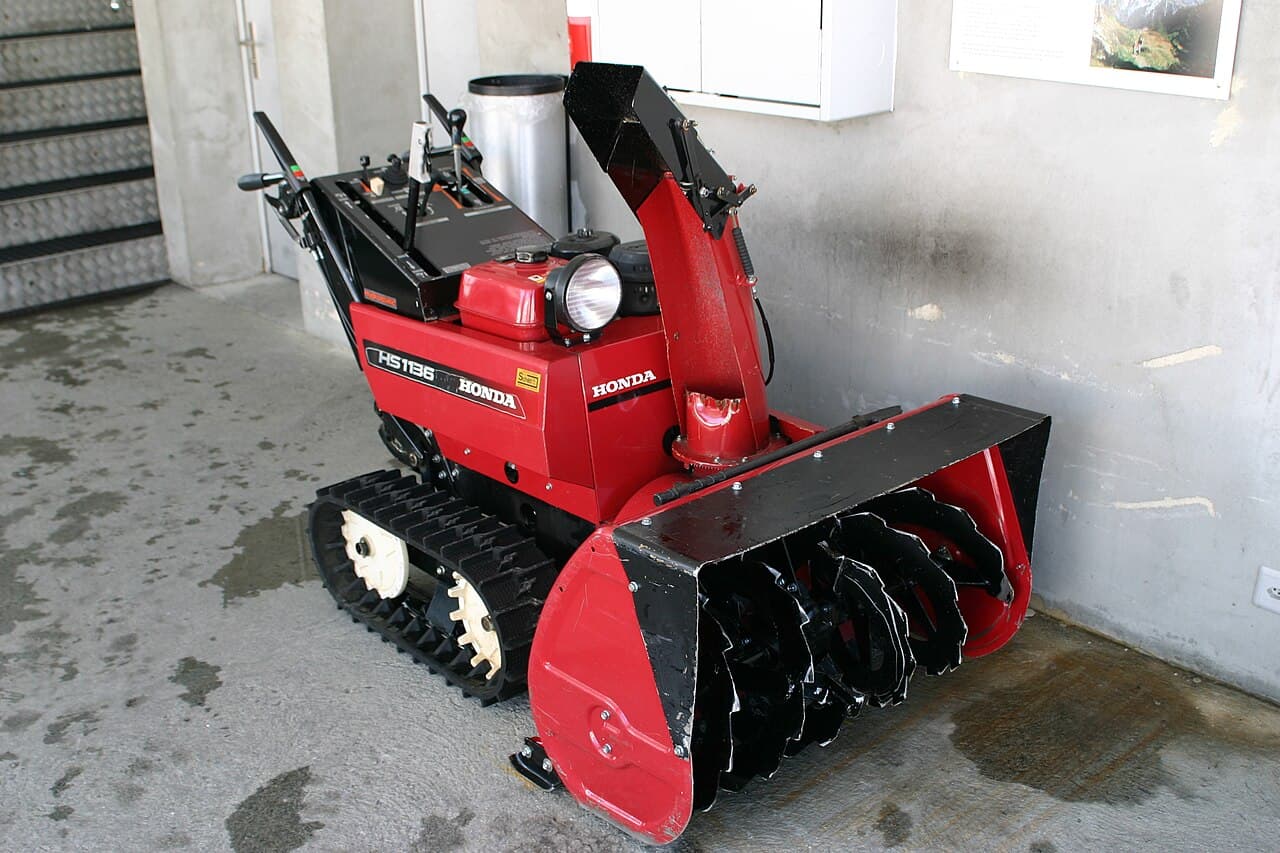
Why fuel is the whole job
Honda says "Fuel deterioration and oxidation can occur in as little as 30 days."[1] Briggs & Stratton agrees: "Gas begins to degrade in as little as 30 days which can lead to your engine's fuel system clogging and your equipment not starting the following season."[3] A snow blower sits from spring to the first snow, far longer than that. Penn State Extension's advice is to "Add fuel stabilizer if the equipment will be idle for more than a few weeks, and avoid keeping stored fuel for long periods of time."[4]
If it already runs badly, see why a snow blower runs rough or surges.
Two ways to handle the fuel
Honda gives you a choice: "You can extend fuel storage life by adding a fuel stabilizer that is formulated for that purpose, or you can avoid fuel deterioration problems by draining the fuel tank and carburetor."[1]
Stabilizer. Fill the tank with fresh gasoline first, because "The air in a partially filled fuel tank promotes fuel deterioration."[1] Briggs & Stratton also says "Keeping the tank full will minimize accumulation of moisture that causes carburetor-clogging rust."[3] Add stabilizer as the label directs. Then "run the engine outdoors for 10 minutes to be sure that treated gasoline has replaced the untreated gasoline in the carburetor."[1]
Draining. Honda's table calls for draining the tank and carburetor when storage will exceed 3 months.[1] Do it outdoors into an approved gasoline container. Keep fuel off the machine's rubber: "Tires and tracks will be damaged if they come in contact with gasoline."[1]
Toro takes a stricter line. Its manual says "When storing the snowthrower for more than 30 days, drain the fuel from the fuel tank,"[2] and "Do not store stabilized gasoline for more than 90 days."[2] It also warns "Do not use fuel stabilizers with an alcohol base such as ethanol, methanol, or isopropanol."[2] If you own a Toro, follow its routine: add stabilizer, run the engine for ten minutes, then run it until it stops.
Clean, lubricate and protect the engine
Rinse first: Honda says to "Rinse the auger housing and wheels (or tracks) with a garden hose,"[1] then wipe the rest, let it dry and touch up paint. Lubricate the points your manual lists. Check the shear pins while it is clean, and if you find a broken one see how to replace snow blower shear pins.
For the engine, Toro says to change the oil while warm, then "Use an oil can to squirt two teaspoons of oil into the spark plug hole."[2] Refit the plug by hand. Toro's instruction is "Do not connect the wire to the plug."[2] Then "Pull the recoil starter slowly to distribute the oil on the inside of the cylinder."[2]
Where to keep it
Toro warns: "Do not store the snowthrower in a house (living area), basement, or any other area where ignition sources may be present, such as hot water and space heaters, clothes dryers, furnaces, and other like appliances."[2] A shed or the far side of a garage fits better. "Allow the engine to cool before storing it in any enclosure,"[2] and cover it. The CPSC also says to store gasoline "out of the house and away from ignition sources."[5]
Stop and call a pro if
- Fuel leaks from the tank, lines or carburetor while you drain or run it.
- The carburetor drain will not open, or fuel will not stop flowing.
- The spark plug is stuck or its threads look damaged.
- The recoil starter binds or the engine will not turn over.
- The gearcase leaks oil or an auger turns stiffly. Get it serviced before the season rather than during it.
Getting help in Virginia
Browse more small engine repair answers or find small engine repair pros near you. If you would rather have a shop do the end-of-season service, describe your snow blower and ask for a written quote; what snow blower repair costs in Virginia explains the usual cost drivers.
Common questions
- Should I drain the gas or use stabilizer?
- Both are accepted by manufacturers. Honda says you can add stabilizer or drain the tank and carburetor, and to drain for storage over 3 months. Toro says to drain for storage over 30 days and not to keep stabilized gas more than 90 days. Follow your own manual.
- How long does gas last in a stored snow blower?
- Honda and Briggs & Stratton both say deterioration can begin in as little as 30 days. Stabilizer extends that, but the time varies with the blend, temperature and how full the tank is.
- Why leave the spark plug wire off?
- So the engine cannot start by accident while stored or handled. Toro says not to connect the wire to the plug after you oil the cylinder.
- Where should I not store a snow blower?
- Toro says not to store it in the living area, a basement, or anywhere with ignition sources such as water heaters, space heaters, dryers or furnaces, because gasoline fumes are flammable.
- Do I need to change the oil before storage?
- Toro's storage routine has you change the engine oil while it is still warm. Check your own manual for the interval.
Sources
- [1] Snow blower owner's manual, American Honda Motor Co., Honda Power Equipment. Checked October 28, 2026.
- [2] 622 Power Throw Snowthrower Operator's Manual (Form No. 3326-370), The Toro Company. Checked October 28, 2026.
- [3] The Importance of Fuel Stabilizer, Briggs & Stratton. Checked October 28, 2026.
- [4] Fuel Ethanol: Hero or Villain?, Penn State Extension. Checked October 28, 2026.
- [5] Snow Thrower Safety (Publication 5117), U.S. Consumer Product Safety Commission. Checked October 28, 2026.
Want a pro to handle it?
Describe the job once. Licensed local businesses send quotes, and you pay only when you book one.
Get a quote for Small Engines