How do I thaw a frozen pipe safely?
Close the main water shut-off valve, open the faucet the frozen pipe feeds, and warm the pipe slowly with towels soaked in warm water or gentle room heat, never a flame. When the pipe feels warm along its length, turn the main back on slowly: water that runs freely means it has thawed. Then check every joint for leaks.
Free to ask. Local shops send quotes, and you pay only when you book one.
By Kasra Taheri, Founder, LoclisUpdated
Researched and drafted with AI, then checked claim by claim against the sources listed below before it was published. Prices and rules change; the dates beside each source say when it was last checked.
Step by step
Read when to stop and call a pro, further down this page, before you start.
Step 1: Shut off the water
Close the main water shut-off valve before you start warming anything.[4]
Step 2: Shut off the water heater for a hot line
If the frozen pipe is a hot water line, shut off the water heater as well,[1] following its owner's manual.
Step 3: Open the faucet
Open the faucet the frozen pipe feeds and leave it open, so melted water can drain out and you can see when the line is clear.
Step 4: Find the frozen section
Trace the pipe back from the faucet, looking first where it runs through a crawl space, an unheated room, a basement, a garage or an exterior wall.[4]
Step 5: Wrap it in warm towels
Soak towels in warm water and wrap them around the frozen section,[2] swapping them for fresh warm ones as they cool.
Step 6: Or warm the air around it
Raise the room's heat or use a hair dryer with care,[1] on a low setting and moving it along the pipe.
Step 7: Work from the faucet end
Start nearest the open faucet and move back along the pipe, so melted water can drain out ahead of the ice.
Step 9: Turn the water back on slowly
When the pipe feels warm along its length, slowly turn the water back on[4] and watch the open faucet: water that runs freely means the line is clear.
Step 10: Keep going if it still trickles
If only a trickle or nothing comes out, close the main again and keep warming the pipe.
Step 11: Check for leaks
Check the pipes and joints for cracks or leaks,[4] including any stretch you could not see while you worked.
Step 12: Check the other faucets
Run the other faucets in the house to make sure no other line has frozen.
The short answer
Close the main valve, open the faucet, and warm the pipe slowly with gentle heat. Never put a flame near it. The real risk is what the ice may already have done: a pipe can crack while frozen and only start leaking once it thaws, which is why the water stays off while you work.
Before you start: shut off the water
Virginia American Water puts it plainly: "Do not attempt to thaw pipes without turning off the main water shut-off valve."[4] In many homes the main shut-off is near the water meter or close to where the water pipe enters the house.[4] Virginia Beach Public Utilities lists the places to look first: on the wall of the garage, near the water heater, in a bathroom vanity cabinet, under the kitchen sink, or in a closet near the front entrance.[3]
If only one line is frozen and it has its own valve, Fairfax County Fire and Rescue's advice is to first shut off the water valve to that pipe, and the water heater as well if it is the hot water pipe, then thaw it slowly.[1] It also advises you to know where the power shut-off for the water heater is before you need it.[1] For a gas water heater, follow the shut-off directions in its owner's manual.
The reason to close the water first: "In most cases, the actual break doesn't appear until the water begins to thaw."[1] With the valve closed, a crack that opens as the ice melts leaks only the water left in the pipe.
Find the frozen section
Start at the faucet that gives a trickle or nothing, open it, and leave it open. Then follow its pipe back toward the cold side of the house. Virginia American Water lists the places prone to freezing as crawl spaces, unheated rooms, basements, garages and exterior walls,[4] and Loudoun Water adds outdoor hose bibs and supply pipes in unheated basements, garages and kitchen cabinets.[2] On exposed pipe, the frozen part is often the stretch that feels coldest, or shows frost.
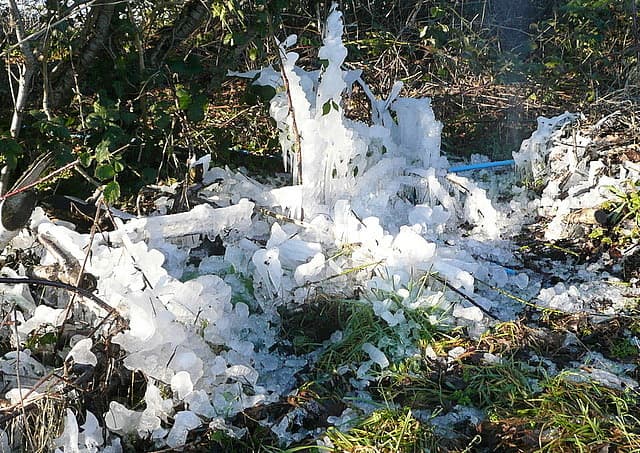
Choose gentle heat
Warm towels are the gentlest choice and need no electricity. Loudoun Water's advice: "Use warm water to soak towels, then wrap the towels around the frozen pipes."[2] Re-soak them as they cool.
Fairfax County Fire and Rescue says: "Room temperature heat and careful use of a hair dryer are good methods."[1] Virginia American Water lists a hair dryer, space heater or hot water,[4] and adds: "Do not leave space heaters unattended".[4] Not every utility agrees on electric heat. Virginia Beach Public Utilities says: "Never try to thaw frozen pipes with an open flame or any electrical appliance. It's dangerous and could damage your pipes."[3] If your utility takes that line, use towels.
If you warm the room with a space heater, follow the U.S. Fire Administration's heating safety tips: Keep anything that can burn at least 3 feet from all heat sources,[6] and turn space heaters off when you leave the room or go to bed.[6]
What never to use
No torch, no flame. Fairfax County Fire and Rescue warns that a torch thaws the water too quickly and weakens the pipe, which makes a break far more likely.[1] Virginia American Water says to avoid kerosene heaters and open flames,[4] and Loudoun Water's advice is to never thaw a pipe with an open flame.[2]
Testing whether it has thawed
With the main closed, the faucet cannot tell you much, so the test comes when you turn the water back on. Once the pipe feels warm along its length, slowly turn the water back on and check the pipes and joints for cracks or leaks.[4] Watch the open faucet. If water runs freely, the line is clear. If only a trickle or nothing comes out, close the main again and keep warming.
Be prepared for possible leaks as the pipes thaw.[3] Look along the whole pipe, including any stretch you could not see while you worked, and check ceilings and floors below it over the next few hours. Then run the other faucets in the house to make sure no other line has frozen.
Once everything is running, find out why that pipe froze. Our guide to keeping pipes from freezing covers insulation, dripping faucets and thermostat settings, and how to tell if pipes are frozen covers the early signs.
Stop and call a pro if
- The pipe is already split, bulging or leaking. Fairfax County Fire and Rescue's order is: "If the pipe breaks, quickly shut off the water valve, if you haven't already done so. Then call a plumber."[1]
- Water is reaching electrical equipment or a gas appliance. Fairfax County Fire and Rescue says to call the fire department if the water gets in or near electrical outlets or panels, or if the water threatens a pilot light or power to a water heater or furnace.[1] For emergencies, including gas leaks, it says to call 911.[1]
- The frozen section is inside a wall, a ceiling or under a floor you cannot reach, or gentle heat has not thawed it. A plumber can find it and reach it without a flame.
- No water reaches any faucet and the frozen part may be at the meter or underground. Call your water utility first and ask where its side ends. In Montgomery County, for example, the meter box and meter are PSA property and should be entered by PSA personnel only.[5] Loudoun Water asks customers not to open the meter crock themselves, because it can damage the meter and result in fines.[2]
- The same pipe freezes every winter. A plumber can insulate it properly or reroute it.
Our answer on when to call a plumber for frozen pipes goes through these cases, and what a frozen pipe repair costs covers quotes. You can also browse frozen pipe repair, find plumbers in Blacksburg, or see all plumbing repair answers.
If the pipe will not thaw or has split, describe the frozen pipe once and licensed local plumbers quote it.
Common questions
- Can I use a hair dryer to thaw a frozen pipe?
- Some Virginia agencies allow it, and one does not. Fairfax County Fire and Rescue calls room-temperature heat and careful use of a hair dryer good methods, and Virginia American Water lists a hair dryer too. Virginia Beach Public Utilities is stricter and advises never to use any electrical appliance. Warm, wet towels need no electricity at all, so they avoid the question.
- Why do I have to turn off the water before thawing?
- Virginia American Water says not to attempt a thaw without closing the main shut-off valve, and the reason is what the ice may have done. Fairfax County Fire and Rescue notes that in most cases the actual break does not appear until the water begins to thaw. With the main closed, a split pipe leaks only what is left in it.
- How do I know the pipe has thawed if the water is off?
- Warm it until it feels warm along its whole length, then turn the main back on slowly with the faucet still open. Water that runs freely means the line is clear. If only a trickle comes out, close the main again and keep warming. Check the pipe and its joints for leaks as soon as water is moving.
- Can I use a torch or a kerosene heater?
- No. Fairfax County Fire and Rescue warns that a torch thaws the water too quickly and weakens the pipe, Virginia American Water says to avoid kerosene heaters and open flames, and Loudoun Water says never to thaw a pipe with an open flame.
- What if the water meter is frozen?
- Call your water utility before you touch the meter, and ask what it wants you to do. In Montgomery County, the Public Service Authority says its meter box and meter are PSA property and should be entered by PSA personnel only. Loudoun Water asks customers not to open their own meter crock, because it can damage the meter and result in fines.
Sources
- [1] Frozen Water Pipes, Fairfax County Fire and Rescue Department. Checked October 26, 2026.
- [2] Frozen Pipes, Loudoun Water. Checked October 26, 2026.
- [3] Prevent Frozen Pipes from Bursting Your Budget (December 15, 2025), City of Virginia Beach Public Utilities. Checked October 26, 2026.
- [4] Virginia American Water Urges Customers to Prepare for Cold Weather (December 3, 2025), Virginia American Water. Checked October 26, 2026.
- [5] Water/Sewer: PSA frequently asked questions, Montgomery County, Virginia, Public Service Authority. Checked October 26, 2026.
- [6] Heating fire safety, U.S. Fire Administration (FEMA). Checked October 26, 2026.
Want a pro to handle it?
Describe the job once. Licensed local businesses send quotes, and you pay only when you book one.
Get a quote for Plumbing Repair