When should I call a plumber for frozen pipes?
Call a plumber when a frozen pipe has split or is leaking, when you cannot find or reach the frozen section, or when gentle heat will not thaw it. If no faucet works, call your water utility first to find out whether the freeze is on its side of the meter. A single exposed pipe that is intact can usually be thawed yourself, slowly and with no flame.
Free to ask. Local shops send quotes, and you pay only when you book one.
By Kasra Taheri, Founder, LoclisUpdated
Researched and drafted with AI, then checked claim by claim against the sources listed below before it was published. Prices and rules change; the dates beside each source say when it was last checked.
Step by step
Read when to stop and call a pro, further down this page, before you start.
Step 1: Close the main valve
If a pipe has split or you suspect one has, close the main water shut-off valve right away, before you make any calls.[1]
Step 2: Check every faucet
Try every faucet in the house and note which ones work and which give a trickle or nothing.
Step 3: Decide who to call
If no faucet runs, call the water utility first and ask where its side ends; if one exposed, intact pipe is frozen, you can thaw it yourself.
Step 4: Move things out of the way
Clear the area under and around the frozen pipe, and move rugs, boxes and electronics away from where water could fall.
Step 5: Tell the plumber what you know
Say where the pipe is, whether it is leaking, whether the main is closed, and whether it is behind a wall or in a crawl space.
Step 6: Check the licence before work starts
Look up the plumber's licence on DPOR's site and get the price and scope in a written contract.[5]
The short answer
Call a plumber when the pipe has split or is leaking, when the frozen section is out of reach, or when gentle heat has not thawed it. An exposed pipe that is frozen but intact is often one you can thaw yourself, and our guide to thawing a frozen pipe safely covers how. If no faucet in the house works, start with your water utility instead.
Call a plumber right away when
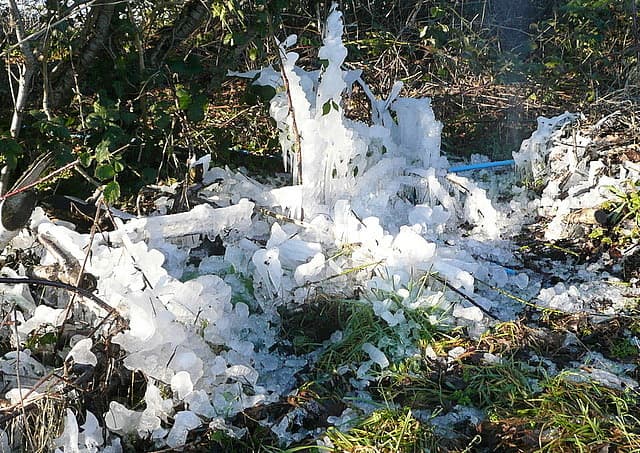
The pipe has split or is leaking. Fairfax County Fire and Rescue's order: "If the pipe breaks, quickly shut off the water valve, if you haven't already done so. Then call a plumber."[1] Its reason: "They have the know-how to correctly fix the break."[1] Watch as the pipe warms, because "In most cases, the actual break doesn't appear until the water begins to thaw."[1] A pipe that looks sound while frozen can still turn out to be split.
Water is coming through a ceiling, wall or floor. Close the main valve first, then call the plumber.
Water is near electrical equipment or a gas appliance. That is a call to the fire department before the plumber. Fairfax County Fire and Rescue says to call the fire department if the water gets in or near electrical outlets or panels, or if the water threatens a pilot light or power to a water heater or furnace.[1] For emergencies, including gas leaks, it says to call 911.[1]
The frozen section is inside a wall, a ceiling or a crawl space you cannot get into. Reaching it means opening finishes or working in a tight, cold space, and that is where a plumber's tools and experience earn their fee.
It will not thaw. Room temperature heat and careful use of a hair dryer are good methods,[1] but if steady, gentle warmth has not brought water back, stop. Do not escalate to a torch: Loudoun Water's advice is to never thaw a pipe with an open flame.[3]
It keeps happening. A line that freezes every winter usually runs somewhere cold. Fairfax County Fire and Rescue suggests that after a break you may consider having the pipe or pipes rerouted through less vulnerable areas.[1]
When to call the water utility first
If no faucet in the house runs, the freeze may be at the meter or in the service line, and who fixes it depends on which side of the meter it is on. Ask your own utility where its side ends. In Montgomery County: "The PSA owns lines to the meter, and the property owner is responsible from the meter to the home."[4] So there, a frozen line between the meter and the house is the owner's to fix, usually with a plumber. The PSA adds that the meter box and meter are PSA property and should be entered by PSA personnel only.[4]
If you suspect a frozen pipe or meter, Loudoun Water asks customers to contact it, by phone during business hours or on its after-hours emergency line,[3] and asks them not to open the meter crock themselves, because it can damage the meter and result in fines.[3] Some utilities also take burst-pipe calls. If your pipe bursts during normal working hours, Virginia Beach Public Utilities asks you to call it at 757-385-4171, and to call 311 after hours, on weekends or on holidays.[2] Look up your own utility's number now and keep it with your water bill.
Heat tape and other electrical problems
If a pipe froze even though it has heat tape, the tape may have failed. Fairfax County Fire and Rescue's caution is to be careful with specially designed, UL approved heat tapes and to follow the directions exactly; a slight variation could cause a fire.[1] A plumber can fix the pipe; an electrician handles any heating cable that is wired in.
Hiring the plumber
Virginia's Board for Contractors warns: "A license number in an advertisement or on a business card does not necessarily mean the contractor's license is valid."[5] Check it on DPOR's lookup; our guide on checking a contractor's licence in Virginia walks through it. The Board says: "Unlicensed contracting is against the law."[5] It adds that if you contract with someone who does not hold a license, the Board for Contractors may not be able to help you resolve a complaint,[5] and that if you want only plumbing work, you may want to hire a contractor licensed in that specialty.[5]
Virginia law requires all licensed contractors to provide a written contract for residential work,[5] so ask for the price and scope in writing before work starts. Ask the plumber, too, whether the repair needs a building permit. If it does, the Board's advice is: "Licensed contractors should apply for and obtain all building permits, not the consumer."[5]
When you call, give the plumber the facts that shape the visit: where the pipe is, whether it is leaking, whether the main is closed, and whether it runs behind a wall or in a crawl space. Our answer on what a frozen pipe repair costs in Virginia covers what to ask for in the quote.
Stop and call a pro if
- The pipe is split, bulging or leaking, or water is coming through a ceiling or wall. Close the main valve first.
- Water is in or near outlets or the electrical panel, or threatens a pilot light or power to a water heater or furnace: call the fire department, as Fairfax County Fire and Rescue advises.
- You cannot find the frozen section, or it is inside a wall, ceiling or floor.
- Gentle heat has not thawed it.
- No faucet in the house runs: call the water utility first.
- The pipe froze even though it has heat tape, or it needs a wired-in heating cable: have an electrician look at the tape or cable, and a plumber at the pipe.
On Loclis, plumbing is licensed work at any job size, so an unlicensed quote is refused, and the directory shows each business's DPOR licence number and class. Find plumbers in Blacksburg, browse frozen pipe repair or burst pipe repair, read how to tell if your pipes are frozen, or see all plumbing repair answers.
When it is time, describe the frozen pipe once and licensed local plumbers quote it.
Common questions
- Can I thaw a frozen pipe myself, or do I need a plumber?
- An exposed pipe that is intact is often a job you can do: shut off the water, open the faucet and warm the pipe slowly with warm towels or room heat, never a flame. Call a plumber when the pipe has split, when the frozen section is inside a wall or you cannot find it, or when it will not thaw.
- Should I call the water utility or a plumber?
- If no faucet in the house works, call the utility first and ask where its side ends, because the freeze may be at the meter or in the service line. Rules differ by utility. In Montgomery County, the Public Service Authority owns the lines to the meter and the owner is responsible from the meter to the home, so a frozen line on the house side of the meter is the owner's to fix there. A frozen pipe inside the house is a plumber's call.
- Is a frozen pipe an emergency?
- A split pipe with water coming through a ceiling or wall is an emergency until the main is closed. A frozen pipe may already be split without showing it: Fairfax County Fire and Rescue notes that in most cases the break does not appear until the water begins to thaw. So close the main valve while you wait for the plumber and watch the pipe as it warms.
- What if water is near outlets or a gas appliance?
- Fairfax County Fire and Rescue says to call the fire department if the water gets in or near electrical outlets or panels, or threatens a pilot light or power to a water heater or furnace, and to call 911 for emergencies including gas leaks. Call the plumber once that is handled.
- Does a frozen pipe repair need a permit in Virginia?
- Ask the plumber, or your city or county building office, whether your repair needs one. Virginia's Board for Contractors advises that licensed contractors, not the homeowner, should apply for and obtain any building permits the job needs.
- Who should look at heat tape on my pipes?
- Heat tape is an electrical product. Fairfax County Fire and Rescue says to be careful with it and follow the directions exactly, because a slight variation could cause a fire. A plumber repairs the pipe; have an electrician deal with any heating cable that is wired in rather than plugged in.
Sources
- [1] Frozen Water Pipes, Fairfax County Fire and Rescue Department. Checked October 26, 2026.
- [2] Prevent Frozen Pipes from Bursting Your Budget (December 15, 2025), City of Virginia Beach Public Utilities. Checked October 26, 2026.
- [3] Frozen Pipes, Loudoun Water. Checked October 26, 2026.
- [4] Water/Sewer: PSA frequently asked questions, Montgomery County, Virginia, Public Service Authority. Checked October 26, 2026.
- [5] What You Should Know Before You Hire a Contractor (2017), Virginia Board for Contractors, DPOR. Checked October 26, 2026.
Want a pro to handle it?
Describe the job once. Licensed local businesses send quotes, and you pay only when you book one.
Get a quote for Plumbing Repair