Is it worth repairing a wine fridge?
Usually yes when the fix is simple or the warranty covers it, and usually no when the repair is a failed sealed system on an inexpensive unit. Check the warranty, rule out placement and power, then get a written quote for the diagnosis and the repair. If it costs a large share of a new unit of the same size, replace it and have the old one's refrigerant recovered.
Free to ask. Local shops send quotes, and you pay only when you book one.
By Kasra Taheri, Founder, LoclisPublished
Researched and drafted with AI, then checked claim by claim against the sources listed below before it was published. Prices and rules change; the dates beside each source say when it was last checked.
Step by step
Read when to stop and call a pro, further down this page, before you start.
Step 1: Look up the warranty
Find the receipt and warranty for your brand. GE's, for example, gives Profile wine chillers five years on the sealed refrigerating system and needs proof of the original purchase date.[1]
Step 2: Check the room
Make sure the cooler is not somewhere below 55°F or above 90°F, and that nothing is blocking the air it needs around it.[1]
Step 4: Let it settle
After any change, give it 24 hours before judging the result.[1]
Step 5: Get the fault named in writing
Ask a repair business to say what failed, what it will replace and what it costs, and, if the repair is large, compare several written estimates; Virginia's Board for Contractors suggests at least three for contractor work.[4]
Step 6: Price a replacement
Check today's price for a new unit of the same capacity and type, plus delivery and haul-away, and compare it with the repair quote.
Short answer: decide by the fault
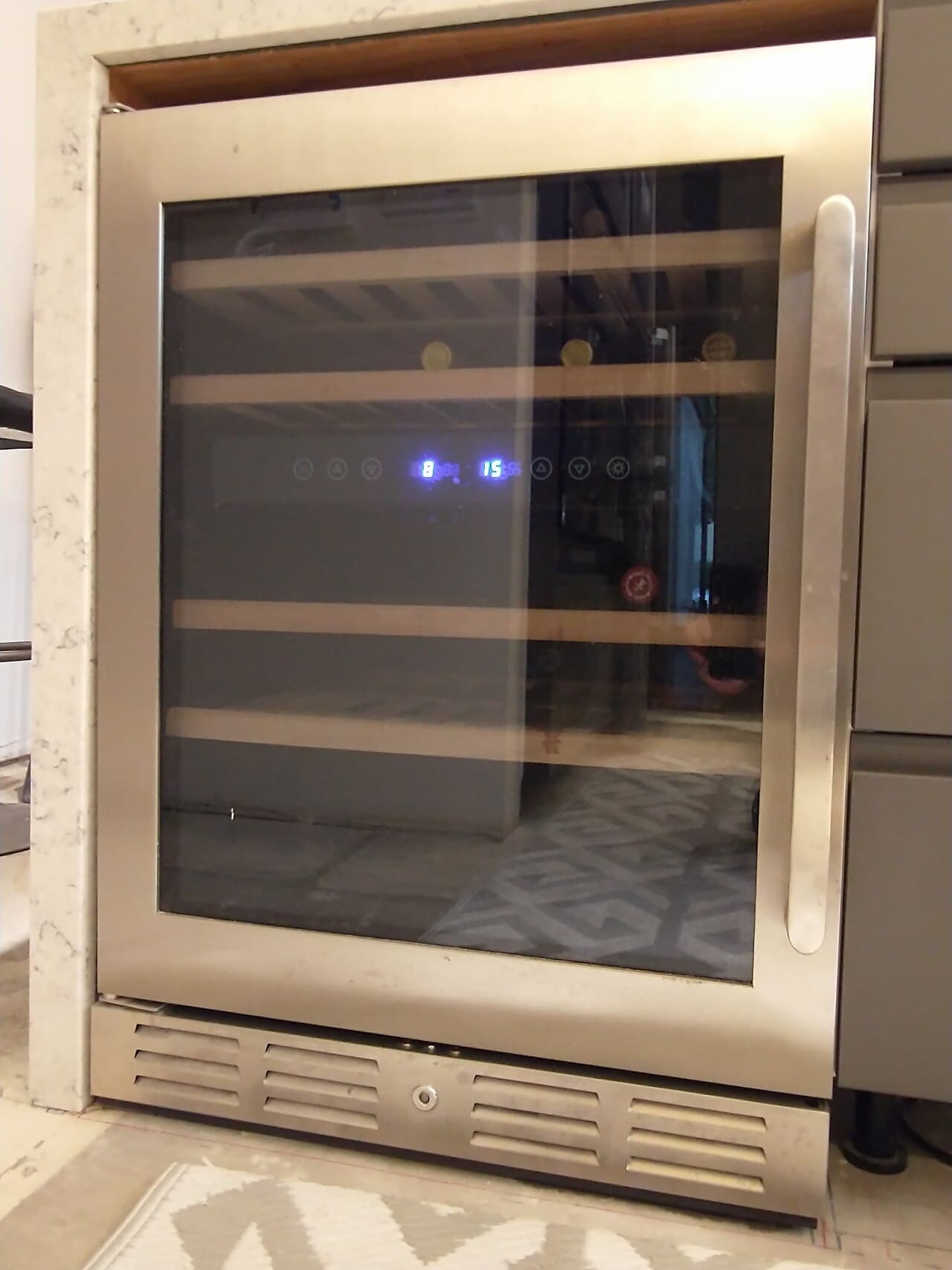
Whether a wine fridge is worth repairing depends on which part failed and who pays. A warranty claim or a small part is nearly always worth it. A failed compressor or leaking sealed system on an inexpensive freestanding unit often is not.
Rule out the free fixes
A wine cooler that is warm is not always broken. A wine chiller is not a refrigerator and does not hold temperatures the way a refrigerator does.[1] GE's manual says to keep it out of rooms below 55°F or above 90°F,[1] and its troubleshooting chart blames a door held open by a bottle, a plug not fully in, a tripped breaker, hot weather and a large load of new bottles for a unit that is not working or runs warm.[1] Unplug it first,[1] fix what you can, and give it 24 hours before judging the result.[1]
Check the warranty before anything else
Warranties differ, but they can change the answer completely. GE gives Profile wine chillers five years on the sealed refrigerating system and needs proof of the original purchase date.[1] The same warranty excludes loss of wine to spoilage, improper installation, and resetting breakers.[1] If the unit is covered, the repair is worth it, and the cheapest thing you can do is claim it before a repair business touches the unit.
When repair makes sense
- It is in warranty. Parts and labor can be covered.
- The fault is small. A fan, a control, a light or a door gasket is a small repair next to a new unit.
- It is built in. An under-counter or cabinet-fit unit costs time and money to replace, and a different size may not fit the opening.
- The unit is a good one you like, the problem is clear, and the quote names the part.
When replacing makes sense
- The quote is a large share of a new unit of the same size and type. Get the replacement price yourself, with delivery and haul-away.
- The sealed system has failed on a low-priced unit. Compressor, evaporator and refrigerant-leak repairs are specialist work.
- The same fault keeps coming back.
- A thermoelectric or very small unit that was never expensive.
We do not quote a break-even percentage, because no primary source sets one. Use the same-size replacement price and the written repair quote, and decide for yourself.
Get the quote in writing
Ask the business to name the fault, the part and the labor, to say what the diagnosis fee is and whether it is credited, and to give the warranty on the repair. Virginia's Board for Contractors suggests getting at least three written bids or estimates so you can compare prices;[4] if the repair is large, do the same for an appliance. See what a wine cooler repair costs.
If you replace it
The old unit still holds refrigerant. The final disposer of appliances is responsible for recovering any refrigerant contained in them,[2] so use a retailer take-back, a recycler, or your locality's appliance pickup rather than the curb. Some new refrigerated appliances are being manufactured with non-fluorinated refrigerants such as R-290 (propane),[2] so do not assume what is in a given unit; leave the refrigerant to whoever recovers it.
Virginia law has a safety rule for abandoned cabinets. It is unlawful to leave an icebox, refrigerator or other container, device or equipment of any kind with an interior storage area of more than two cubic feet of clear space which is airtight without first removing the door or doors or hinges.[3]
Stop and call a pro if
- The cord, plug or outlet is hot, damaged or scorched. Unplug it and have it checked.
- The unit runs constantly but never gets cold, or there is an oily residue or hissing. That points to the sealed system.
- The breaker trips again after you reset it.
- Water is pooling on the floor or swelling the cabinet beside it.
Getting help in Virginia
Browse wine fridge repair, appliance repair and the other appliance repair answers.
When you are ready, describe the wine cooler problem once and local appliance repair businesses quote it.
Common questions
- When is a wine fridge repair clearly worth it?
- When it is under warranty, when the fix is a simple one such as a door gasket, fan, light or control, or when it is a built-in unit that would cost real money and effort to swap. Get the fault named in writing first so you know which kind of repair you are buying.
- When should I replace instead of repair?
- When the quote is a large share of what a new unit of the same size and type costs, when the fault is in the sealed system on a low-priced freestanding unit, or when the same problem keeps coming back. Compare the written repair quote with a current replacement price including delivery and haul-away.
- Can I throw an old wine fridge out at the curb?
- Not safely as it stands. EPA says the final disposer of an appliance is responsible for recovering the refrigerant it holds, so use a retailer take-back, a recycler or your locality's appliance pickup. Virginia law also requires the doors or hinges to be removed from an abandoned airtight cabinet with more than two cubic feet of storage.
- Does a wine cooler keep as cold as a refrigerator?
- No. It is built to hold wine at cellar temperatures, so a warm reading on a wine chiller is not the same as a failed refrigerator. GE's manual says a wine chiller is not a refrigerator and does not maintain temperatures like one, and it advises placing it where the room stays between 55°F and 90°F.
Sources
- [1] Beverage Center and Wine Chiller Owner's Manual and Warranty (U.S.), GE Appliances. Checked October 27, 2026.
- [2] Appliance Disposal (Section 608), U.S. Environmental Protection Agency. Checked October 27, 2026.
- [3] Va. Code § 18.2-319, Discarding or abandoning iceboxes, etc.; precautions required, Code of Virginia, Virginia General Assembly. Checked October 27, 2026.
- [4] What You Should Know Before You Hire a Contractor, Virginia Board for Contractors, DPOR. Checked October 27, 2026.
Want a pro to handle it?
Describe the job once. Licensed local businesses send quotes, and you pay only when you book one.
Get a quote for Appliance Repair