Why is my wine cooler not getting cold?
Most often the cooler is fine and something around it is not: a bottle propping the door open, a room outside the 55°F to 90°F range, a freshly loaded cabinet, or a unit that has not had 24 hours to settle. Rule those out first. If it runs all the time and stays warm, the sealed system needs a technician.
Free to ask. Local shops send quotes, and you pay only when you book one.
By Kasra Taheri, Founder, LoclisPublished
Researched and drafted with AI, then checked claim by claim against the sources listed below before it was published. Prices and rules change; the dates beside each source say when it was last checked.
Step by step
Read when to stop and call a pro, further down this page, before you start.
Step 1: Look at the door
Check that no bottle is holding the door open and that the door closes fully.[1]
Step 2: Check the plug, breaker and outlet
Push the plug completely into the outlet, reset a tripped breaker, and reset the outlet if it is a GFI.[1]
Step 3: Check the room
Note the temperature where the cooler stands. GE says not to install a wine chiller where the temperature will go below 55°F or above 90°F.[1]
Step 4: Check the air and the sun
Keep the front unobstructed for air circulation and keep the cooler out of direct sunlight, heat or moisture.[1]
Step 5: Check the temperature setting
Look at the control setting, then change it only once, and wait.[1]
Step 7: Give it 24 hours
Leave the door shut and wait a full day before judging the result.[1]
Step 8: Write down what you see
If it is still warm, note how long it has run, any noises, and what you tried. That shortens the technician's diagnosis.
Short answer: rule out the room and the door first
A wine cooler that is not cold is more often a placement, door or settling problem than a broken part. Work through the free checks below before booking a repair, and give the unit a full day after each change.
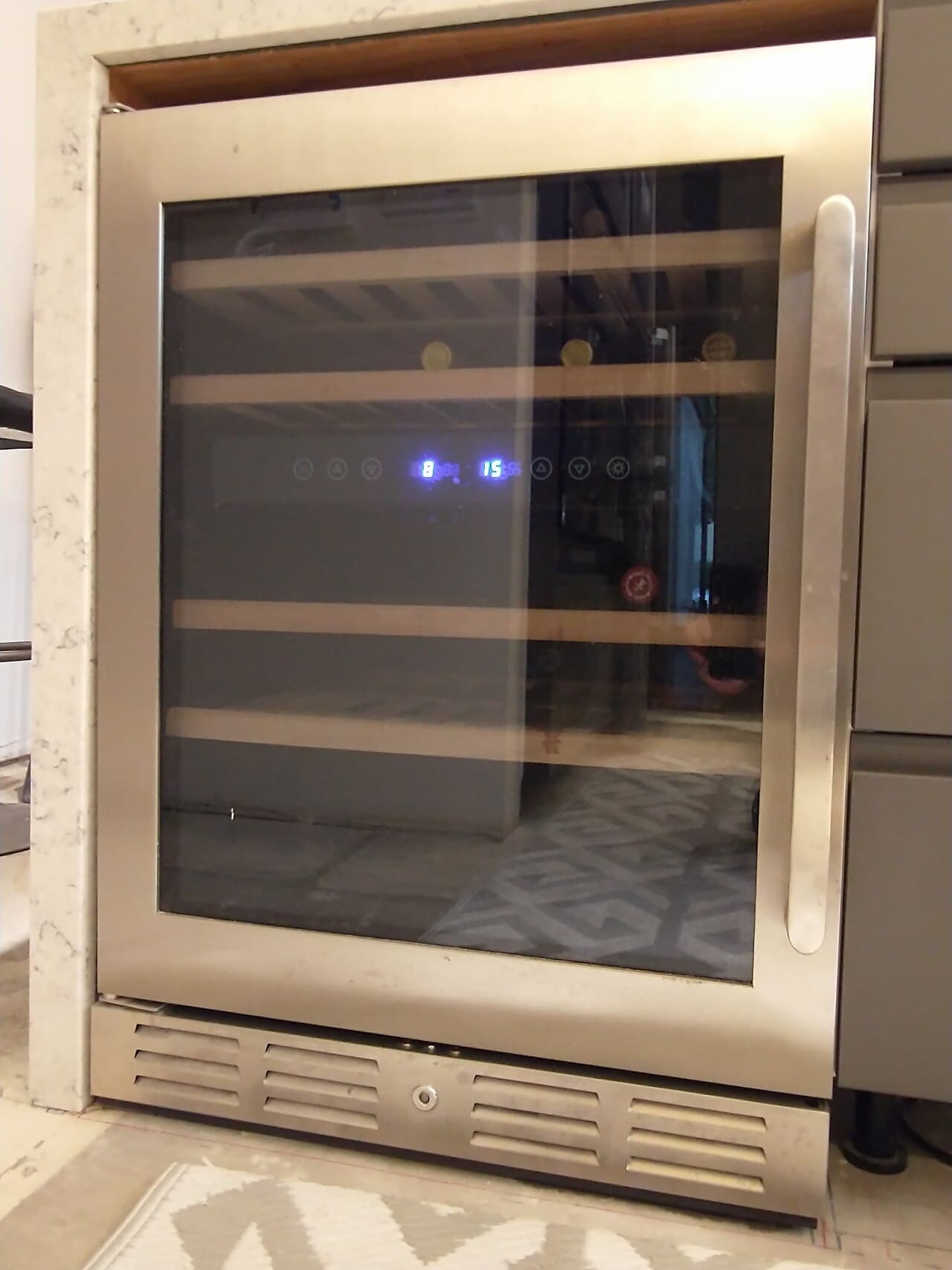
What "cold" means for a wine cooler
A wine cooler is not a small refrigerator. GE says its wine chiller runs from the low forties to the mid sixties and, not being a refrigerator, does not hold temperatures below 41°F the way one does.[1] If you expect beer-fridge cold, the cooler may be working exactly as built.
Temperatures at the bottom of the cabinet will be cooler than temperatures at the top.[1] Whites belong low, reds high, and a single reading from the top shelf will look warmer than the cabinet's average.
Normal behavior that looks like a fault
Some things feel like failure and are not. Hot weather, frequent door openings and large amounts of newly loaded wine make the motor run for long periods.[1] A new cooler also needs time. Once the bottles are loaded, allow at least 24 hours before making any adjustments to the initial setting.[1]
Another one is defrost. The compressor does not operate for about 30 minutes when the unit is in its defrost cycle.[1] Check back before assuming it has quit.
Work through the checks
- Check the door. Check that no bottle is holding the door open and that the door closes fully.[1]
- Check power. Push the plug completely into the outlet, reset a tripped breaker, and reset the outlet if it is a GFI.[1]
- Check the room. GE says not to install a wine chiller where the temperature will go below 55°F or above 90°F.[1] A garage in a Virginia August or a cold basement in January can both put a cooler outside its design range.
- Check the air. Keep the front unobstructed for air circulation and keep the cooler out of direct sunlight, heat or moisture.[1] Do not push things against the grille.
- Check the gasket. A leaking door seal lets warm air in all day. Unplug the cooler before cleaning.[1] Wash the vinyl gasket with mild soap and water or a baking soda solution and rinse well.[1] If it sticks or folds over, rub a thin layer of petroleum jelly or paraffin wax on its hinge side.[1]
- Wait. Wait a full day before judging the result.[1]
Move the dial once, not three times. Repeated changes make it impossible to tell which one helped.
When it is a real fault
If the room is within range, the door seals, the power is solid and a day has passed, a genuine fault is likely. Typical signs are a unit that runs without stopping and never cools, one that clicks on and off but never starts, or a fan you can no longer hear. You cannot see which part has failed from the outside, so a technician has to name it.
Do not open the sealed system yourself. Under Section 608 of the Clean Air Act, EPA requires technicians who maintain, service, repair, or dispose of equipment that could release ozone depleting refrigerants to be certified.[2] EPA's rules also prohibit intentionally venting ozone-depleting refrigerants or their substitutes while servicing, repairing or disposing of refrigeration equipment.[3] A "recharge" kit is not a safe shortcut.
Before paying for any repair, read what a wine cooler repair costs and whether a wine fridge is worth repairing.
Stop and call a pro if
- The cord, plug or outlet is hot, damaged or scorched. Leave it unplugged.
- The breaker trips again after you reset it.
- It runs constantly but stays warm after 24 hours in a room within range, or you see an oily residue or hear hissing. That points to the sealed system.
- Water is pooling on the floor or swelling the cabinet beside it.
- The unit is built in and the problem needs it pulled from its cabinet.
Getting help in Virginia
Browse wine fridge repair, appliance repair and more appliance repair answers on Loclis.
When you are ready, describe the wine cooler problem once and local appliance repair businesses quote it.
Common questions
- How cold should a wine cooler get?
- Not as cold as a refrigerator. GE's manual gives the range of its wine chiller as the low forties to the mid sixties and says it does not maintain temperatures like a refrigerator, which stays below 41°F. Its red wine setting aims at about 55°F and the white wine setting at about 45°F.
- My wine cooler runs but is warm. Is the compressor dead?
- Not necessarily. A unit that is new, newly loaded with warm bottles, in a hot room or opened often will run for long periods and cool slowly, and GE's manual calls that normal. Give it 24 hours with the door shut. If it still runs constantly and stays warm, it needs a technician.
- Why does the top of my cooler read warmer than the bottom?
- That is how these cabinets behave. GE's manual says temperatures at the bottom of the cabinet are cooler than at the top, so it advises keeping white wines in the cooler zones and reds in the warmer ones. A reading from one shelf is not the whole picture.
- Can I recharge the refrigerant in my wine cooler myself?
- No. Under Section 608 of the Clean Air Act, EPA requires technicians who service or repair equipment that could release ozone-depleting refrigerants to be certified, and EPA's rules prohibit intentionally venting ozone-depleting refrigerants or their substitutes. A cooler that has lost its charge is a job for a certified technician.
- Is a cooler that stops for half an hour broken?
- Not if it is in a defrost cycle. GE's manual says the compressor does not operate for about 30 minutes in defrost, and tells the owner to treat that as normal. If it stays off with the light out as well, check the plug, breaker and outlet.
Sources
- [1] Beverage Center and Wine Chiller Owner's Manual and Warranty (U.S.), GE Appliances. Checked October 27, 2026.
- [2] Section 608 Technician Certification, U.S. Environmental Protection Agency. Checked October 27, 2026.
- [3] Stationary Refrigeration - Prohibition on Venting Refrigerants, U.S. Environmental Protection Agency. Checked October 27, 2026.
Want a pro to handle it?
Describe the job once. Licensed local businesses send quotes, and you pay only when you book one.
Get a quote for Appliance Repair