What can't you put in a dumpster in Virginia?
Keep these out of a rented dumpster in Virginia: car and other lead-acid batteries, which state law bars from mixed trash; lithium-ion batteries; paint, solvents, pesticides, motor oil, fuel and other household chemicals; propane tanks; tires; refrigerators, freezers and AC units still holding refrigerant; and building material you suspect contains asbestos. Your hauler's agreement and local landfill usually add items of their own.
Free to ask. Local shops send quotes, and you pay only when you book one.
By Kasra Taheri, Founder, LoclisPublished
Researched and drafted with AI, then checked claim by claim against the sources listed below before it was published. Prices and rules change; the dates beside each source say when it was last checked.
Step by step
Read when to stop and call a pro, further down this page, before you start.
Step 1: Get the hauler's list
Ask the hauler for its prohibited and surcharged items in writing before the container arrives, and keep it where everyone loading can see it.
Step 2: Set up a hold-back corner
Pick a dry spot in the garage or yard, away from the container, for anything that should not go in the box.
Step 3: Pull out every battery
Take batteries out of tools, toys and electronics, and keep car batteries upright and apart from everything else.
Step 4: Tape lithium battery terminals
Put tape over the terminals of lithium-ion batteries or bag each one separately before storing it for recycling.[4]
Step 5: Keep chemicals in their containers
Leave paint, cleaners, pesticides and oils in their original labelled containers, with lids on, and never pour them together.[5]
Step 6: Set aside fuel and gas cylinders
Keep gasoline cans, propane tanks and other pressurized cylinders out of the box and out of the sun until you can take them to a proper drop-off.
Step 7: Separate appliances and tires
Leave refrigerators, freezers, dehumidifiers, window AC units and tires out of the container unless the hauler has agreed to take them for a stated fee.
Step 8: Leave suspect materials in place
If old flooring, insulation or siding might contain asbestos, stop removing it and leave it undisturbed until it has been tested.[7]
Step 9: Book the drop-offs
Call your locality or solid waste authority for household hazardous waste days, tire hours and battery and appliance drop-off points, and take each item there.
Some things never belong in a rented dumpster in Virginia, whatever the hauler's price: car and other lead-acid batteries, lithium-ion batteries, paint and household chemicals, motor oil and fuel, propane tanks, tires, appliances that still hold refrigerant, and building material you suspect contains asbestos. Some are barred by state law, some are a fire or chemical risk on the truck and at the landfill, and the rest cost the landfill extra to handle. Your hauler's agreement will have its own list, often longer, so read it before you start loading.
Items Virginia law and federal rules single out
Lead-acid batteries. Virginia law makes it unlawful to put a used lead acid battery in mixed municipal solid waste, or to dispose of one except by delivering it to a battery retailer or wholesaler, a secondary lead smelter, or an authorized collection or recycling facility.[1] The statute treats any wet cell battery as a lead acid battery, sets a fine of not more than fifty dollars, and counts each battery improperly disposed of as a separate violation.[1] Most car, truck, boat, mower and motorcycle batteries are this type.
Tires. Virginia's solid waste regulations require tires disposed in a sanitary or construction/demolition/debris landfill to be split, cut or shredded before disposal.[2] That is one reason landfills handle tires separately and charge for them, and why most haulers refuse them in a mixed load. The Montgomery Regional Solid Waste Authority, for example, takes tires on Wednesdays only, from 8 a.m. to noon, with fees based on weight.[6]
Refrigerators, freezers and AC units. EPA says older refrigerators, freezers, window air conditioners and dehumidifiers contained CFC and HCFC refrigerants, ozone-depleting substances phased out under the Clean Air Act.[3] It also says that the final disposer of an appliance is responsible for recovering any refrigerant in it,[3] and that municipalities may require the refrigerant to be recovered before they accept an appliance.[3] The Montgomery authority takes appliances but charges a Freon removal fee of $19 per appliance that is not certified as Freon-free.[6] Unless your hauler has agreed to take an appliance for a stated fee, keep it out of the box. Some retailers haul the old one away when they deliver a new one.
Items that are a fire or chemical risk
Lithium-ion batteries. EPA says lithium-ion batteries and devices containing them should not go in household garbage or recycling bins.[4] It warns that a battery thrown in the trash can be damaged or crushed in transport or processing, creating a fire hazard.[4] Power tool packs, laptops, phones, vapes, e-bike and scooter batteries all count. Until you can drop them at a battery recycler or retailer, EPA recommends taping the terminals or bagging each battery separately.[4]
Paint, cleaners, pesticides and oils. EPA says paints, cleaners, oils, batteries and pesticides can contain hazardous ingredients and require special care when you dispose of them,[5] and that some household hazardous waste can injure sanitation workers.[5] EPA also says to keep these products in their original containers with the labels on, never in food containers.[5]
Your locality decides where they go. In the New River Valley, the Montgomery authority accepts household chemicals, paints and fluorescent bulbs only at its household hazardous waste events, held twice a year for Montgomery County residents.[6] Separately, it takes motor oil, kerosene, hydraulic oil, diesel and transmission fluid in a closed container at its facility;[6] it adds a $19.00 surcharge per propane tank;[6] and it does not accept medications.[6] For latex paint, its preferred method is to dry the paint out with cat litter, mulch or sand and then put it in the regular garbage once it is completely dry.[6] Ask your hauler before putting even dried paint cans in a rented box.
Fuel and pressurized cylinders. Gasoline, kerosene, propane tanks and aerosol cans that are not empty belong at a fuel or hazardous waste drop-off, not in the box. EPA counts leftover household products that can catch fire, react or explode as household hazardous waste.[5]
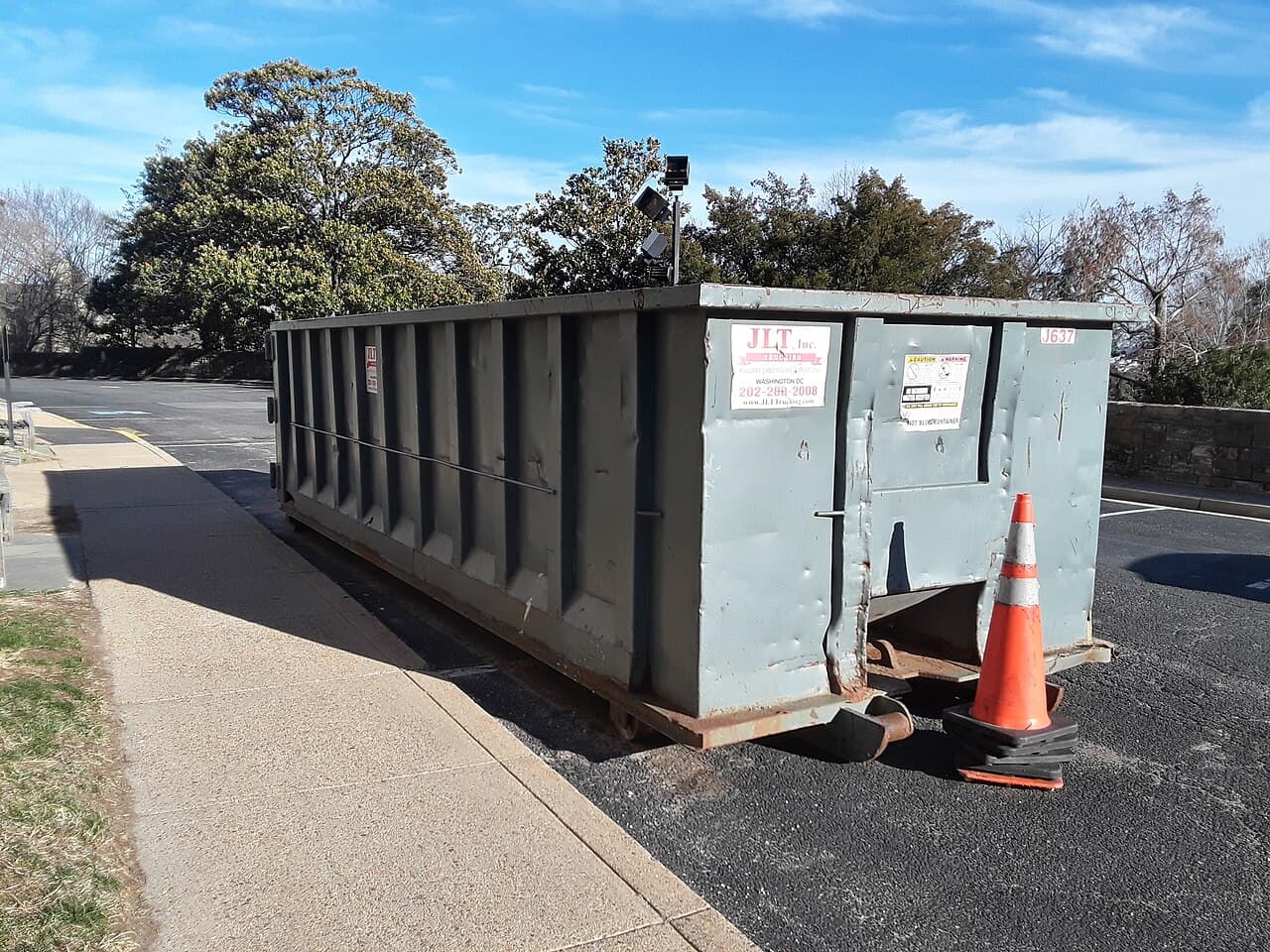
Remodel debris that needs checking first
Tearing out old flooring, insulation, ceilings or siding raises a question to settle before anything goes in the box. EPA says you generally cannot tell whether a material contains asbestos by looking at it, that remodeling can disturb asbestos-containing materials, and that if in doubt you should treat the material as asbestos and leave it alone.[7] If material will be disturbed by remodeling, EPA says repair or removal by a trained and accredited asbestos professional is needed.[7] Keep suspect material out of the container until it has been tested.
Things haulers often restrict
Beyond the legal and safety list, haulers commonly restrict or charge extra for mattresses, electronics and TVs, large amounts of concrete, dirt or brick (because of weight), yard waste, and anything wet or leaking. These differ from company to company, so get the list in writing. A prohibited item found in the box can mean a fee or a load left behind; see why a dumpster rental can come with extra fees. Loading heavy debris in the right box also keeps the bill down; see what size dumpster you need.
Stop and call a pro if
- You find drums, unlabelled containers, leaking batteries or anything that smells of fuel or solvent. Leave it closed and ask your locality's hazardous waste program how to handle it.
- Remodel work has uncovered material that might contain asbestos. Stop and have it tested before more is removed.
- A lithium-ion battery is swollen, hot, leaking or damaged. Contact the battery or device maker for handling instructions.
- The cleanout is full of chemicals, ammunition, medical waste or other items you cannot identify. A specialist cleanout company can sort them safely.
Getting it done on Loclis
Read more junk removal and moving answers, see dumpster rental businesses, or find junk removal businesses around Blacksburg. For the cost side, see how much it costs to rent a dumpster in Virginia. To get quotes from haulers who will tell you up front what they take, describe the job on Loclis.
Common questions
- Can I throw a car battery in a dumpster in Virginia?
- No. Virginia law makes it unlawful to put a used lead acid battery in mixed municipal solid waste. Take it to a battery retailer or wholesaler or an authorized recycling facility; many stores that sell car batteries take old ones back.
- Can I put an old refrigerator in a rented dumpster?
- Usually not without the hauler's agreement and a fee. EPA says the final disposer of an appliance is responsible for recovering its refrigerant, and landfills often charge for it: the Montgomery Regional Solid Waste Authority charges $19 per appliance not certified as Freon-free.
- Can dried paint go in a dumpster?
- Often, yes. The Montgomery authority's preferred method for latex paint is to dry it out with cat litter, mulch or sand and put it in the regular garbage once it is completely dry. Liquid paint is different; ask your locality's household hazardous waste program where it goes.
- Why can't tires go in a dumpster?
- Virginia's regulations require landfills to split, cut or shred tires before burying them, so most landfills take them separately and charge for them. Haulers usually refuse them or add a per-tire fee.
- What about old electronics and TVs?
- Many haulers do not take them, and devices with lithium-ion batteries should not go in the trash, according to EPA. Ask your locality or a retailer about electronics recycling.
- Are the rules the same everywhere in Virginia?
- The state laws on lead-acid batteries and landfilled tires apply everywhere, and EPA's refrigerant rules apply nationwide. Beyond that, each landfill and each hauler sets its own list, so ask for yours in writing.
Sources
- [1] Va. Code § 10.1-1425.1, Disposal of lead acid batteries, Code of Virginia, Virginia General Assembly. Checked October 26, 2026.
- [2] 9VAC20-81-640, Waste tires (Solid Waste Management Regulations), Virginia Administrative Code, Virginia General Assembly. Checked October 26, 2026.
- [3] Appliance Disposal, U.S. Environmental Protection Agency. Checked October 26, 2026.
- [4] Used Lithium-Ion Batteries, U.S. Environmental Protection Agency. Checked October 26, 2026.
- [5] Household Hazardous Waste (HHW), U.S. Environmental Protection Agency. Checked October 26, 2026.
- [6] Disposal Guide, Montgomery Regional Solid Waste Authority. Checked October 26, 2026.
- [7] Protect Your Family from Exposures to Asbestos, U.S. Environmental Protection Agency. Checked October 26, 2026.
Want a pro to handle it?
Describe the job once. Licensed local businesses send quotes, and you pay only when you book one.
Get a quote from a local pro