What does demolishing a house involve?
Demolishing a house in Virginia means a permit, a utility locate through Virginia 811, a check for asbestos and other hazards, utility disconnection, the teardown, debris hauling and recycling, then removing the foundation and grading the lot. It is licensed, permitted work that you should leave to a contractor and read the quote closely.
Free to ask. Local shops send quotes, and you pay only when you book one.
By Kasra Taheri, Founder, LoclisPublished
Researched and drafted with AI, then checked claim by claim against the sources listed below before it was published. Prices and rules change; the dates beside each source say when it was last checked.
This is a job for a licensed pro in Virginia
This page explains what the work involves, the permits, what a licensed pro does and what drives the cost. It does not give step-by-step instructions, because this work needs a licence, a permit or both, and doing it wrong can injure someone. Before you hire, check the licence on Virginia's DPOR record.
Demolishing a house is a permitted, staged job, not just a machine and a weekend. In Virginia the work runs in this order: the paperwork and utility locates, a check for hazardous materials, disconnection of the utilities, the teardown itself, hauling and recycling the debris, and finally removing the foundation and regrading the lot. The paperwork and the hazardous-material check come first because they can stop the job.
Permit and utility locates come first
Virginia's building code requires a permit from the building official before demolition of a building or structure begins.[1] Your locality issues it, and the rules and fees differ from place to place. The details are in do you need a permit to demolish a building in Virginia.
The utility locate is separate and also mandatory. Virginia law says no person shall make or begin any excavation or demolition without first submitting a locate request to the notification center.[2] That notification center is Virginia 811. Virginia 811 says its service is always free and that a hired contractor is responsible for contacting it,[3] but confirm they have done it before machines arrive. The same step matters for buried lines you may not know about; see do I need to call 811 before digging in Virginia.
Hazardous materials are checked before anything comes down
Older houses can contain asbestos. EPA says asbestos fibers may be released into the air when asbestos-containing material is disturbed during demolition work, building or home maintenance, repair and remodeling.[4] EPA lists roofing shingles, ceiling and floor tiles and asbestos cement products among the building materials that have contained asbestos,[4] and it notes that symptoms of asbestos-related disease may take many years to develop.[4]
The legal picture has layers. The building code says a permit is also required for removing or disturbing asbestos-containing materials during the demolition of a building or structure.[1] Virginia's asbestos inspection law does not apply to single-family dwellings or housing with four or fewer units, unless the demolition is for commercial or public development purposes.[5] Localities can ask for more: Richmond's application tells owners to fill out an asbestos certification form.[7] Even where the state rule does not require an inspection for a house, ask your contractor how they will check for asbestos before the crew starts.
The teardown, in the order the site demands
Utilities are shut off and capped before the structure is touched. Gas, electric, water and sewer connections are handled by the utility companies or licensed tradespeople, so ask who is arranging each one.
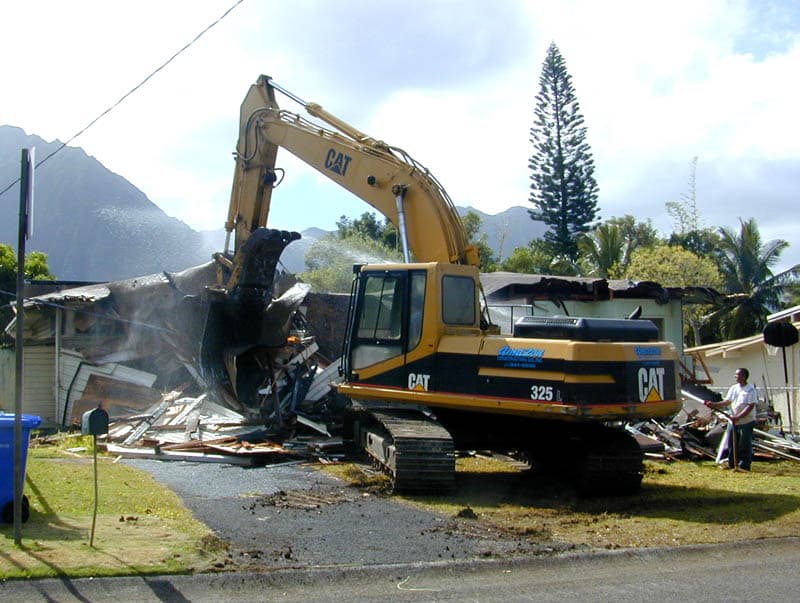
Then the building comes down. On most house lots a tracked excavator with a grapple or thumb works the structure down from the roof and sorts material as it goes, with water sprayed to hold the dust. Tight lots, shared walls and fragile neighbouring buildings push the job toward slower hand work and partial dismantling. Interior items that can be reused or recycled, such as fixtures, cabinets and framing lumber, are often taken out first.
Debris, recycling and deconstruction
A house produces a lot of waste. EPA says demolition represents more than 90 percent of total construction and demolition debris generation.[6] Concrete, brick, metal and clean wood are often recycled; the rest goes to a permitted landfill, and disposal charges are a real part of the price.
If you want to save materials, ask about deconstruction. EPA describes deconstruction as the process of carefully dismantling buildings to salvage components for reuse and recycling.[6] It takes longer than machine demolition and is priced differently, so ask for it as a separate line in the quote.
Finishing the site
After the structure is down, the contractor removes or breaks up the slab or foundation walls, fills the basement or crawlspace with approved material, and grades the lot so water drains away. Ask whether the quote includes foundation removal, backfill, grading, seed or straw and erosion control. A lot that is left as a pile of rubble is not finished. If the lot will be rebuilt, say so, because the fill and compaction the next builder needs may differ from a lot that will simply be grassed.
When to call a licensed pro
For all of it. Demolition is structural work with asbestos, utility and collapse hazards, and it needs permits. Hire a licensed contractor of the right class: a Class C licence covers a single contract over $1,000 but less than $30,000, and a Class B licence covers a single contract of $30,000 or more but less than $150,000,[8] and a Class A licence starts at a single contract of $150,000 or more.[8] Richmond requires a copy of your state contractor's licence and business licence on file before it issues a demolition permit.[7] Check the licence with the state before you sign.
Loclis lists licensed excavation and demolition businesses. Browse excavation services, read more excavation answers, see what a demolition costs in Virginia, or describe your job once and licensed local businesses will quote it.
Common questions
- Can I demolish my own house in Virginia?
- Not casually. The building code requires a permit before demolition begins, a permit applicant must show a contractor licence or file a statement that they are not subject to licensure, and the work carries asbestos, utility and collapse hazards. Most owners hire a licensed contractor.
- How long does a house demolition take?
- The teardown itself is often a matter of days, but the permit, utility locates and disconnections, and any asbestos work come first and can take longer. Ask the contractor for a schedule that lists each stage.
- What happens to the debris?
- Some is recycled, such as concrete, brick, metal and clean wood, and the rest is taken to a permitted landfill. EPA says demolition represents more than 90 percent of total construction and demolition debris generation, so disposal is a major part of the job.
- Do I need to call 811 before a demolition?
- Yes. Virginia law says no one may begin any excavation or demolition without first submitting a locate request to the notification center. Virginia 811 says a hired contractor is responsible for contacting it.
- What is deconstruction?
- EPA describes deconstruction as the process of carefully dismantling buildings to salvage components for reuse and recycling. It is slower than machine demolition, so get it priced as its own option.
- Does the lot have to be graded afterwards?
- It should be. Agree in writing whether the contractor will remove the foundation, backfill, grade the lot and seed it, so that the site drains and is ready for whatever comes next.
Sources
- [1] 13VAC5-63-80. Section 108 Application for permit (Virginia Uniform Statewide Building Code), Virginia Administrative Code, Virginia General Assembly. Checked October 27, 2026.
- [2] Va. Code § 56-265.17, Notification required prior to excavation or demolition, Code of Virginia, Virginia General Assembly. Checked October 27, 2026.
- [3] Homeowners FAQ, Virginia 811. Checked October 27, 2026.
- [4] Learn About Asbestos, U.S. Environmental Protection Agency. Checked October 27, 2026.
- [5] Va. Code § 36-99.7, Asbestos inspection in buildings to be renovated or demolished; exceptions, Code of Virginia, Virginia General Assembly. Checked October 27, 2026.
- [6] Sustainable Management of Construction and Demolition Materials, U.S. Environmental Protection Agency. Checked October 27, 2026.
- [7] Demolition Permit Application (rev. 05-21-2024), City of Richmond, Department of Planning and Development Review. Checked October 27, 2026.
- [8] Va. Code § 54.1-1100, Definitions, Code of Virginia, Virginia General Assembly. Checked October 27, 2026.
Want a pro to handle it?
Describe the job once. Licensed local businesses send quotes, and you pay only when you book one.
Get a quote from a local pro