What is a WDI inspection?
A WDI (wood-destroying insect) inspection is a visual check by a pest professional for termites and other insects that damage wood, and for damage they have already done. In Virginia it is done by a licensed pest control business, usually as a short written report during a home purchase. It is separate from a general home inspection.
Free to ask. Local shops send quotes, and you pay only when you book one.
By Kasra Taheri, Founder, LoclisPublished
Researched and drafted with AI, then checked claim by claim against the sources listed below before it was published. Prices and rules change; the dates beside each source say when it was last checked.
This is a job for a licensed pro in Virginia
This page explains what the work involves, the permits, what a licensed pro does and what drives the cost. It does not give step-by-step instructions, because this work needs a licence, a permit or both, and doing it wrong can injure someone. Before you hire, check the licence on Virginia's DPOR record.
What the inspector looks for
In Virginia the insect that matters most is the subterranean termite. Subterranean termites usually invade a structure from the soil along the foundation, commonly through cracks in the slab, utility conduits, expansion joints and plumbing connections.[1] An inspector spends most of the visit where soil, concrete and wood meet: the crawlspace or basement, sill plates and joists, the foundation perimeter, porches, decks and any wood that touches the ground.
Virginia Cooperative Extension lists three usual signs of a subterranean infestation: mud tubes, swarmers and wood damage.[1]
- Mud tubes are shelter tubes the termites build from the ground up to the wood. The tubes are flattened and muddy looking, and most are about the width of a pencil.[1]
- Swarmers are winged termites, often found near light fixtures, windows and doors, and discarded wings on sills and floors point the same way.[1]
- Wood damage can be hidden, because the surface may stay intact. Inspectors probe by tapping the wood every few inches with the handle of a screwdriver.[1] The damaged wood sounds hollow.[1]
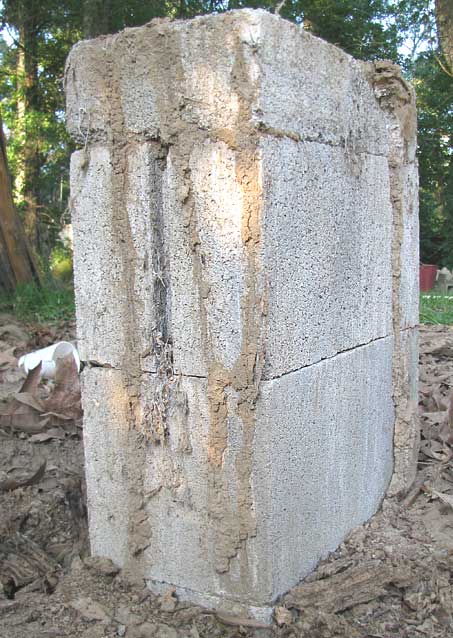
Inspectors also note the conditions that invite termites, such as leaks, wet crawlspaces, wood piled against the house and soil touching siding. Extension notes that termites can be hard to spot where a foundation is hidden behind brick veneer, stucco or foam insulation that sits below grade, because there is then no outside evidence until the damage is obvious.[1] That is a limit of any visual inspection: an inspector reports what can be seen and reached, not what is behind finished walls.
What the report does and does not tell you
A typical report says whether visible evidence of wood-destroying insects was found, whether there is visible damage, and whether the inspector recommends treatment. Read the fine print on three points:
- Which areas were inspected, and which were not. Finished basements, stored belongings and tight crawlspaces are common gaps.
- Active or past. Old damage and old treatment are not the same as a live colony. Ask the inspector which one they are describing.
- Damage versus infestation. The report says termites were or were not seen. It is usually not a structural repair estimate. If damage is found, a contractor or engineer decides what needs repair.
A WDI report is also not a termite warranty. If you want ongoing protection, that is a separate treatment contract, covered in do I need a termite bond in Virginia.
Who can do it
Pest control work is licensed in Virginia. A pesticide business license is required for any person or business operating in Virginia that, in exchange for compensation, sells, stores, distributes, mixes, applies or recommends pesticides.[3] The state's applicator rules also set up a wood-destroying pest control subcategory for commercial applicators who use or supervise the use of pesticides to control organisms that destroy structures made of wood.[4] The EPA's advice on termite firms is to ask to see the company's licence, and to call the state pesticide agency if you have concerns.[2] See do pest control companies need a licence in Virginia.
A general home inspector is a different licence and a different scope. Virginia's home inspector regulation lists the presence of wood-destroying organisms among the exclusions a home inspection contract may state,[6] so do not assume your home inspection covered termites. Read the contract, and see does a home inspector need a licence in Virginia.
When a WDI inspection is ordered
Most are ordered during a purchase. Lenders can require one: the VA says that wood-destroying insect information is required for the entire state of Virginia on VA home loans.[5] Whether yours is required depends on your loan and your contract, which is a termite inspection required to buy a house in Virginia explains. Homeowners also order one when they see mud tubes or swarmers, or when selling and wanting the answer before a buyer asks. The cost depends on the house, and how much a termite inspection costs in Virginia covers what changes the price.
When to call a licensed pro
Always, for this job. Do not diagnose termites yourself and do not apply a termiticide to wood or soil on a guess. The EPA warns that if a treatment is conducted improperly it can contaminate the home and surrounding drinking water wells and will not protect against termites.[2] Hire a licensed pest control business, confirm its licence, and ask for a written report that names the areas inspected.
Loclis lists licensed businesses by trade. Browse inspection services, read more inspection answers, or learn the signs of termites in a house. When you are ready, describe the termite job on Loclis so licensed local businesses can quote it in writing.
Common questions
- Is a WDI inspection the same as a termite inspection?
- Mostly yes. WDI covers termites plus other insects that damage wood, such as carpenter ants and wood-boring beetles. In Virginia the termite is the main concern, so people use the two terms interchangeably.
- Does a regular home inspection include termites?
- Not necessarily. Virginia's home inspector regulation lists wood-destroying organisms among the exclusions a contract may state. Read your home inspection contract and, if termites are not covered, order a separate WDI inspection.
- Does a clean WDI report mean the house is termite free?
- It means nothing was seen in the areas the inspector could reach on that day. Termites can be hidden behind finished walls, and new activity can start later.
- Who does a WDI inspection in Virginia?
- A licensed pest control business. A pesticide business license is required for a business that sells, applies or recommends pesticides for pay in Virginia. Ask to see the licence.
- What should I do if the report finds termites?
- Get a written treatment proposal from a licensed pest control business, and if damage is noted, have a contractor assess the repairs. Compare the scope of each written quote, including what any warranty covers.
Sources
- [1] Signs of Subterranean Termite Infestation (Publication 444-501), Virginia Cooperative Extension, Virginia Tech. Checked October 27, 2026.
- [2] Termites: How to Identify and Control Them, U.S. Environmental Protection Agency. Checked October 27, 2026.
- [3] Pesticide Business License, Virginia Department of Agriculture and Consumer Services. Checked October 27, 2026.
- [4] 2VAC5-685-70, Categories for commercial applicator certification, Virginia Administrative Code, Virginia General Assembly. Checked October 27, 2026.
- [5] Local Requirements, Wood-Destroying Insect Information, U.S. Department of Veterans Affairs, VA Home Loans. Checked October 27, 2026.
- [6] 18VAC15-40-120, Home inspection contract, Virginia Administrative Code, Board for Home Inspectors. Checked October 27, 2026.
Want a pro to handle it?
Describe the job once. Licensed local businesses send quotes, and you pay only when you book one.
Get a quote from a local pro