Why does my bathroom keep getting moldy even after disinfecting?
Because disinfecting does not fix the moisture that feeds mold. Mold spores are always present indoors, and they grow back wherever the bathroom stays damp: grout, caulk, the ceiling over the shower, behind the toilet. Run the fan or open a window when you shower, keep humidity down, scrub the mold off and dry the surface, and look for leaks.
Free to ask. Local shops send quotes, and you pay only when you book one.
By Kasra Taheri, Founder, LoclisPublished
Researched and drafted with AI, then checked claim by claim against the sources listed below before it was published. Prices and rules change; the dates beside each source say when it was last checked.
Step by step
Read when to stop and call a pro, further down this page, before you start.
Step 2: Gear up
Wear long gloves and goggles without vent holes, and open a window or run the fan before you start.[2]
Step 3: Scrub, do not just spray
Scrub the mold off tile, grout and other hard surfaces with detergent and water, then dry them completely.[3]
Step 4: Do not cover it up
Do not paint or caulk over a moldy surface; clean the mold off and dry the surface first.[3]
Step 5: Run the fan every shower
Run the bathroom fan or open the window every time someone showers.[2]
Step 6: Dry the wet surfaces
Squeegee or wipe the shower walls and door after use, spread the curtain out, and hang towels and the bath mat to dry.
Step 7: Check the humidity
Put a humidity meter in the bathroom or nearby hall and aim for below 60 percent, ideally 30 to 50 percent.[2]
Step 8: Look for leaks
Check under the sink, around the toilet base and along the tub edge for drips, soft spots or stains, and get any leak fixed promptly.[1]
Step 9: Clean more often
Wipe the usual problem spots more often than you used to, so small spots never get a chance to spread.[3]
Your bathroom keeps getting moldy because disinfecting deals with what is on the surface but does nothing about the moisture that feeds mold. The spores are always in the air. As long as the grout, caulk or ceiling stays damp for hours after each shower, they settle and grow again. The fix is mostly about water: getting steam out, drying surfaces, keeping humidity down and catching leaks. Then the mold you scrub off is far less likely to come back.
Why disinfecting alone does not work
Spores never go away. Mold spores are in every home's air, and there is "no practical way to eliminate all mold and mold spores in the indoor environment," according to the Virginia Department of Health.[1] What you can control is moisture, which the department calls the key to controlling indoor mold growth.[1] EPA notes that some spores will always remain, but they will not grow once the moisture problem is solved.[2]
Killing is not removing. Even dead mold can still set off allergic reactions in some people, so mold has to be removed, not just killed.[2] A spray that leaves the growth in place has done half the job. Allergic reactions are the health effect of mold that people report most often,[1] and young children, older people, pregnant women and people with asthma or other respiratory diseases are more likely to get symptoms.[1]
Bleach is not a routine fix. The Virginia Department of Health says small areas of mold, under 10 square feet, "can be cleaned up from hard surfaces with detergent and water, or a mild bleach solution."[1] For routine use, though, EPA says bleach and other biocides are "not recommended as a routine practice during mold cleanup."[2] Whatever you clean with, the mold comes back if the bathroom stays damp.
Porous materials hold on. Mold can work its way into the gaps and crevices of porous materials, which can make it hard or impossible to remove completely,[3] and EPA says porous materials such as ceiling tiles and carpet may have to be thrown away once they are moldy.[3]
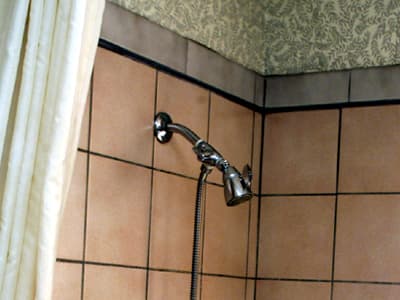
Where the moisture comes from
Steam that never leaves. It takes very little water for mold to grow; a bit of condensation in a bathroom or on a window sill can be enough.[4] Bathroom tile and grout are among the common places mold grows indoors.[4] A fan that is not switched on, is switched off too soon, or barely moves air leaves the room wet for hours.
A warm, humid house. Mold spores become active and grow quickly when there is plenty of moisture, high humidity and a temperature above 65°F.[1] EPA recommends keeping indoor relative humidity under 60 percent, ideally 30 to 50 percent.[2] What humidity to keep your house at covers how to get there.
Cold surfaces. An exterior wall, a window, or a ceiling under a cold attic often collects condensation first. When condensation or moisture collects on windows, walls or pipes, dry the surface quickly and cut down the source of the moisture.[2] Insulation on cold surfaces such as windows, pipes and exterior walls makes condensation less likely.[1]
Leaks. A dripping supply line under the sink, a failing seal under the toilet or a gap where the tub meets the wall can keep one spot wet all the time. Mold that keeps returning in the same corner, or a stain that grows, often points to one.
Hidden growth. Mold can also grow out of sight: behind drywall, wallpaper or paneling, on top of ceiling tiles, or under carpet and padding.[2] A musty smell with nothing visible is the usual clue.
How to stop it coming back
Ventilate every time. A room that is damp most of the time is hard to keep entirely free of mold,[3] but more ventilation, from a fan or an open window, plus more frequent cleaning will usually keep mold from returning or at least hold it to a minimum.[3] EPA's advice is to run the fan or open the window whenever you shower,[2] and the Virginia Department of Health recommends exhaust fans to send moisture from cooking, dishwashing and showers outdoors.[1]
Clean it off properly. Scrub the mold off tile and other hard surfaces with detergent and water, then dry them completely.[3] Never paint or caulk over mold; clean it off and let the surface dry first.[3]
Protect yourself. With a disinfectant, a biocide such as chlorine bleach or a strong cleaning solution, wear gloves made of natural rubber, neoprene, nitrile, polyurethane or PVC,[2] along with goggles without ventilation holes.[2] Mixing chlorine bleach with cleaners or detergents that contain ammonia can produce toxic fumes, so never combine them.[2]
Dry what stays wet. A squeegee on the shower walls, a curtain pulled straight so it can dry, and towels and bath mats hung up rather than left in a pile take a minute and cut down the water mold would use.
Stop and call a pro if
- The mold covers a large area. EPA says in most cases you can clean up a moldy area yourself when it is smaller than about 10 square feet, roughly a 3 ft. by 3 ft. patch.[3] For a large area covered in mold, the Virginia Department of Health recommends professional help.[1] Look for a mold remediation business. Under Virginia's Consumer Protection Act, it is a prohibited practice to sell or offer professional mold remediation on a home "without holding a mold remediation certification from a nationally or internationally recognized certifying body for mold remediation, and failing to comply with" EPA's guide to mold remediation in schools and commercial buildings, the ANSI/IICRC S520 standard, or another equivalent ANSI-accredited mold remediation standard.[5]
- The mold or water damage came from sewage or other contaminated water. EPA's advice is to call in a professional with experience cleaning and repairing buildings damaged by contaminated water.[3]
- Someone in the house has health concerns, asthma or a weakened immune system. EPA advises talking to a health professional before you start cleaning up if you have health concerns,[3] and the Virginia Department of Health says people with suppressed immune systems should avoid heavy mold infestations.[1]
- Drywall or the ceiling is soft, bulging or stained from behind, or the smell is musty with no visible source.
- You find a leak under the sink, at the toilet or in the wall; that is a job for a plumber.
- The fan does not work, is not vented to the outside, or there is no fan at all. Repairing or adding one is electrical work; hire an electrician.
- You rent and the landlord has not fixed it. The Virginia Department of Health tells tenants whose landlord has not promptly addressed their concerns to contact the Virginia Office of the Attorney General's Consumer Protection Section.[1]
Getting help
If you would rather have the bathroom deep cleaned and disinfected by someone else, read when a professional disinfecting service makes sense and browse disinfecting and sanitizing businesses. You can also look up cleaning services around Blacksburg or read more cleaning answers. To get quotes, describe the job on Loclis.
Common questions
- Does bleach kill bathroom mold for good?
- No. Spores in the air settle and grow again wherever the bathroom stays damp, whatever you cleaned with. EPA does not recommend biocides such as chlorine bleach as a routine part of mold cleanup, and the Virginia Department of Health lists detergent and water or a mild bleach solution for small areas on hard surfaces. Scrubbing with detergent and water, drying the surface and fixing the moisture are what stop it coming back.
- How long should I run the bathroom fan after a shower?
- Run it for the whole shower, and it usually helps to leave it on until the mirror and walls have cleared of fog, longer in a small bathroom with no window. If the fan barely moves air, is very loud, or the room stays steamy with it on, have it checked. Repairing or replacing a fan is electrical work; hire an electrician.
- Why does mold keep growing on the ceiling above the shower?
- Warm, wet air rises and condenses on the cooler ceiling, especially on an exterior wall or under an attic. Better ventilation during and after showers is the first fix. If the stain spreads, the paint bubbles, or the drywall feels soft, there may be a leak or condensation inside the ceiling, which needs a pro.
- Can I just caulk or paint over the mold?
- No. EPA advises against painting or caulking moldy surfaces. Clean the mold off and dry the surface first; paint applied over a moldy surface is likely to peel.
- Is the black mold in my shower dangerous?
- Mold in a shower is common. Allergic reactions are the most commonly reported health effect, and young children, older people, pregnant women and people with asthma or other respiratory diseases are more likely to have symptoms. If anyone has symptoms that may be related, talk to a doctor, and treat a large or spreading growth as a job for a professional.
- I rent. Who fixes recurring bathroom mold?
- Tell your landlord in writing. If the landlord does not deal with it, the Virginia Department of Health points tenants to the Office of the Attorney General's Consumer Protection Section for landlord-tenant issues.
Sources
- [1] Mold, Virginia Department of Health. Checked October 26, 2026.
- [2] A Brief Guide to Mold, Moisture and Your Home, U.S. Environmental Protection Agency. Checked October 26, 2026.
- [3] Mold Cleanup in Your Home, U.S. Environmental Protection Agency. Checked October 26, 2026.
- [4] Mold Course Chapter 1: Introduction to Molds, U.S. Environmental Protection Agency. Checked October 26, 2026.
- [5] Va. Code § 59.1-200, Prohibited practices (Virginia Consumer Protection Act), Code of Virginia, Virginia General Assembly. Checked October 26, 2026.
Want a pro to handle it?
Describe the job once. Licensed local businesses send quotes, and you pay only when you book one.
Get a quote from a local pro