Why does my battery mower shut off in tall grass?
Most battery mowers have overload protection that stops the motor when the blade is working too hard, which tall, thick or wet grass and a clogged deck all cause. Take out the battery, clear the deck, raise the cutting height, slow your pace and restart. If it trips often, have it checked.
Free to ask. Local shops send quotes, and you pay only when you book one.
By Kasra Taheri, Founder, LoclisPublished
Researched and drafted with AI, then checked claim by claim against the sources listed below before it was published. Prices and rules change; the dates beside each source say when it was last checked.
Step by step
Read when to stop and call a pro, further down this page, before you start.
Step 2: Clear the deck
Check whether grass has accumulated beneath the deck and clean it out if necessary.[1] Use a stick or a gloved hand, never bare fingers near the blade.
Step 3: Raise the cutting height
Set the deck to a higher position, with the battery still out, so the blade takes less grass at once.[1]
Step 4: Slow your pace
Walk slower, especially through thick patches, so the blade can cut and discharge the clippings.[1]
Step 5: Check the blade
With the battery out, look at the blade. A dull blade makes the motor work harder, so sharpen or replace it if it is worn.[1]
Step 6: Let a hot mower cool
If the status light shows an overheat warning, release the blade trigger and wait until the mower cools before restarting.[1]
Step 7: Cut tall grass in two passes
Mow once at a high setting, then again a few days later or after a second pass at the final height.[1]
It is probably protecting itself
Battery mowers are built to cut out before the motor or battery is damaged. EGO's manual puts it this way: "Your mower has built-in overload circuit protection. When the mower is overloaded, the motor will stop and the mower status indicator on the dashboard will flash orange."[1] Other brands use different lights or just stop, but the logic is the same. Tall, thick or damp grass, a packed deck and a dull blade all raise the load, and the motor stops when it gets too high.
So shutting off in tall grass is usually a sign you are asking the mower for too much in one pass, not a sign it is broken.
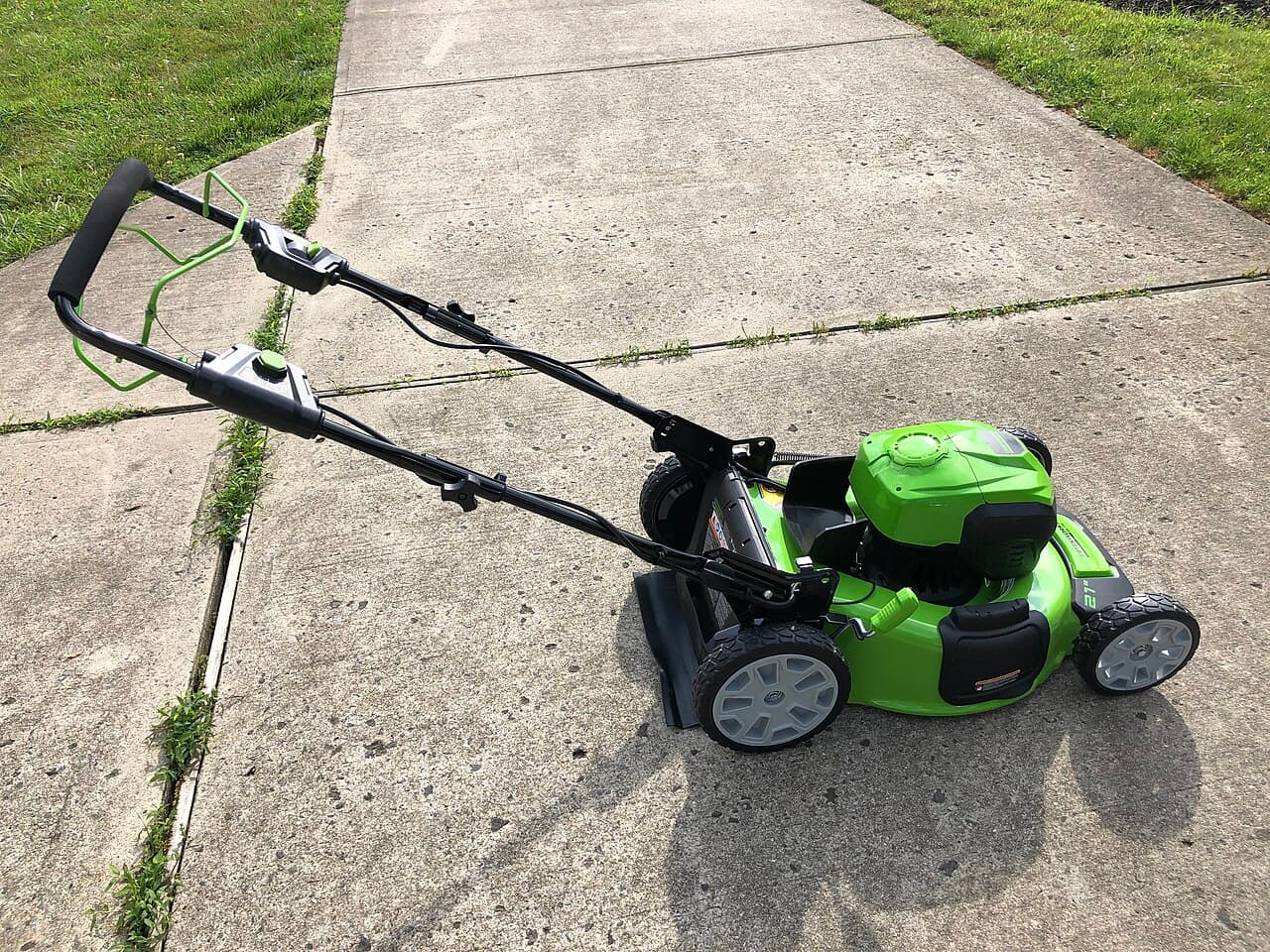
Clear it and restart
Before you touch anything under the deck, remove the battery. Virginia Cooperative Extension's rotary mower safety guidance says: "Disconnect the spark or electric plug before troubleshooting or repairing the mower."[2] On a cordless mower, taking out the battery is the equivalent.
Then work through the usual causes in order:
- A packed deck. The manual's first step for an overload is to check if grass has accumulated beneath the deck, and clean it if necessary.[1] Wet clippings pack under the deck fast, and a clogged deck can stall the blade even when the grass is fine.
- Cutting too low. The manual says: "To avoid overloading the motor, avoid setting the cutting height too low in tall grass. If the motor speed begins to slow, raise the cutting height."[1] Listen for the motor note dropping, and lift the deck before it cuts out.
- Walking too fast. Slowing your stride gives the blade time to cut and throw the clippings out.[1]
- A dull blade. EGO notes that "A sharp blade will greatly enhance the performance of the mower, especially when cutting tall grass."[1] See how to sharpen lawn mower blades and how often mower blades need sharpening.
Cut overgrown grass in two passes
If the lawn has got away from you, do not drop the deck to your usual height and push through. Cutting grass that is several inches over its normal height in one pass is the classic way to trip the cutout.
Mow once at the highest deck setting, then go over it again at the next setting down. EGO says that "For mulching extremely thick or tall grass, it is advisable to first cut at a high cut-height setting, and then re-cut to the final cut height."[1] It also helps the lawn: Virginia Cooperative Extension's rule is to never remove more than one-third of the leaf blade at any mowing event,[3] and two staged cuts, days apart if the grass is very long, get you there without stressing the turf. Mow when the grass is dry, because wet grass clumps and loads the motor.
Heat can also shut it off
Overload is not the only automatic shutoff. In EGO's design, "If the mower temperature exceeds 194 °F (90 °C) during operation, the temperature-protection circuit will immediately shut off the mower to prevent overheating damage."[1] That shows up as a different light. On a hot afternoon, with heavy grass, an overheating trip is easy to hit. Release the trigger and give the mower time to cool, then restart on a higher setting.
Your own model may use other lights, thresholds and reset steps, so check the troubleshooting table in your manual. The model number is on a label on the mower, and the manual is usually a free download from the maker.
Stop and call a pro if
- It trips on short, dry grass with a clear deck, a sharp blade and the deck set high. The manual says: "If the mower's built-in overload protection switch frequently trips, contact EGO Customer Service or your closest EGO service center."[1]
- The status light shows an electronics or battery error instead of an overload or heat warning.
- The blade does not spin freely with the battery out, or it is bent, cracked or wobbles.
- The battery is swollen, hot, damaged or smells burnt. Stop using it and do not charge it.
- You hear grinding, or the mower vibrates hard after hitting something.
Getting help in Virginia
For more on what goes wrong with cordless and plug-in mowers, browse lawn equipment repair answers and the lawn care directory. A small-engine or mower shop can test the battery, the switch and the motor, and replace a worn blade.
When it still cuts out after the basics, describe the problem and local mower repair shops can quote it.
Common questions
- Is it normal for a battery mower to cut out in tall grass?
- Yes, to a point. The cutout is a protection feature, not a fault. EGO's manual describes built-in overload protection that stops the motor and flashes the status light orange when the mower is overloaded. It becomes a problem when it happens in ordinary grass or keeps repeating.
- Does a dull blade make a battery mower shut off?
- It can contribute. A dull blade tears grass instead of slicing it and loads the motor more. EGO's manual says a sharp blade greatly improves performance, especially in tall grass, so check the edge before you blame the battery.
- Could the battery be the problem instead of the grass?
- Sometimes. A low or worn battery can cut power under load, and a hot battery or mower can shut itself off. If the mower runs fine on a light load with a charged battery but stops only when the grass is heavy, the load is the more likely cause. A second battery of the same type is a quick test.
- How tall is too tall to mow in one pass?
- Virginia Cooperative Extension says never remove more than one-third of the leaf blade at any mowing event. If the lawn has grown well past that, raise the deck, cut once at the high setting, then lower it for a second pass.
- When should I stop trying to fix it myself?
- When the mower trips on short, dry grass with a sharp blade and a clear deck, or the status light shows an electronics error. EGO tells owners to contact customer service or a service center if the overload protection frequently trips.
Sources
- [1] Operator's Manual, 56-Volt Lithium-Ion Cordless 22" Lawn Mower, LM2200SP, EGO Power+. Checked October 28, 2026.
- [2] Lawn Care: Rotary Mower Safety (BSE-42P), Virginia Cooperative Extension, Virginia Tech. Checked October 28, 2026.
- [3] Fall Lawn Care (430-520), Virginia Cooperative Extension, Virginia Tech. Checked October 28, 2026.
Want a pro to handle it?
Describe the job once. Licensed local businesses send quotes, and you pay only when you book one.
Get a quote for Lawn Equipment