Why is my newly remodeled bathroom getting moldy?
Almost always because moisture stayed too long: a weak or unused exhaust fan, high humidity, wet materials closed in behind new finishes, or a slow leak. The EPA says to dry wet areas within 24-48 hours. Mold that returns after cleaning, or smells with no visible source, is a job to raise with your remodeler or a licensed contractor.
Free to ask. Local shops send quotes, and you pay only when you book one.
By Kasra Taheri, Founder, LoclisPublished
Researched and drafted with AI, then checked claim by claim against the sources listed below before it was published. Prices and rules change; the dates beside each source say when it was last checked.
This is a job for a licensed pro in Virginia
This page explains what the work involves, the permits, what a licensed pro does and what drives the cost. It does not give step-by-step instructions, because this work needs a licence, a permit or both, and doing it wrong can injure someone. Before you hire, check the licence on Virginia's DPOR record.
Almost always, water that never got a chance to leave
A bathroom that molds soon after a remodel has a moisture problem, not a cleaning problem. Mold needs a damp surface and some time, and the EPA's rule is that it is important to dry water-damaged areas and items within 24-48 hours to prevent mold growth.[1] When damp materials are dried in that window after a leak or spill, in most cases mold will not grow.[1] A new bathroom grows mold when something keeps it wet longer than that, or when wet material was closed up behind new finishes.
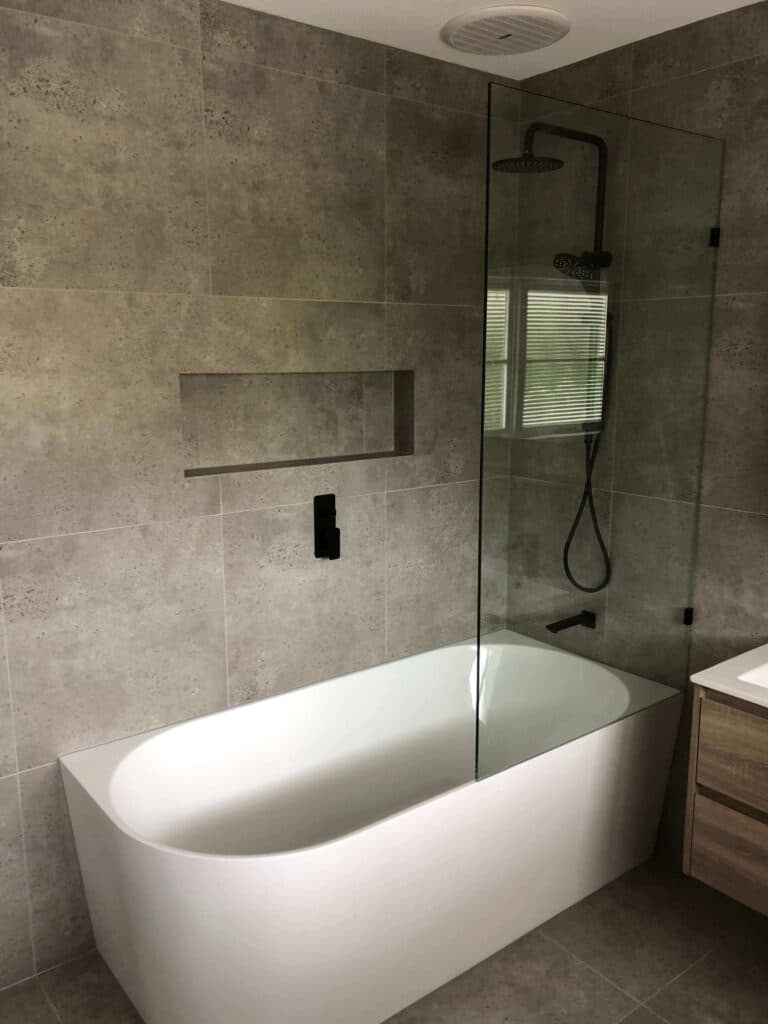
The usual causes, roughly in order of likelihood
The exhaust fan is too weak, not ducted outside, or not used. A shower puts a great deal of water vapor into a small room. Virginia Cooperative Extension lists a bathroom ventilation fan with humidistat or timer vented to exterior as a feature of a moisture-resistant new home.[3] A fan that dumps into the attic or into the ceiling cavity moves the moisture somewhere worse, and a fan on a timer helps because people actually leave it running. The EPA's bathroom advice is that if mold in the shower or elsewhere in the bathroom seems to reappear, increasing ventilation (running a fan or opening a window) and cleaning more frequently will usually prevent mold from recurring, or at least keep the mold to a minimum.[1]
High humidity in the whole house. The EPA suggests that, if possible, you keep indoor humidity below 60 percent (ideally between 30 and 50 percent) relative humidity.[1] A new tile bathroom in a house that sits well above that in July can grow mold whatever the fan does.
Materials were wet when they were closed in. Framing, backer board or drywall that was rained on, sat in a damp basement or was soaked during the work, and was then covered, holds water against the new finish. Paint and caulk over damp or already moldy material hide the problem for a few weeks, and the EPA is blunt about it: Do not paint or caulk moldy surfaces.[1]
A slow leak behind the finish. A poorly sealed shower valve, drain connection or supply joint, or a gap in the shower's waterproofing, wets the wall cavity continuously. Mold on the wall outside the shower, a musty smell with no visible source, or a soft spot in the floor all point this way.
Joints that were never sealed well. Caulk and grout joints are where water gets behind tile. Mold along the caulk line is usually a surface problem. Mold that returns through a freshly cleaned joint suggests water is coming from behind it.
Surface mold or hidden mold
Mold on the surface of caulk or grout in a room where the fan is rarely used is the mild case. Hidden mold is another matter. The EPA says you may suspect hidden mold if a building smells moldy but you cannot see the source,[1] and that mold may be hidden in places such as the back side of dry wall, wallpaper, or paneling.[1] Other possible places are areas inside walls around pipes (with leaking or condensing pipes).[1] If you believe that you may have a hidden mold problem, consider hiring an experienced professional.[1]
Size matters too. If the moldy area is less than about 10 square feet (less than roughly a 3 ft. by 3 ft. patch), in most cases, you can handle the job yourself.[2] For a larger area, or after a lot of water damage, the EPA points to its remediation guidance instead. The Virginia Department of Health says it does not have the capability to provide environmental testing or remediation for mold problems,[4] so the work is arranged privately.
Raise it with the contractor who built it
Mold in a bathroom finished in the last year or two is worth taking to the contractor who did the work, because the cause is often in what they installed or enclosed: the fan and its duct, the waterproofing, the moisture left in the wall. Put the complaint in writing with dates and photos, before anyone paints over it. For context on the job itself, see what happens during a bathroom remodel and how much a bathroom remodel costs in Virginia, and for avoiding a repeat, how to keep a new bathroom from getting moldy.
When to call a licensed pro
Call a Virginia-licensed contractor when mold returns after cleaning, when it covers more than a small patch, when there is a leak or a soft floor or wall, or when the exhaust fan needs to be replaced or re-ducted. Opening a wall to find the source, repairing a supply or drain line and rerouting a fan duct are work for licensed trades, and plumbing and electrical changes can need a permit; see whether you need a permit to remodel a bathroom in Virginia.
Virginia's Board for Contractors says: "If the work you are considering is valued at $1,000 or more, a valid Virginia Contractor’s License is required for the license category in which the contractor is to work."[5] It adds that hiring a licensed contractor makes you eligible for compensation from the Contractor Transaction Recovery Fund in case of improper or dishonest conduct.[5] Check the licence number and class on the DPOR licence lookup before you sign. If anyone in the home has asthma, allergies or other health concerns, talk to a health professional before any cleanup begins.
Find help
Browse more remodeling answers or remodeling contractors in Virginia. When you are ready, describe the bathroom problem once and licensed local contractors can quote the diagnosis and repair.
Common questions
- Is mold in a new bathroom my contractor's fault?
- Not automatically, but it is worth raising with them. Mold means moisture stayed too long, and the cause is often something the remodel controls: the exhaust fan and where it vents, the waterproofing, or damp material that was closed in. Report it in writing with dates and photos, and have the cause found before anyone paints or caulks over it.
- Can I just clean the mold off and be done?
- On a small surface patch, possibly. The EPA says a moldy area of less than about 10 square feet can in most cases be handled yourself. But cleaning does nothing if the moisture source stays, and the EPA says not to paint or caulk moldy surfaces. If it returns, look for a leak or poor ventilation.
- How fast does mold start after a leak?
- The EPA says to dry wet or damp materials within 24-48 hours, and that if they are dried in that time, in most cases mold will not grow. After a plumbing leak, wet drywall or backer board that was not dried is the usual starting point.
- Does a window in the bathroom replace an exhaust fan?
- Not reliably. The EPA's advice is to run the bathroom fan or open the window when showering, so a window is a backup. A fan vented to the outside, on a timer or humidistat, works whether or not anyone remembers the window.
- Should I get my bathroom tested for mold?
- The Virginia Department of Health says it does not provide environmental testing or remediation for mold problems. Finding and fixing the moisture source matters more than a test result; for hidden mold, the EPA suggests hiring an experienced professional.
Sources
- [1] A Brief Guide to Mold, Moisture and Your Home, U.S. Environmental Protection Agency. Checked October 27, 2026.
- [2] Mold Cleanup in Your Home, U.S. Environmental Protection Agency. Checked October 27, 2026.
- [3] Energy Series: What Can Builders Do to Help Prevent Moisture Problems in New Construction?, Virginia Cooperative Extension, Virginia Tech. Checked October 27, 2026.
- [4] Mold - Environmental Health, Virginia Department of Health. Checked October 27, 2026.
- [5] What You Should Know Before You Hire a Contractor, Virginia Board for Contractors, DPOR. Checked October 27, 2026.
Want a pro to handle it?
Describe the job once. Licensed local businesses send quotes, and you pay only when you book one.
Get a quote from a local pro