Why is my wood fence rotting at the bottom?
Because the bottom stays wet. Decay fungi need moisture, mild temperatures and air, and wood at the soil line, under mulch or in sprinkler spray rarely dries out. Boards touching the ground, untreated sapwood, posts not treated for ground contact and bare cut ends rot first. Find which parts are soft, fix the water, then replace what has rotted.
Free to ask. Local shops send quotes, and you pay only when you book one.
By Kasra Taheri, Founder, LoclisPublished
Researched and drafted with AI, then checked claim by claim against the sources listed below before it was published. Prices and rules change; the dates beside each source say when it was last checked.
Step by step
Read when to stop and call a pro, further down this page, before you start.
Step 1: Map the soft wood
Probe the posts, the bottom rail and the board ends with an awl or screwdriver above and just below the soil to find where the wood has gone soft.[1]
Step 2: Look for termites
Check posts at the ground line for earthen tubes on the surface or galleries running along the grain inside soft wood.[1]
Step 3: Clear the base
Rake soil, mulch, leaves and grass clippings away so no board, rail or post face is buried against damp material.
Step 4: Fix the water
Turn sprinkler heads away from the fence, extend downspouts that drain toward it, and trim shrubs and vines so the bottom can dry.
Step 5: Lift the boards
Where pickets touch the ground, trim their bottoms or raise them so a gap separates the wood from the soil.
Step 6: Treat cut ends
Brush copper naphthenate onto any end you cut in treated lumber, following the product label.[2]
Step 7: Replace soft boards and rails
Swap rotted pickets and rails for treated lumber, using lumber rated for ground contact (UC4) for anything close to the soil.[2]
Step 8: Seal new end grain
Brush a water-repellent preservative onto the bottom end grain of new boards before you hang them.[3]
Step 9: Plan for soft posts
Mark any post that is soft at the ground line for replacement, and request a Virginia 811 locate before anyone digs.[8]
A wood fence rots at the bottom because that is where it stays wet. Decay fungi need suitably mild temperatures, moisture and air,[1] and the bottom few inches of a fence get all three for most of the year in Virginia: soil and mulch hold water against the wood, rain splashes up, sprinklers soak it, and shade keeps it from drying. Wood that never dries out is where rot starts, and the fence fails there first even when the boards a foot higher look new.
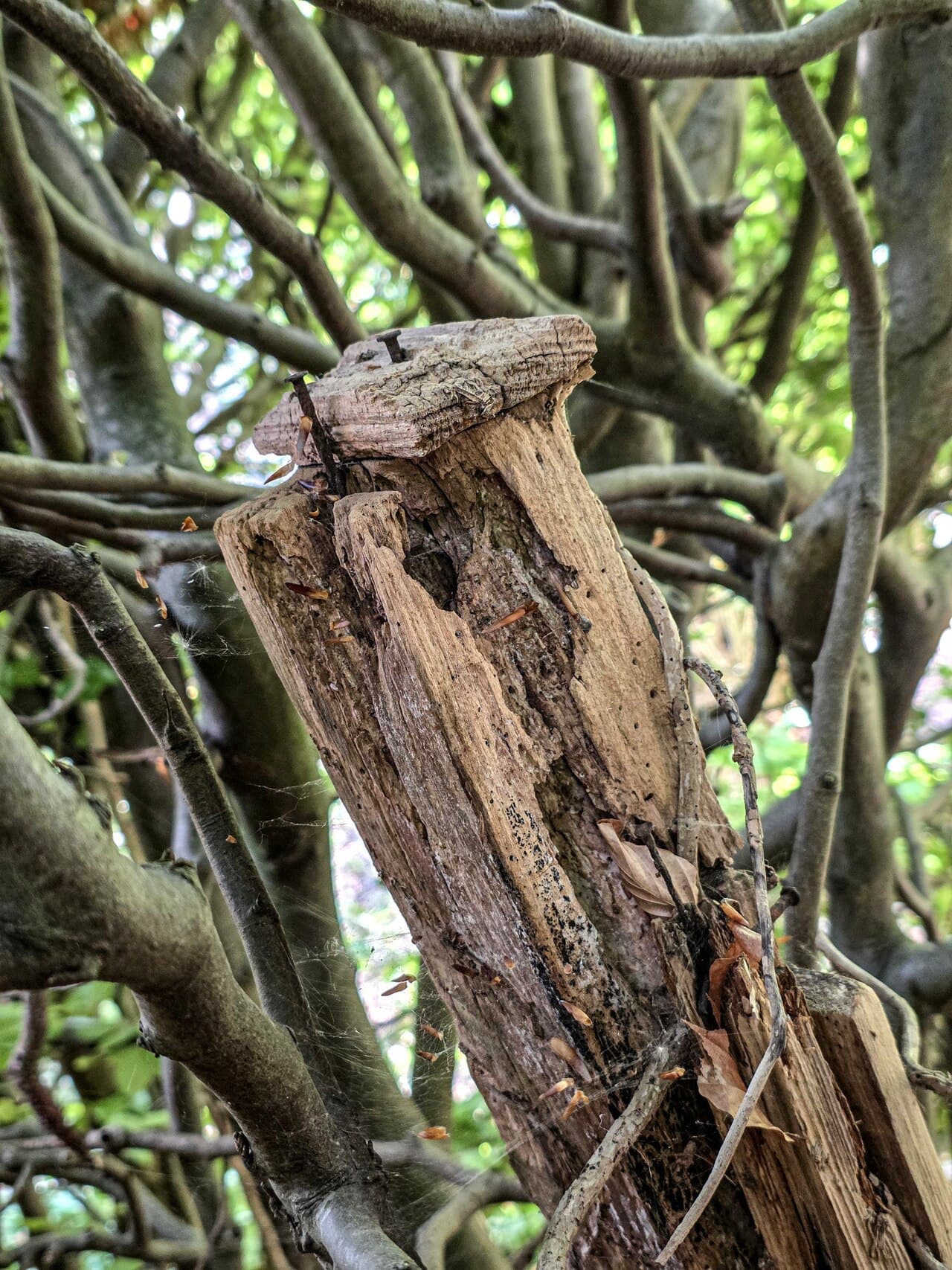
What rot needs
Rot is not just age. It needs wet wood. According to the Forest Products Laboratory, serious decay happens only when wood is wetter than its fiber saturation point, which averages 30% moisture.[1] Dried wood reaches that point only when rain or condensation wets it or it sits in contact with wet ground.[1] Fully air-dried wood usually stays at or below 20% moisture, a reasonable margin of safety.[1] Temperature matters too: decay is slow below 50 °F and above 95 °F,[1] so the long mild stretches of a Virginia year are when it does most of its work.
That is why height above the ground matters so much. For houses, the Forest Products Laboratory recommends at least 6 inches between soil and siding and 8 inches between soil and framing.[1] Fences have no such rule, and many are built with pickets almost touching the dirt. The closer the wood is to the soil, the longer it stays wet after every rain.
The usual causes
Boards touching the ground. Pickets that sit on or in the soil wick water up through their end grain, which soaks up water far faster than the face of a board. Grass, leaves and mulch piled against them make it worse.
Posts not treated for ground contact. Treated lumber is graded by use: UC3 is for exterior wood used above ground and UC4 is for wood in ground contact.[2] A post cut from above-ground stock rots at the soil line much faster than one treated for burial. Each piece of treated wood should carry a stamp or end tag showing the preservative, the retention and the use category,[2] so leftover lumber in the garage may tell you what was used.
Untreated or sapwood-heavy wood. Untreated sapwood of essentially all species has low resistance to decay.[1] Cedar and other naturally durable species help, but only the heartwood of the most decay-resistant species generally holds up in ground contact,[1] and much of what is sold today is second growth with a high share of sapwood.[1] That is why, where decay conditions are severe, pressure-treated wood is generally recommended over resistant heartwood.[1] Virginia Cooperative Extension's figures give red cedar posts 15 to 20 years untreated and southern pine only 3 to 7,[4] against treated southern pine posts 25 to 30 years.[4]
Bare cut ends. Cutting treated lumber exposes wood the treatment may not have reached. The Forest Products Laboratory says the damage can be partly overcome by brushing copper naphthenate (1% to 2% copper) onto the cut surface.[2] Fence boards trimmed to length on site and never treated at the bottom are a common weak spot.
Water aimed at the fence. A sprinkler head that hits the same few boards every morning, a downspout draining toward the fence line, or a low spot where water pools will rot that section years ahead of the rest.
Posts that hold water. Concrete that is flush or dished around a post, or soil heaped on top of the footing, holds water against the wood at exactly the point where it is most vulnerable. QUIKRETE suggests a gravel base under each post and a concrete top that slopes away from the wood to protect posts against rot.[7]
Termites. Rot and termites like the same conditions. Powhatan County's design table rates its termite hazard moderate to heavy and its weathering severe,[5] and Shenandoah County lists the same.[6] Subterranean termites nest in the ground, need a constant source of moisture, and build earthen tubes to reach wood.[1] Their galleries follow the grain and leave a shell of sound wood, so probing with a pick or knife is the way to check.[1]
Reading where it rots
- Only the bottoms of the pickets: ground contact or splash. The fence is usually saveable.
- The bottom rail: water sitting on its top edge, or soil against it.
- Posts at the soil line: the wrong grade of post, or a footing that holds water. This decides how long the fence has left.
- One section much worse than the rest: look for the sprinkler, downspout or low spot.
- Hollow wood behind a firm surface: suspect termites.
Water-repellent preservatives soak readily into end grain and can slow water absorption there for years,[3] which makes them worth brushing onto the bottom ends of any new boards. How to make a wood fence last longer covers the maintenance routine, and how long a wood fence lasts helps you decide whether to repair or replace.
Stop and call a pro if
- You find termite tubes or hollow, tunnelled wood. Termite treatment is a job for a licensed pest control company.
- Several posts are soft at the ground line. Replacing posts means digging, and Virginia law requires a locate request before any excavation.[8]
- The fence is leaning, is a swimming pool barrier, or sits on a retaining wall.
- The rot has spread into a deck, porch or shed the fence is attached to.
If you hire the repair out, a Class C contractor's licence covers single contracts over $1,000 and under $30,000,[9] so check the business with DPOR. If a post is already leaning, see how to fix a leaning fence post. Browse fence repair businesses, exterior businesses around Blacksburg, or all exterior answers. To get it fixed, describe the rotting fence once and local businesses send written quotes.
Common questions
- My fence is pressure-treated. Why is it still rotting?
- Treated lumber comes in grades. Wood treated for above-ground use (UC3) is not meant for soil contact; ground contact needs UC4. Cut ends also expose wood the treatment may not have reached. Check the end tag on any leftover lumber, and treat cut ends with copper naphthenate following the label.
- Is the white or green growth on the bottom boards rot?
- Not necessarily. Mildew and algae grow on damp wood and discolour it without breaking it down. Rot shows as soft, stringy, cracked or crumbling wood. Push an awl into the spot: if it sinks in easily, it is decay; if the wood is hard under the stain, clean it and keep the area drier.
- Could termites be causing it?
- They can. Powhatan and Shenandoah counties rate their termite hazard moderate to heavy. Subterranean termites need moisture and come up from the soil, so the bottom of a fence is where they start. Look for earthen tubes and probe for hollow wood behind a sound surface. Termite treatment is a job for a licensed pest control company.
- Can I just replace the bottom boards?
- Yes, if the posts are hard at the ground line. Replace soft pickets and the bottom rail with treated lumber, leave a gap above the soil, and seal the new bottom end grain. If the posts are soft too, new boards on rotting posts will not last long.
- Should I add a kickboard along the bottom?
- A kickboard is a separate board along the bottom of the fence that takes the ground contact instead of the pickets, so it can be replaced on its own. If you add one, use lumber treated for ground contact (UC4) and keep the pickets above it so they do not touch the soil.
Sources
- [1] Wood Handbook, Chapter 14: Biodeterioration of Wood, USDA Forest Service, Forest Products Laboratory. Checked October 26, 2026.
- [2] Wood Handbook, Chapter 15: Wood Preservation, USDA Forest Service, Forest Products Laboratory. Checked October 26, 2026.
- [3] Wood Handbook, Chapter 16: Finishing of Wood, USDA Forest Service, Forest Products Laboratory. Checked October 26, 2026.
- [4] Fencing Materials for Livestock Systems, publication 442-131 (archived), Virginia Cooperative Extension, Virginia Tech. Checked October 26, 2026.
- [5] Building Codes and design information, Powhatan County, Virginia. Checked October 26, 2026.
- [6] Design Information, Shenandoah County, Virginia. Checked October 26, 2026.
- [7] Setting Posts in Concrete, The QUIKRETE Companies. Checked October 26, 2026.
- [8] Va. Code § 56-265.17, Notification required prior to excavation or demolition, Code of Virginia, Virginia General Assembly. Checked October 26, 2026.
- [9] Va. Code § 54.1-1100, Definitions (Contractors), Code of Virginia, Virginia General Assembly. Checked October 26, 2026.
Want a pro to handle it?
Describe the job once. Licensed local businesses send quotes, and you pay only when you book one.
Get a quote for Roofing