How do I fix a leaning fence post?
Find out why it leans first. A sound post that has tipped in soft soil can usually be dug out on one side, pushed plumb, braced and set again with fresh concrete. A post that has rotted or snapped at the ground line has to be replaced instead. Either way, Virginia law requires a free 811 locate request before you dig.
Free to ask. Local shops send quotes, and you pay only when you book one.
By Kasra Taheri, Founder, LoclisPublished
Researched and drafted with AI, then checked claim by claim against the sources listed below before it was published. Prices and rules change; the dates beside each source say when it was last checked.
Step by step
Read when to stop and call a pro, further down this page, before you start.
Step 1: Find what moved
Push the top of the post and watch the ground line to see whether the post rocks inside its concrete, the whole footing tips in the soil, or the wood is broken.
Step 2: Probe for rot
Push a screwdriver into the post just below the soil line; if it sinks into soft wood, the post needs replacing rather than straightening.
Step 4: Take the load off
Unlatch any gate and prop the fence sections on each side with a 2x4 so the panels do not pull the post over while you work.
Step 5: Dig beside the footing
Dig out the soil around the footing, mostly on the side the post leans away from, so the post has room to move back.
Step 6: Push it plumb
Push the post upright and check it with a level on two adjacent faces, not just the one facing you.[4]
Step 7: Brace it
Screw angled 2x4 braces to two adjacent sides of the post and fasten their lower ends to stakes driven into the ground.[4]
Step 8: Fill the hole
Fill the gap with fast-setting concrete to 3 to 4 inches below grade, add water as the bag directs, and backfill with soil once it sets.[4]
Step 9: Wait before loading it
Leave the braces on until the concrete is firm, and longer when the temperature is below 72 degrees.[5]
Step 10: Refasten the fence
Check the rails and boards on both sides, replace popped nails with exterior screws, and rehang or adjust the gate last.
Start by working out why the post leans, because that decides the fix. A sound post that has tipped in soft or wet soil can usually be straightened where it stands: dig beside the footing, push it plumb, brace it and set it again in fresh concrete. A post that has rotted or snapped at the ground line cannot be straightened. It has to be replaced. Both jobs involve digging, and Virginia law requires a locate request to the notification center before any excavation.[1]
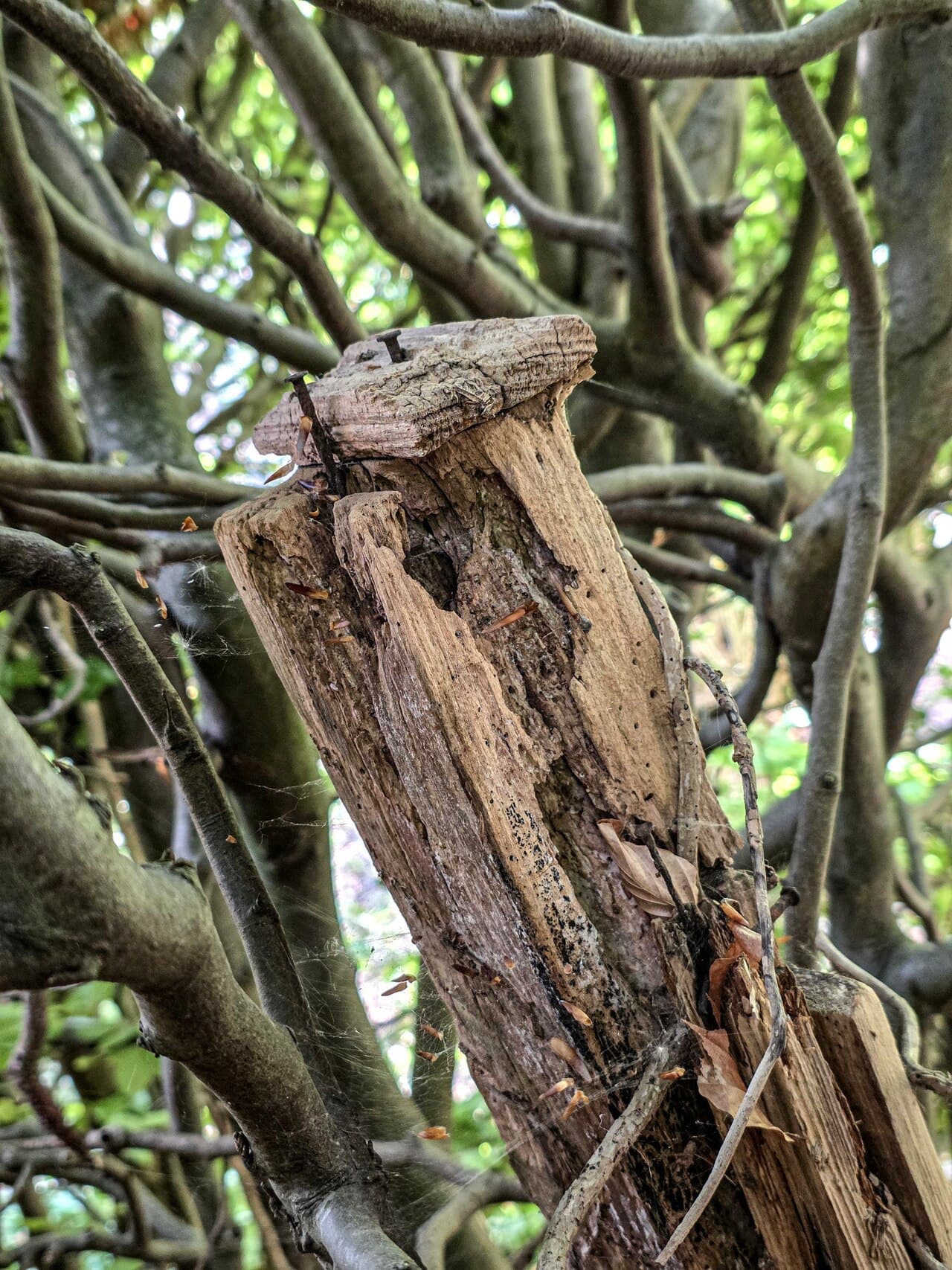
Why posts lean
Soft or wet soil. Heavy clay that stays wet after long rains loses its grip on a footing, and a downspout or sprinkler that soaks one spot makes it worse. The post and its concrete collar tip together.
A footing that is too small. QUIKRETE's guide sizes a post hole at three times the post's width and one-third to one-half of the post's above-ground length deep, plus 6 inches,[4] with 6 inches of gravel or crushed stone in the bottom.[4][5] A 6-foot fence on posts with a foot or so in the ground has little to resist a strong gust.
Frost. Water that freezes in the soil can lift a shallow footing unevenly, so the post tips as it rises. Loudoun County lists a frost depth of 24 inches[9] and Powhatan County lists 18 inches.[10] Those figures are for building footings, not fences, but they show how deep the freeze can reach. Posts that stood straight in October and lean in March point to this.
Wind and weight. A solid privacy fence catches wind like a sail, and board fences typically have posts every 8 feet,[8] so a longer span puts more load on each post. Virginia Cooperative Extension notes that post strength is especially important for corner and gate posts.[8] If only the gate post leans, the gate is the cause.
Rot at the ground line. This is the most common cause on an older fence. Decay fungi need mild temperatures, moisture and air,[6] and serious decay happens only when wood is wetter than its fiber saturation point, which averages 30% moisture.[6] The few inches of post just below the soil sit at exactly that wetness for months. A post that was not rated for ground contact softens there first, and the fence leans because the post is breaking, not because the footing moved.
Straighten it or replace it?
Rock the post and look closely at the ground line.
- The post and its concrete move together, and the wood is hard: straighten and reset it. The steps on this page cover that job.
- The post wiggles inside a concrete collar that stays still: the wood has shrunk or rotted inside the collar. Probe it. Hard wood can be wedged and reset; soft wood means replacement.
- A screwdriver sinks into the wood at or just below the soil: replace the post. Straightening a rotted post only moves the break.
- The post is snapped or split: replace it.
When you replace a post, the Forest Products Laboratory recommends pressure-treated wood for the high hazard of ground contact.[6] Look for use category UC4, the category for wood used in ground contact in exterior applications,[7] and check the end tag of treated lumber before you buy, since the tag shows the use category. How to set a fence post in concrete covers the hole, the gravel and the pour for a new post.
Dig safely
Digging around a post is excavation under Virginia law: the law's definition of excavation includes digging, augering and driving.[2] Virginia 811 asks homeowners to contact it three days before any digging project, fences included, and the service is free.[3] After you submit the request, you may start once every utility has marked its lines, reported that none are present, or otherwise posted a response that digging may begin.[1] Dig by hand near any marks.
Getting it to stay straight
A few details make the difference between a post that stays put and one that leans again by spring:
- Check plumb on two faces. A post checked only on the face toward you can look straight from the house and still lean along the fence line.
- Do not skimp on concrete in poor soil. For loose or sandy soil, QUIKRETE calls for larger, dish-shaped holes.[5]
- Shed water away from the wood. Adding gravel under the post and finishing the concrete so it slopes away from the post helps protect it from rot.[4]
- Give it time. Fast-setting concrete sets in about 20 to 40 minutes,[5] but it needs longer in cool weather, so leave the braces on and do not hang a gate the same afternoon.
- Fix the water. Turn sprinkler heads away and extend a downspout that drains toward the fence, or the soil will soften again.
If several posts in a run lean the same way, the whole run was probably set too shallow, and resetting it in one go usually costs less than chasing single posts. Why new fence posts lean goes through that pattern, and how long a wood fence lasts helps you judge whether an old fence is worth saving.
Stop and call a pro if
- You have not had a Virginia 811 locate, or the post sits close to utility marks, an irrigation line or a buried cable.
- Several posts or a whole run are leaning, or the fence is tipping toward a neighbour's yard, a sidewalk or a driveway.
- The fence is a swimming pool barrier, sits on top of a retaining wall, or holds back soil.
- A heavy drive gate is pulling its post over.
- The post is part of a deck, porch or pergola rather than a freestanding fence. That is structural work, not fence repair.
If you hire it out, a Class C contractor's licence covers jobs where a single contract is over $1,000 and under $30,000,[11] so check the business on DPOR's licence lookup before you sign. Browse fence repair businesses, all exterior answers, or exterior businesses around Blacksburg. To get it fixed, describe the leaning fence once and local businesses send written quotes.
Common questions
- Can I just push a leaning post back and pack dirt around it?
- Sometimes, if the post is sound and the footing only tipped in soft soil. Loose soil alone rarely holds it, though, and the post tends to drift back after the next long rain. Bracing it plumb and setting it in fresh concrete with a top that slopes away from the wood lasts much longer.
- Do I really need to call 811 to fix one fence post?
- Yes. Virginia law requires a locate request before any excavation, and the definition of excavation includes digging and augering. Virginia 811 asks homeowners to contact it three days before digging, and the service is free.
- What about a metal repair spike or bracket instead of digging?
- A repair bracket driven beside a post can steady a fence whose post broke at the ground line, but it does not fix a footing that is too shallow or soil that keeps moving. It still involves driving into the ground, so request a locate first. Replacing the post usually lasts longer.
- Why does my gate post keep leaning?
- A gate hangs its whole weight off one post and pulls on it every time it swings. Virginia Cooperative Extension stresses post strength for corner and gate posts. A heavier post set deeper, and a gate with a diagonal brace so it does not sag, usually fixes it.
- My posts were straight in the fall and leaned by spring. Why?
- That pattern points to wet soil and frost. Water that freezes around a shallow footing can lift it unevenly. Loudoun County lists a frost depth of 24 inches and Powhatan County 18 inches for building footings, so a short fence footing in wet clay is exposed to that movement.
Sources
- [1] Va. Code § 56-265.17, Notification required prior to excavation or demolition, Code of Virginia, Virginia General Assembly. Checked October 26, 2026.
- [2] Va. Code § 56-265.15, Definitions (Underground Utility Damage Prevention Act), Code of Virginia, Virginia General Assembly. Checked October 26, 2026.
- [3] Virginia 811: Safety is in Your Hands, Virginia 811. Checked October 26, 2026.
- [4] Setting Posts in Concrete, The QUIKRETE Companies. Checked October 26, 2026.
- [5] Setting Posts Project (Fast-Setting Concrete), The QUIKRETE Companies. Checked October 26, 2026.
- [6] Wood Handbook, Chapter 14: Biodeterioration of Wood, USDA Forest Service, Forest Products Laboratory. Checked October 26, 2026.
- [7] Wood Handbook, Chapter 15: Wood Preservation, USDA Forest Service, Forest Products Laboratory. Checked October 26, 2026.
- [8] Fencing Materials for Livestock Systems, publication 442-131 (archived), Virginia Cooperative Extension, Virginia Tech. Checked October 26, 2026.
- [9] Building Codes and Regulations (structural design load criteria), Loudoun County, Virginia. Checked October 26, 2026.
- [10] Building Codes and design information, Powhatan County, Virginia. Checked October 26, 2026.
- [11] Va. Code § 54.1-1100, Definitions (Contractors), Code of Virginia, Virginia General Assembly. Checked October 26, 2026.
Want a pro to handle it?
Describe the job once. Licensed local businesses send quotes, and you pay only when you book one.
Get a quote for Roofing