Why won't my cabinet doors stay closed?
Usually the door is out of alignment, a catch has stopped working, or the door has warped. Close the door and look at the gaps: adjust the hinge side and depth screws until it sits flat against the frame, then check the catch. A door that has warped will not shut flat whatever the hinges do and may need replacing.
Free to ask. Local shops send quotes, and you pay only when you book one.
By Kasra Taheri, Founder, LoclisPublished
Researched and drafted with AI, then checked claim by claim against the sources listed below before it was published. Prices and rules change; the dates beside each source say when it was last checked.
Step by step
Read when to stop and call a pro, further down this page, before you start.
Step 1: Watch how the door fails
Open and close the door slowly and note whether it swings back open on its own, stops short of the frame, or touches the door next to it.
Step 2: Empty the shelf behind it
Take out anything pressing on the back of the door and check that nothing is caught between the door and the frame.
Step 3: Tighten the hinge screws
Snug the screws holding each hinge to the door and to the cabinet with a hand screwdriver, stopping when they are snug.
Step 4: Set the depth
On a concealed hinge, loosen the rear screws, then rotate the rear cam screw so the door sits flat against the frame, and retighten.[1]
Step 5: Set the side gap
Rotate the front screw on the hinge to bring the door edge into line with its neighbour.[1]
Step 6: Check the catch
Look at the magnetic, roller or friction catch and its strike plate. Tighten loose screws and move the strike plate until the door meets the catch squarely.
Step 7: Replace a worn catch
If the magnet has fallen out or the roller is stuck, take the catch off and fit a matching one in the same place.
Step 8: Test it
Close the door several times with the shelf loaded and confirm it stays shut.
A cabinet door that will not stay closed is out of alignment, has lost its catch, or has warped. In most kitchens the first two are the cause, and both are a screwdriver job. Close the door, then look at the gaps around it: that tells you which one you have.
Read the symptoms first
Open and close the door slowly. A door that swings back open and sits slightly proud of the frame is usually seated too far out, so the catch cannot reach it. A door that stops short or rubs on its neighbour is often too wide at the hinge side. A door that closes cleanly and then drifts open has a weak or missing catch.
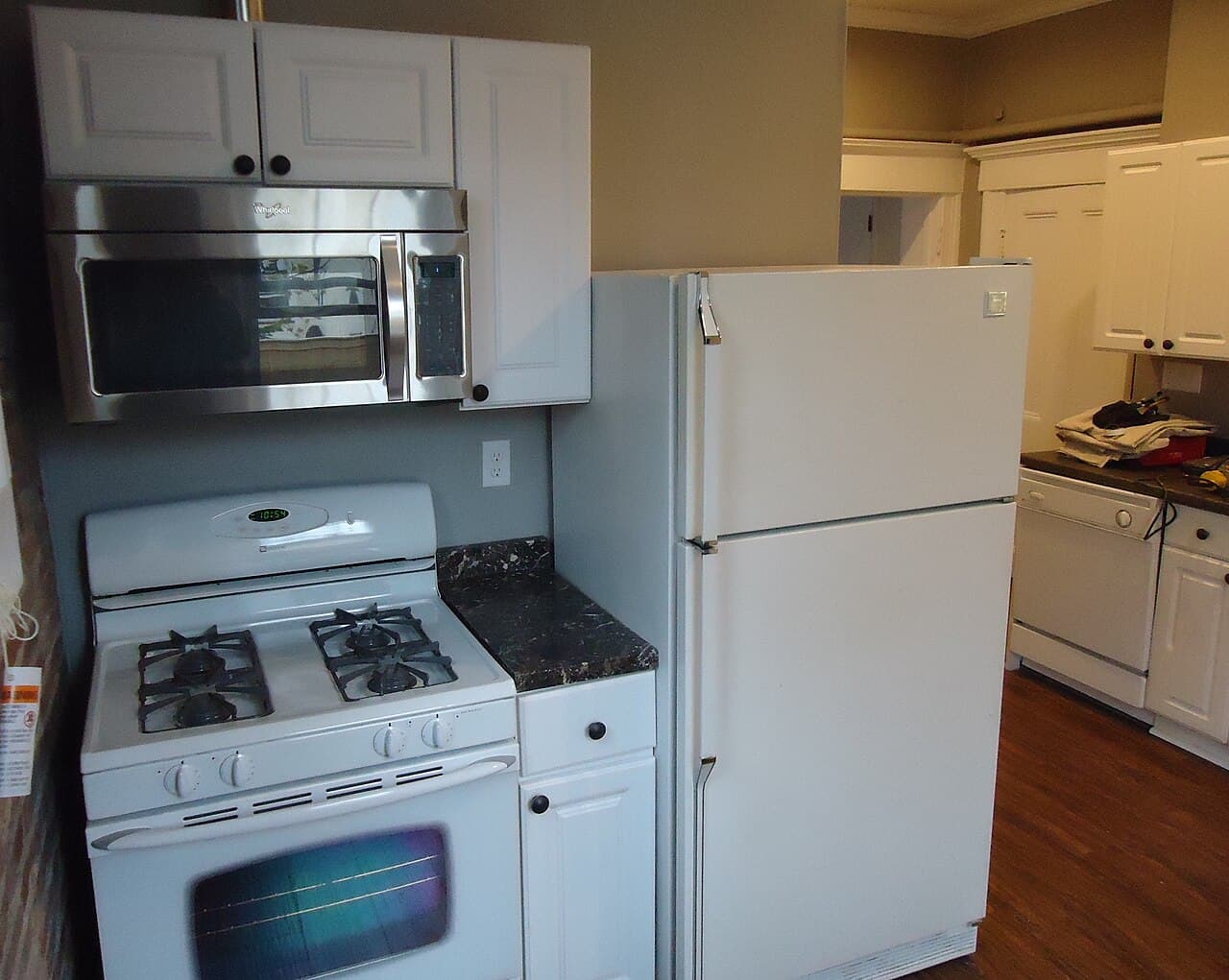
Before touching any screws, empty the shelf behind the door. A tall bottle or an overfull shelf can push the door open, and a plate edge caught in the gap looks like a hinge fault.
Tighten, then adjust the hinge
Snug the screws that hold each hinge to the door and the cabinet with a hand screwdriver. A hinge that has loosened lets the door shift, and the catch never lines up again. Stop when the screws are snug; a drill makes it easy to strip the hole. A screw's holding power depends on how deep and how wide its threaded part is: the Forest Products Laboratory says "the withdrawal load varies directly with the depth of penetration of the threaded portion and the diameter of the screw."[3] If a screw spins without tightening, follow how to fix a sagging cabinet door for the toothpick-and-glue repair.
Most newer kitchen cabinets use concealed hinges with separate adjustment screws. Blum's instructions for its CLIP hinge give two adjustments that matter here:
- Depth: rotate the rear spiral tech cam screw to adjust the door position (+ 3/- 2 mm).[1] Pushing the door in by a millimetre or two is often all a door needs to meet its catch.
- Side: rotate the front screw to increase or decrease the door overlay (+/- 2 mm).[1] Use this when the door rubs its neighbour or leaves an uneven gap.
Turn a screw a quarter turn, close the door and look before you turn it again. The ranges are small, so the door should end up flat against the frame with an even gap all round. Other makers put the screws in slightly different places, so if your hinge looks different, find the model name stamped on the arm and look up the maker's sheet.
Check the catch
Cabinets without soft-close hinges rely on a catch: a magnet, a roller or a friction catch on the cabinet with a strike plate on the door. Tighten its screws, then close the door and see whether the plate meets the catch squarely. If it is off by a few millimetres, slot the plate or move it. Magnets lose pull when dirt builds up, and rollers jam with grease, so wipe both. If the catch is worn out, a matching one costs little and fits the same two holes.
Soft-close hinges can cause the opposite fault. Blum says that for small or light doors, the BLUMOTION can be deactivated on one of the hinges.[1] That is a manufacturer feature for light doors and not a general fix, so check your own hinge before changing anything.
When the door itself has moved
Wood moves with the humidity in the room. The Forest Products Laboratory says changes that occur because of seasonal variation, although gradual, tend to be of more concern.[2] A finish does not stop it: protective coatings can retard dimensional changes in wood but do not prevent them.[2] A solid wood door can therefore bow slightly in a damp summer and flatten again by winter.
Hold a straightedge across the inside of the door. If it rocks, the door is warped and no hinge setting will make it close flat. A slight bow can often be pulled back by adding a second catch near the far corner. A bad one needs a new door, which is a decision to make alongside whether to repair or replace your kitchen cabinets.
Stop and call a pro if
- The cabinet box has racked. If several doors on a run will not close, and the gaps vary from top to bottom, the box or the wall may have moved.
- The hinge cup has torn out of the door. A door with a broken hinge mount needs a cabinetmaker or furniture repair pro.
- The door is cracked or badly warped. A new matching door is often cleaner than a repair.
- The home was built before 1978 and you plan to sand the old finish. EPA says any renovation, repair or painting project in a pre-1978 home that has lead-based paint can easily create dangerous lead dust, and recommends hiring a lead-safe certified contractor.[4]
Getting help in Virginia
For other furniture and cabinet jobs, see more furniture repair answers and browse cabinet repair pros. To plan the budget, read how much cabinet repair costs in Virginia.
If the doors will not stay fixed, describe the cabinets and local repair pros can quote it.
Common questions
- Why does my cabinet door pop open by itself?
- Most often the door is not seated flat against the frame, so the catch cannot hold it, or the catch itself has worn out. Adjust the hinge depth until the door closes flat, then check the catch and its strike plate.
- Can I add a catch to a door that never had one?
- Yes. A magnetic or roller catch is a small part fixed inside the cabinet with two screws, with a strike plate on the back of the door. Mount the catch on the cabinet, close the door against it and mark where the plate goes.
- Why does the door close, then spring back open?
- Usually it is hitting something: an overfull shelf, a neighbouring door, or a frame edge. If the door is touching its neighbour, widen the gap with the side screw. If it is not hitting anything, the catch is probably too weak or misaligned.
- Can a soft-close hinge keep a door from closing?
- It can. Blum says that for small or light doors the BLUMOTION can be deactivated on one of the hinges, and the door must be closed once for the deactivation to complete. Check your hinge maker's sheet before changing anything.
- Do doors stop closing in humid weather?
- They can. Wood takes up and gives off moisture with the seasons, and the Forest Products Laboratory says seasonal changes tend to be of more concern than daily ones. A door that sticks in summer may close fine in winter, and a small hinge adjustment usually settles it.
Sources
- [1] Euro hinge attachment and adjustment (CLIP top, LIT.HNG6200.10.10), Blum. Checked October 28, 2026.
- [2] Wood Handbook, Chapter 13: Drying and Control of Moisture Content and Dimensional Changes (FPL-GTR-190), USDA Forest Service, Forest Products Laboratory. Checked October 28, 2026.
- [3] Wood Handbook, Chapter 8: Fastenings (FPL-GTR-190), USDA Forest Service, Forest Products Laboratory. Checked October 28, 2026.
- [4] Renovation, Repair and Painting Program: Do-It-Yourselfers, U.S. Environmental Protection Agency. Checked October 28, 2026.
Want a pro to handle it?
Describe the job once. Licensed local businesses send quotes, and you pay only when you book one.
Get a quote for Furniture