Why won't my edger blade spin?
On a gas stick edger the usual causes are a locking pin left in the blade, a loose or mis-seated blade or flange, debris jammed behind the guard, or a drive shaft that is not engaged in the clutch. With the spark plug cable off, check those in order. If the blade still will not turn at full throttle, the clutch or gear needs a shop.
Free to ask. Local shops send quotes, and you pay only when you book one.
By Kasra Taheri, Founder, LoclisPublished
Researched and drafted with AI, then checked claim by claim against the sources listed below before it was published. Prices and rules change; the dates beside each source say when it was last checked.
Step by step
Read when to stop and call a pro, further down this page, before you start.
Step 1: Switch off and disarm
Stop the engine and pull the spark plug cable off the plug before touching the blade, and wait until the blade has stopped completely, because it keeps rotating after the throttle is released.[1] On a battery edger, take the battery out.
Step 2: Look for a locking pin
If the blade was removed or fitted recently, check that the locking pin pushed through the hole behind the guard into the drive disc has been taken out.[1]
Step 3: Clear the guard
Wearing gloves, pull out grass, string, roots or a stick wrapped around the blade or jammed between the blade and guard.
Step 4: Turn the blade by hand
With the plug cable off, turn the blade by hand. It should rotate freely with only the drag of the gear and shaft.
Step 5: Check the blade stack
Look for a cracked blade, a cracked support flange or a nut that has lost its grip, and replace any damaged part.[1]
Step 6: Check the shaft coupling
Make sure the shaft is fully seated in the power head, the clamp is tight and the locating bolt is in its hole, so the inner drive shaft is engaged in the clutch.[2]
Step 7: Check the angle gear
Confirm the angle gear sits on the supporting tube with its slot lined up with the line on the tube and its screw tightened.[1]
Step 8: Test in the open
Reconnect the plug cable, set the edger on the ground with the blade guard fitted and nobody nearby, start it and squeeze the throttle to see whether the blade now turns.[1]
Check the simple causes first
A stick edger whose blade will not turn is usually blocked, not broken. The most common causes, in the order worth checking, are a locking pin still in the blade, grass or debris jammed behind the guard, a loose or damaged blade stack, and a shaft that has not seated fully in the power head so the clutch has nothing to drive.
First, a point that confuses many owners. At idle the blade should not turn. ECHO's manual states the rule plainly: "Cutting attachment must not turn or move when unit is idling."[2] On the ECHO SRM-410U trimmer the clutch is a centrifugal type and the correct idle speed is 2300 to 2700 r/min; check your own manual for your model's figure.[2] So judge the problem at full throttle, not at idle.
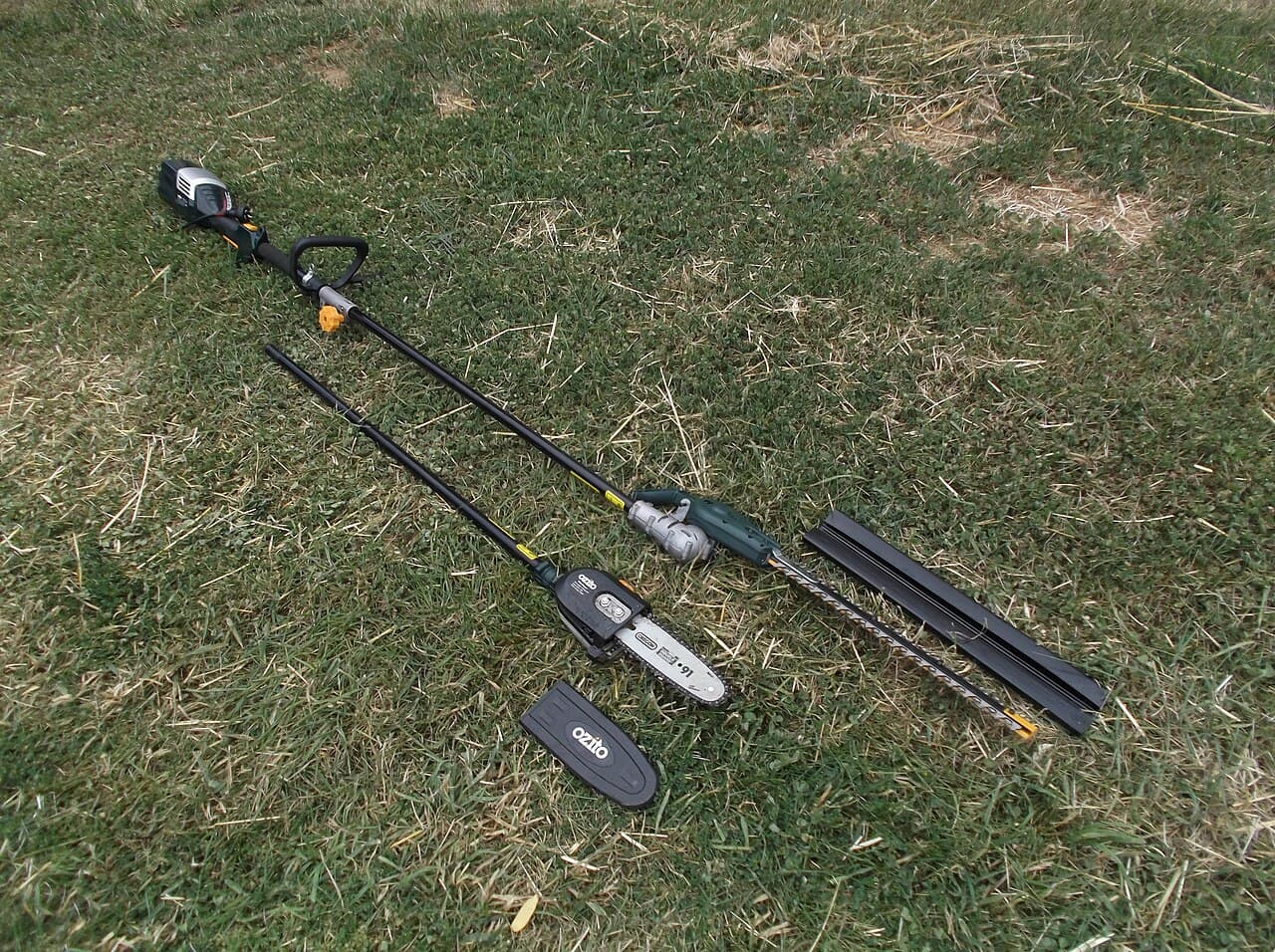
Make it safe before you look
Do all the checking with the machine disarmed. Husqvarna warns that the cutting equipment continues to rotate even after the throttle has been released.[1] Its instruction is to make sure the cutting equipment has stopped completely and remove the cable from the spark plug before you start to work on it.[1] On a battery edger, take the battery out. Wear gloves: even a dull edger blade cuts a hand.
The locking pin
Many edgers use a locking pin to hold the blade still while you tighten or loosen the nut. Husqvarna's procedure is to block the blade rotation by inserting the locking pin in the hole behind the blade guard, engaging it in the corresponding hole in the drive disc.[1] The manual then warns: "Do not forget to remove the locking pin before using the machine."[1]
If you changed the blade just before the problem started, look behind the guard for the pin. It is the single most common reason a freshly fitted blade will not spin.
Debris and a stuck blade
Pull out any grass, string, roots or thin stems wound around the blade or packed between it and the guard. Then turn the blade by hand with the plug cable off. It should rotate freely, with only the light drag of the gear and shaft. A blade that is stiff or locked points to packed debris, a bent blade, or a failed bearing or gear.
The blade stack
Look at everything clamped on the shaft. Check the blade for cracks or any other damage.[1] Husqvarna says to replace a blade or blade guard that has been exposed to impact or is cracked, and to discard the support flange if it is cracked.[1]
The order of assembly matters too: drive disc, blade, support flange, locknut. The support flange must be fitted with its outer edge hard up against the blade.[1] The nut has left-hand threads, and its tightening torque is 35 to 50 Nm.[1] A nut that has lost its grip lets the blade slip on the disc, and a blade fitted without the drive disc engaged can sit still while the shaft turns. Under no circumstances may the edge cutter blade be used without the blade guard fitted.[1]
The shaft, the angle gear and the clutch
The edger spins through a chain of parts: clutch in the power head, a drive shaft in the tube, and an angle gear at the blade. A break at any link leaves the engine running and the blade still.
On a combination power head, the drive shaft must be fitted making sure that the inner drive shaft engages the clutch mount, then locked with the clamp bolt and locating bolt.[2] If the attachment was swapped or the clamp has loosened, the shaft can be sitting short of the clutch.
At the blade end, Husqvarna's instruction is to position the angle gear so that its slot is aligned with the line on the supporting tube, then tighten the screw firmly.[1]
Inside the edger's drive shaft is a flexible drive axle, which should be regularly lubricated after 30 hours of operation.[1] When you refit it, turn the axle while inserting it so that it correctly engages in the clutch.[1] A dry or damaged axle is worth ruling out while the shaft is apart.
Test it safely
When you have refitted everything, reconnect the plug cable, put the edger on the ground with the guard on, keep bystanders well back, and start it. Squeeze the throttle and watch the blade. If it spins, shut it down and make sure the blade stops promptly. If heavy vibrations occur, stop the engine.[1]
Stop and call a pro if
- The blade is free by hand but does not turn under power. That points to a worn clutch, a broken drive axle or a damaged gear, which need the power head or angle gear opened up.
- The blade turns at idle. The idle speed is set too high or the clutch is faulty. ECHO states that carburetor adjustments, other than idle speed, must be performed by an authorized ECHO dealer.[2]
- The blade or flange is cracked, or the guard is damaged. Replace them before using the machine; do not run it with a damaged part.
- The engine will not start or runs badly. That is a separate engine problem, not an edger problem.
- There is a grinding noise, heat at the gear head or heavy vibration. Stop the engine, take the plug cable off and check the machine for damage before running it again.[1]
Getting help in Virginia
If the blade still will not spin, a small-engine shop can test the clutch and drive shaft quickly. Related reading: why a lawn looks ragged after mowing and how to sharpen mower blades. Browse more lawn equipment repair answers or see lawn mowing and lawn care pros.
When you are ready, describe the edger problem once and local repair shops quote it.
Common questions
- The engine runs but the blade does not turn. Is that normal?
- At idle, yes. ECHO's trimmer manual says the cutting attachment must not turn or move when the unit is idling, because the centrifugal clutch only engages as the engine speeds up. If the blade stays still when you squeeze the throttle, something between the clutch and the blade is wrong.
- Does it matter which way I turn the blade nut?
- Yes. On the Husqvarna edger attachment the locknut has left-hand threads, so it loosens in the direction the blade rotates and tightens against it. Tightening it the wrong way can strip it or leave the blade loose. The manual gives a tightening torque of 35 to 50 Nm.
- Can I run the edger without the blade guard to see the blade spin?
- No. The Husqvarna manual says under no circumstances may the edge cutter blade be used without the blade guard fitted. Test with the guard on, the machine on the ground and nobody within range of thrown debris.
- How often does the flexible drive axle need grease?
- Husqvarna's manual says the flexible drive axle inside the shaft should be lubricated after 30 hours of operation. A dry or damaged axle is one reason a blade can stall or fail to turn, and it is worth checking when the shaft is already apart.
- Why does the whole edger vibrate and the blade slow down?
- A bent or cracked blade, a loose nut or a damaged part. Husqvarna's manual says to stop the engine if heavy vibrations occur, take the plug cable off and check the machine for damage before running it again.
Sources
- [1] Edger Attachment Operator's Manual, Husqvarna. Checked October 27, 2026.
- [2] Grass Trimmer/Brush Cutter Operator's Manual, model SRM-410U, ECHO Incorporated. Checked October 27, 2026.
Want a pro to handle it?
Describe the job once. Licensed local businesses send quotes, and you pay only when you book one.
Get a quote for Lawn Equipment