Does Virginia require a fence or barrier around a pool?
Usually, but the rule is local. The Code of Virginia lets each locality require a fence at least four feet high around a pool, and Chesterfield County, for one, requires a barrier at least 48 inches high with a self-closing, self-latching gate. The state building code does not exempt a pool barrier from permits. Call your building department.
Free to ask. Local shops send quotes, and you pay only when you book one.
By Kasra Taheri, Founder, LoclisPublished
Researched and drafted with AI, then checked claim by claim against the sources listed below before it was published. Prices and rules change; the dates beside each source say when it was last checked.
Step by step
Read when to stop and call a pro, further down this page, before you start.
Step 1: Call your building department
Ask which barrier rules apply and whether a barrier permit is needed.[1]
Step 2: Measure the height
The barrier should be at least 48 inches above grade, measured on the side facing away from the pool.[2]
Step 3: Check the gaps
Chesterfield County allows no opening that passes a 4-inch sphere and a bottom gap of 2 inches or less.[1]
Step 4: Test the gate
Chesterfield County requires a gate that closes and latches by itself and opens outward, away from the pool.[1]
Step 5: Check the latch
In Chesterfield County, a latch under 54 inches must be on the pool side, 3 inches below the top, with no opening of half an inch within 18 inches.[1]
Step 6: Look for climbing aids
Move furniture, planters and equipment away from the barrier.[2]
In practice, yes for most outdoor pools, but the rule is set locally. The Code of Virginia lets each locality adopt a fencing ordinance, and Chesterfield and Roanoke counties require a barrier on outdoor residential pools. Your county, city or town decides the details, so call its building department before you build, buy or fill a pool.
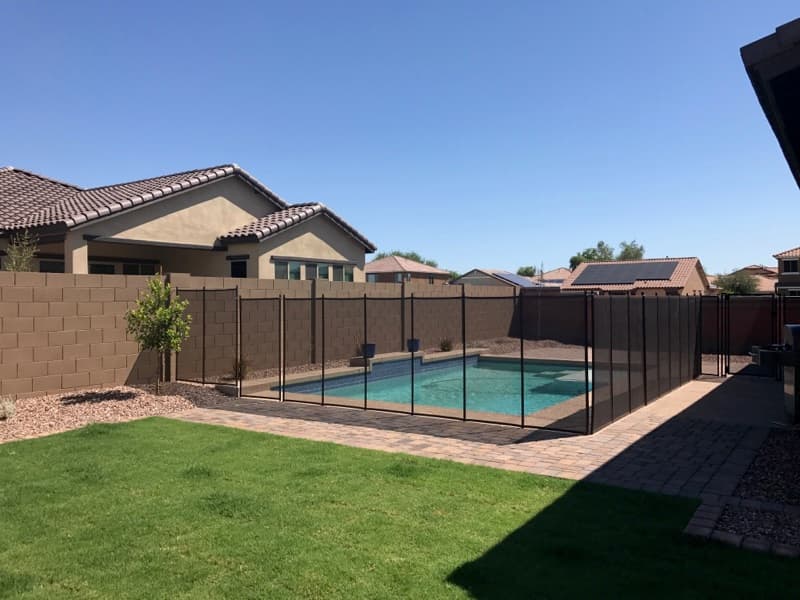
What state law says
The Code of Virginia says any locality may adopt ordinances making it unlawful for any person to construct, maintain, use, possess or control any pool on any property in such locality, without having a fence completely around such swimming pool.[6] It defines a fence as a close type vertical barrier not less than four feet in height above ground surface.[6] A violation of such an ordinance may be punished by a fine of not more than $300 or confinement in jail for not more than thirty days, either or both, and each day can count as a separate offense.[6]
The statute says "may", so what binds you is your locality's ordinance and the building code it enforces.
What Virginia counties require
Chesterfield County states that outdoor swimming pools are required to have a barrier around them.[1] Roanoke County's rules say all pools, spas and hot tubs must be provided with a code compliant barrier per the International Swimming Pool and Spa Code.[4] The general provisions in Chesterfield's handout, which says to see the actual code for the definitive provisions, include:
- Height. At least 48 inches above grade, measured from the outside face of the barrier.[1]
- Gaps. No more than 2 inches between grade and the bottom of the barrier, and no opening that lets a 4-inch sphere pass.[1]
- Gates. Self-closing and self-latching, opening outward away from the pool.[1] Where the latch is less than 54 inches from the bottom of the gate, it must be on the pool side at least 3 inches from the top, with no opening of half an inch or more within 18 inches of it.[1]
- Climbability. For horizontal and vertical members, spacing between verticals of 1.75 inches or less where the horizontals are less than 45 inches apart.[1]
- Doors and windows. Where the house forms part of the barrier, door and window alarms are required.[1]
Both counties allow a powered safety cover that complies with ASTM F1346 to stand in for a fence-style barrier on a pool.[1][4] Roanoke County also permits listed mesh fences, installed per the manufacturer's instructions, as temporary barriers.[4]
Permits
The Chesterfield County handout says the Virginia Uniform Statewide Building Code requires a building permit for any swimming pool larger than 150 square feet in surface area, holding over 5,000 gallons of water, or 24 inches or more in depth, and lists a barrier permit among the permits needed.[1] The state building code's list of work that does not need a permit includes fences of any height, except one used for the barrier for a swimming pool.[5] So a pool fence is not a permit-free fence.
Chesterfield also says existing barriers will be required to be code compliant, and that if they are not, a permit will be required to bring them into compliance.[1] Buying a house with a pool is a good moment to ask.
Why it matters
The Consumer Product Safety Commission says many of the nearly 300 children under 5 who drown each year in backyard pools could be saved if homeowners completely fenced in pools and installed self-closing and self-latching devices on gates.[2] Its guidelines are not mandatory, and it adds that barriers cannot replace adult supervision.[2]
Check your own barrier
- Ask your building department which rules apply and whether a barrier permit is needed.
- Measure the height of the barrier on the side facing away from the pool. The CPSC guideline is at least 48 inches above grade.[2]
- Look at the bottom gap and any openings with a 4-inch ball or a measuring tape.[1]
- Open the gate and let go. It should swing shut and latch every time by itself.[2]
- Check the latch height and the gaps near it against the 54 inch, 3 inch and 18 inch figures above.[1]
- Look for chairs, planters or equipment a child could climb to get over the barrier.[2]
Stop and call a pro if
- The barrier does not meet the rules. New fence sections and gates are construction work you may prefer to hire out, and the permit holder bears the responsibility that the work will comply with the code.[1]
- The house is part of the barrier. Alarms on doors and windows need to meet the locality's standard.[1]
- A powered cover needs wiring. Chesterfield County encourages homeowners to have a licensed electrical contractor apply for the electrical permit.[1]
- You are hiring. Ask the Board for Contractors whether the contractor is properly licensed for the work.[3]
Getting help in Virginia
If a cover is part of your plan, read how to put on a pool safety cover and what a pool safety cover costs in Virginia. More topics are in our pool and spa answers, and you can look at local pool pros.
When you are ready, describe the job and local pool pros can quote it.
Common questions
- Is a fence required by state law?
- The Code of Virginia lets each locality adopt a fencing ordinance, so the requirement comes from your locality's ordinance and the building code it enforces.
- How tall must a pool fence be?
- The state statute defines a fence as at least four feet high. Chesterfield County requires at least 48 inches, and the CPSC says fences 5 feet or higher are preferable.
- Do I need a permit for a pool fence?
- The state building code's permit exemption for fences does not cover one used as a pool barrier. Chesterfield County also lists a barrier permit among its pool permits.
- Can a pool cover replace a fence?
- In Chesterfield and Roanoke counties, a powered cover that complies with ASTM F1346 can. Check your own locality.
- What about an above-ground pool?
- Chesterfield says the pool wall can be the barrier if it is 48 inches tall and the ladder can be removed or secured.
Sources
- [1] Requirements for Outdoor Residential Swimming Pools (December 2021), Chesterfield County Building Inspection Department, Virginia. Checked October 27, 2026.
- [2] Safety Barrier Guidelines for Residential Pools (Publication 362), U.S. Consumer Product Safety Commission. Checked October 27, 2026.
- [3] What You Should Know Before You Hire a Contractor, Virginia Board for Contractors, DPOR. Checked October 27, 2026.
- [4] Residential Pools, Spas, & Hot Tubs Barrier & Safety Requirements, Roanoke County Office of Building Safety, Virginia. Checked October 27, 2026.
- [5] 13VAC5-63-80, Section 108 Application for permit (Virginia Uniform Statewide Building Code), Virginia Administrative Code, Virginia General Assembly. Checked October 27, 2026.
- [6] Va. Code § 15.2-921, Ordinances requiring fencing of swimming pools, Code of Virginia, Virginia General Assembly. Checked October 27, 2026.
Want a pro to handle it?
Describe the job once. Licensed local businesses send quotes, and you pay only when you book one.
Get a quote from a local pro