How do I put on a pool safety cover?
Lay the mesh cover out evenly over the pool, then fasten each strap spring to its deck anchor with the installation rod until the cover is drum-tight with no gap at the edge. Work with a second person, remove ladders first and keep the water 15 to 18 inches below the cover. Leave first-time anchor setting to a pool professional.
Free to ask. Local shops send quotes, and you pay only when you book one.
By Kasra Taheri, Founder, LoclisPublished
Researched and drafted with AI, then checked claim by claim against the sources listed below before it was published. Prices and rules change; the dates beside each source say when it was last checked.
Step by step
Read when to stop and call a pro, further down this page, before you start.
Step 1: Get a second person and the rod
Tara recommends at least two people to install a cover; have the installation rod and hex key ready.[2]
Step 2: Clear the pool
Remove handrails and ladders, and set 5-gallon buckets of water around the pool, to rest on the straps and hold the cover.[2]
Step 3: Inspect the cover
Check the mesh, straps and buckles for damage, and do not use a damaged cover.[2]
Step 4: Lay it out
Unroll the cover parallel to the pool, labels up and strap reinforcements down, without dragging it.[2]
Step 5: Keep anchors flush
Leave the deck anchors flush until the cover is positioned so it does not snag on them.[2]
Step 6: Centre the overlap
Adjust the cover so the overlap is equal on each side and on each end, and fit cut-outs around obstructions.[2]
Step 7: Fasten the springs
Raise the anchors, then use the installation rod to slide each spring onto its anchor, working outward from the middle of each side.[2]
Step 8: Check the tension
The cover should be drum-tight, with mesh springs compressed about 50 percent; shorten slack straps in small steps.[2]
Step 9: Check the edges and the water
Look for gaps at the edge, then keep the water 15 to 18 inches below the cover and sweep debris off the top.[2]
Lay the cover across the pool, fasten every spring to its anchor until the fabric is drum-tight, and check that no gap is left at the edge. This guide covers putting an existing mesh safety cover back on a pool whose anchors are already in the deck. The very first installation, which means drilling and setting the anchors, is a pool professional's job.
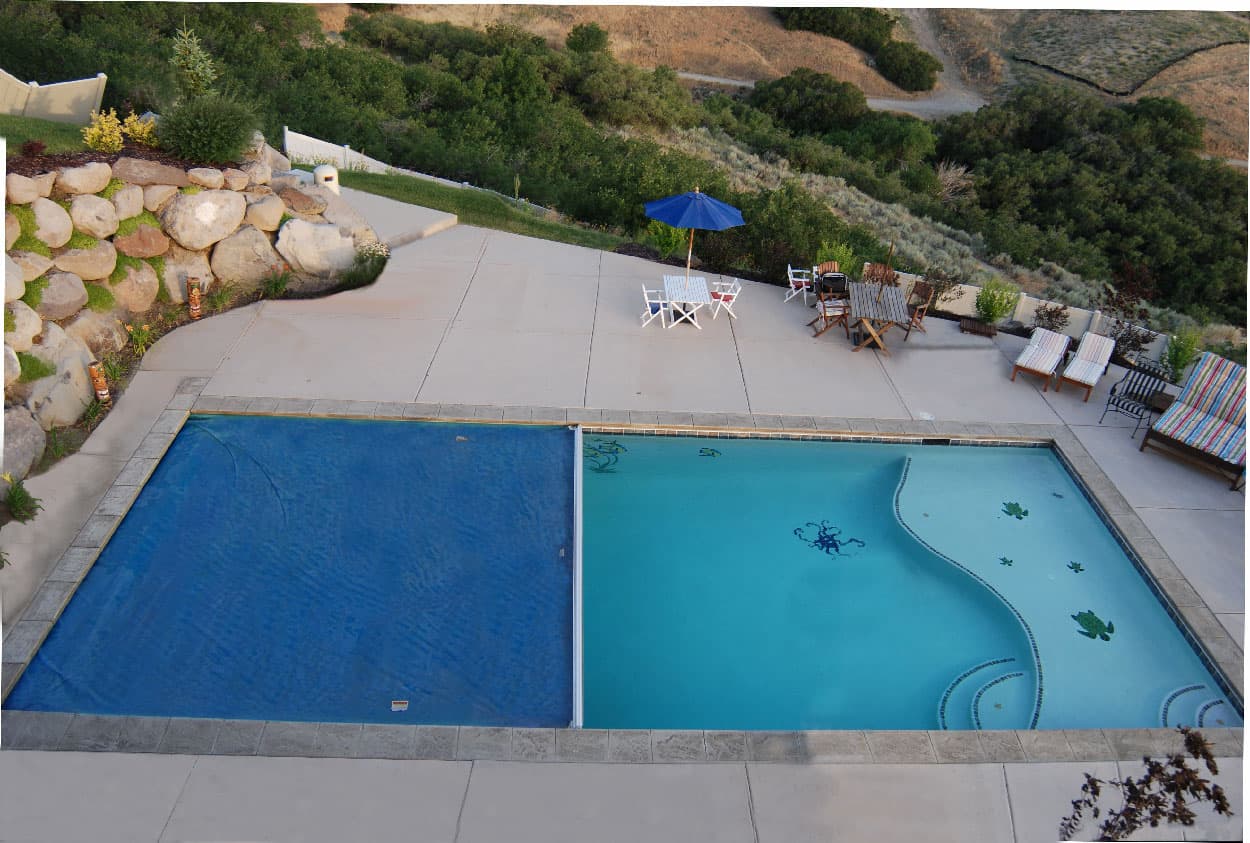
What you need
Tara Safety Covers, a maker of mesh covers, recommends that at least two people install a cover.[2] You will also want the installation rod and the hex key that came with the cover, a few 5-gallon buckets and a hose. The rod stretches each spring onto its anchor; without it the springs are close to impossible to fasten.
Tara's manual says initial installation of pool safety covers should only be performed by qualified pool professionals, and that improper installation can void the warranty.[2] That is why the steps below assume the anchors are already set and the straps are sized to your pool.
Before you lay the cover out
Clear the deck and the pool first. Tara's instructions are to remove all handrails, ladders and similar fittings, and to position 5-gallon buckets filled with water around the pool.[2] The buckets hold the cover in place while you work. Rest them on the straps, not on the cover material.[2]
Check the cover itself. Tara warns to inspect the cover annually for damage and not to use it if it is damaged.[2] Look at the straps, the stitching at the buckles and the mesh, and have any tear repaired before the cover goes on.
Look at the anchors too. Tara says to clean and lube the anchors every opening and closing.[2] A light spray of silicone lubricant on the installation rod helps the springs slide on.[2]
Putting the cover on
- Lay the cover beside the pool, perpendicular to the long side, then unroll it so it lies parallel to the pool, with the labels facing up and the strap reinforcements facing down.[2] Do not drag it across the deck.
- Keep the deck anchors flush until the cover is in place. Tara warns never to raise the deck anchors before reinstalling, because dragging the cover over raised anchors can damage it.[2]
- Handle the cover by its webbing. Tara says never to grab the paneled material and to move the cover by the reinforced webbing and straps.[2]
- Slide the cover out over the water and adjust it for equal overlap, so one side matches the other side and one end matches the other end.[2] Fit any cut-outs around steps, rails or walls.
- Raise the anchors, then fasten the springs. Slide the installation rod through the loop of the spring, set its tip on the far side of the anchor and pull the handle away from the pool, so the spring slips off the rod onto the anchor head.[2] Start at the middle of each side and work outward so the tension builds evenly.
- Check the tension. The cover should be drum-tight once all of the springs are fastened, and Tara says springs on a mesh cover should be compressed about 50 percent.[2] If the straps are slack, release the spring, shorten the strap at its buckle in small steps (Tara suggests 2 inches at a time) and refasten.
- Walk the edge and look for gaps between the cover and the coping. If a cover is too loose, a child may be able to slip beneath it.[2]
Check the water level and the top
Leave the water where the manufacturer wants it. Tara says the pool water level must stay between 15 and 18 inches below the cover at all times, or the warranty will be voided.[2]
The surface needs attention all season. Tara says debris on top has to be swept off so rain water can drain into the pool, because a blocked top can let water puddle and the cover fail.[2] Its warnings are blunt about the danger: standing water on top of a cover can let a child drown, and nobody should walk on the cover except in an emergency.[2] A cover is also no substitute for watching children: the U.S. Consumer Product Safety Commission says barriers are not the sole method to prevent pool drowning of young children and cannot replace adult supervision.[1]
Taking the cover off
Lower the anchors before you move the cover, to protect the fabric.[2] Take the cover off completely before anyone swims, since Tara warns that entrapment is possible if a swimmer enters with it on.[2] Before you store it, remove leaves and debris, spray it with the hose and brush off dirt, check it for damage and fold it into its bag. Hang the bag off the ground, away from chemicals and heat, so mice and rodents stay out.[2]
Stop and call a pro if
- The anchors are missing or loose. Setting anchors means drilling into the deck, and Tara's manual leaves that to qualified pool professionals.[2]
- The cover no longer fits. If a new liner, a changed pool shape or a new step leaves large gaps, the cover is not doing its job, because a loose cover may let a child slip beneath it.[2]
- The cover is torn or the straps are failing. Tara says not to use a damaged cover.[2]
- You want the cover to count as your pool barrier. Local codes set that standard. Read whether Virginia requires a fence or barrier around a pool.
Getting help in Virginia
If you are weighing a replacement, see how much a pool safety cover costs in Virginia. How to open a pool in spring pairs naturally with taking the cover off, and all of our pool and spa answers are in one place. You can also browse local pool pros.
When you are ready, describe the job and local pool pros can quote it.
Common questions
- Can I install a pool safety cover myself?
- Putting an existing cover back on anchors that are already set is a two-person job. Tara's manual says the initial installation should be done by qualified pool professionals.
- How tight should the cover be?
- Drum-tight. A loose cover can let a child slip beneath it, and Tara says mesh-cover springs should be compressed about 50 percent.
- How high should the water be under the cover?
- Tara says between 15 and 18 inches below the cover at all times, or the warranty will be voided.
- What do I do about rain and leaves on top?
- Sweep debris off so rain can drain through. Tara warns that standing water on a cover can let a child drown.
- Can I walk on the cover or swim with it on?
- No. Tara says not to walk on it except in an emergency, and to remove it completely before anyone swims.
Sources
- [1] Safety Barrier Guidelines for Residential Pools (Publication 362), U.S. Consumer Product Safety Commission. Checked October 27, 2026.
- [2] Mesh Safety Cover Installation & Care Guide, Tara Safety Covers, Inc.. Checked October 27, 2026.
Want a pro to handle it?
Describe the job once. Licensed local businesses send quotes, and you pay only when you book one.
Get a quote from a local pro