How do pros remove snow from a roof safely?
Pros plan before they climb: they look the roof over from the ground, use fall protection, reach from the ground where they can, clear in sections, often leave a thin layer of snow to protect the roofing, and keep people clear of what falls. Alexandria says not to climb your roof to remove snow because it is extremely dangerous.
Free to ask. Local shops send quotes, and you pay only when you book one.
By Kasra Taheri, Founder, LoclisPublished
Researched and drafted with AI, then checked claim by claim against the sources listed below before it was published. Prices and rules change; the dates beside each source say when it was last checked.
This is a job for a licensed pro in Virginia
This page explains what the work involves, the permits, what a licensed pro does and what drives the cost. It does not give step-by-step instructions, because this work needs a licence, a permit or both, and doing it wrong can injure someone. Before you hire, check the licence on Virginia's DPOR record.
Professional roof snow removal is mostly planning, fall protection and restraint, not speed. A good crew decides whether the snow needs to come off at all, picks the lowest-risk way to move it, and stops before the roofing is damaged. The work is dangerous enough that the City of Alexandria says not to climb on your roof to remove snow, because it is extremely dangerous,[1] and that homeowners who are concerned about snow depth should contact a licensed snow removal professional.[1] This page explains what a professional job looks like so you can judge a quote. It is not a how-to.
Start with the warning signs
Snow on a roof is not an emergency by itself. Roofs are built to carry snow, and a thin layer often melts off without help. What changes the picture is heavy or wet snow, deep drifts, or signs that the structure is stressed. The City of Alexandria's advice is that if you see signs of roof sagging, see new cracks in walls or ceilings, or hear popping and creaking noises, evacuate the building immediately.[1] If a collapse occurs, it says to call 911.[1]
If you notice those signs, leave first and call afterwards. Stressed roofs are no place for a homeowner or a handyman with a shovel.
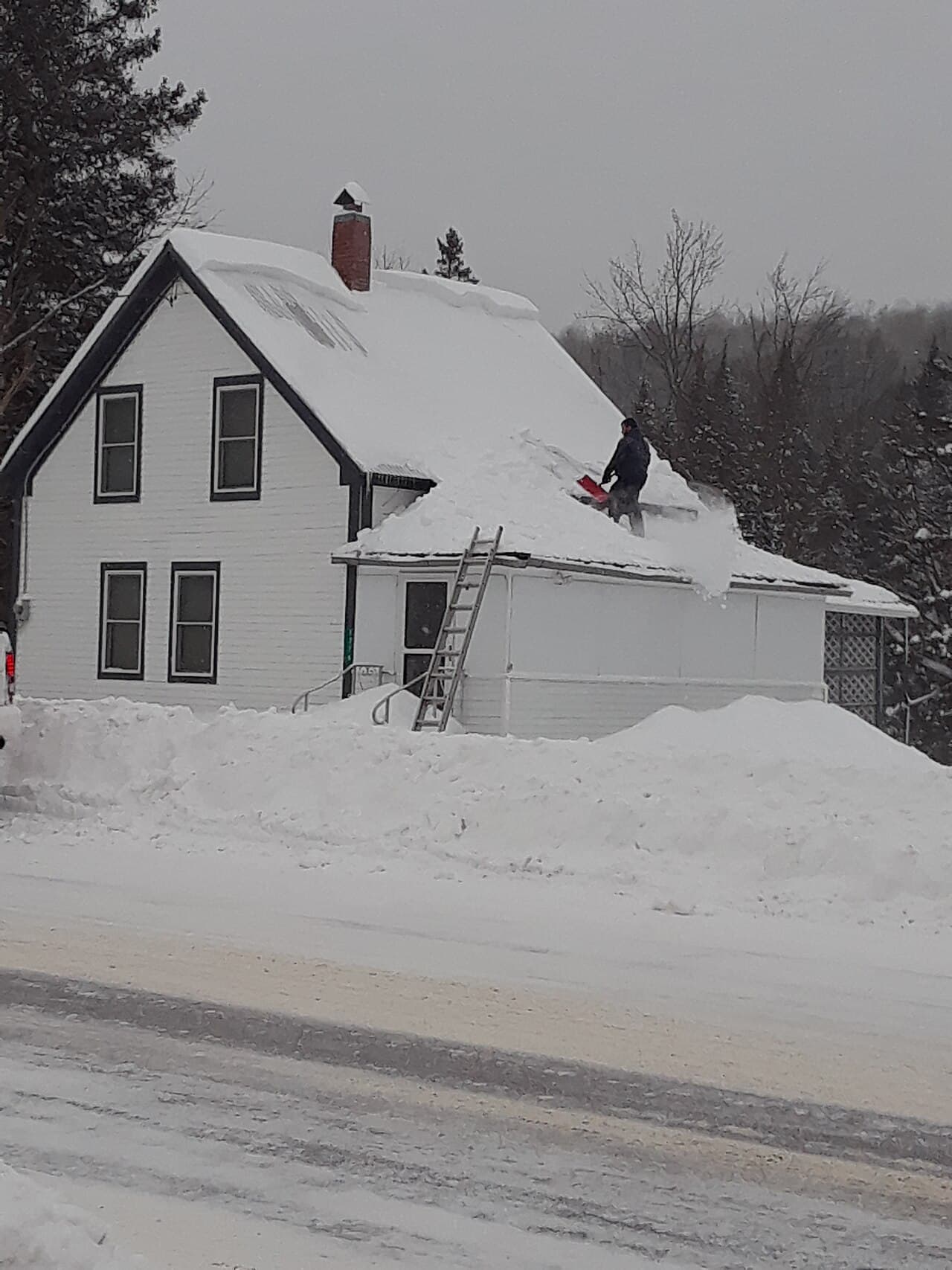
What a professional job looks like
A walk-around first. A competent company looks at the roof from the ground before anyone climbs: the pitch, the roofing material, where snow has drifted, what sits on the roof (skylights, vents, solar panels, satellite dishes) and what is below the eaves. It also asks about the weather ahead, because rain on top of snow adds weight.
Fall protection and access. Wet, icy and steep roofs are where workers fall. Ask how each person on the roof will be protected and how they will get up and down safely. A crew that says it will simply climb up and shovel is not the crew to hire.
Reach from the ground where it works. On lower roofs, long-handled tools used from the ground can clear the snow nearest the eaves without anyone leaving the ground. Crews choose between that and working on the roof based on pitch, height and what is underneath.
Leaving a layer. Scraping down to bare shingles or metal can tear granules, bend panels and snag flashing. Professionals often leave a thin layer of snow on purpose and clear in sections, so weight comes off evenly instead of loading one side of the roof.
Managing what falls. Snow and ice sliding off a roof can hit people, cars, shrubs, gas meters and the heat pump outside. A good crew marks off the area below, keeps people and pets clear, and plans where the snow will land. Alexandria treats falling roof snow as a safety issue: its City inspectors first complete their duty of inspecting buildings and other locations for safety issues created by snow and ice falling from rooftops.[1]
Looking for damage. While up there, a crew may spot cracked shingles, lifted flashing or a leak path. Repairing a roof is a different job from clearing one. Virginia's regulations define roofing contracting as the installation, repair, removal, or improvement of materials common to the industry that form a watertight, weather resistant surface for roofs and decks.[2] A snow crew that also offers repairs should be able to show the licence for that work.
What to ask before you book
- How will each person on the roof be protected from a fall?
- What will you do about my skylights, vents, solar panels and low roof sections?
- How do you avoid damaging the roofing, and what happens if something is damaged?
- Is the price per visit, per hour or per roof, and does it include the area below?
- Can I have the scope and price in writing before you start?
When to call a licensed pro
Always, for anything on the roof itself. The Board for Contractors guide says that if the work is valued at $1,000 or more, a valid Virginia contractor's license is required for the license category the contractor works in.[3] Whether a plain snow-clearing visit counts is worth asking the company directly, but any repair is roofing work, so ask which licence it holds and what that licence covers. DPOR's advice after a storm is to hire only licensed contractors qualified to do your job, with the right class and right specialty,[4] to get at least three estimates whenever possible,[4] and to insist on a written contract. On deposits, it says: "Pay 10 percent down or $1,000, whichever amount is less."[4] It adds: "Don't pay 100% of the bill until the work is 100% complete and you are satisfied with the job."[4]
To learn how to check a licence, see how to check if a contractor is licensed in Virginia. For what a visit costs and what moves the price, read how much it costs to rake snow off a roof in Virginia. To decide whether yours needs to come off at all, see when to hire someone to remove snow from a roof. More winter guidance is in snow and seasonal answers, and you can browse snow and seasonal services on Loclis.
To get quotes for your own roof, describe the job once and local businesses reply.
Common questions
- Can I just shovel the snow off my roof myself?
- The City of Alexandria says not to climb on your roof to remove snow, because it is extremely dangerous, and advises homeowners worried about snow depth to contact a licensed snow removal professional. Renters should contact their landlord or building manager.
- Do pros scrape the roof down to the shingles?
- Often not. Scraping to bare roofing can tear granules, bend panels and catch flashing, so many crews leave a thin layer and clear in sections. Ask how a company protects your roofing, and who pays if something is damaged.
- What are the signs my roof is overloaded?
- The City of Alexandria lists roof sagging, new cracks in walls or ceilings, and popping or creaking noises, and says to evacuate the building immediately if you see or hear them. Call 911 if a collapse occurs.
- Is a roof snow removal company the same as a roofer?
- Not necessarily. Virginia defines roofing contracting as installation, repair, removal or improvement of roofing materials. If a crew offers to repair what it finds, ask which licence it holds for that work.
Sources
- [1] Snow and Ice Control, City of Alexandria, Virginia. Checked October 27, 2026.
- [2] 18VAC50-22-30, Definitions of specialty services, Virginia Administrative Code, Board for Contractors. Checked October 27, 2026.
- [3] What You Should Know Before You Hire a Contractor, Virginia Board for Contractors, Department of Professional and Occupational Regulation. Checked October 27, 2026.
- [4] Disaster Recovery: Avoiding Fraud, Virginia Department of Professional and Occupational Regulation. Checked October 27, 2026.
Want a pro to handle it?
Describe the job once. Licensed local businesses send quotes, and you pay only when you book one.
Get a quote from a local pro