How does mudjacking or foam slab lifting work?
Both methods raise a sunken concrete slab by pumping material into the gap beneath it through holes drilled in the concrete. Mudjacking uses a cement-based grout and larger holes. Foam lifting uses a two-part polyurethane that expands under the slab through much smaller holes. In both, the crew raises the slab a little at a time while watching its level so it does not crack.
Free to ask. Local shops send quotes, and you pay only when you book one.
By Kasra Taheri, Founder, LoclisPublished
Researched and drafted with AI, then checked claim by claim against the sources listed below before it was published. Prices and rules change; the dates beside each source say when it was last checked.
This is a job for a licensed pro in Virginia
This page explains what the work involves, the permits, what a licensed pro does and what drives the cost. It does not give step-by-step instructions, because this work needs a licence, a permit or both, and doing it wrong can injure someone. Before you hire, check the licence on Virginia's DPOR record.
Mudjacking and foam lifting both raise a sunken concrete slab by pumping material into the empty space beneath it through holes drilled in the concrete. The material fills the gap, then pushes the slab up. The difference is what goes under the slab: a cement-based grout in mudjacking, a two-part expanding polyurethane foam in foam lifting. Both are specialist jobs done with truck-mounted equipment, and the skill is in raising the slab slowly and evenly so it does not crack.
What the two methods share
The Federal Highway Administration (FHWA) defines slab jacking as the "Raising of settled concrete slabs to their original elevation by pressure injecting cement grout or polyurethane materials through drilled holes at carefully patterned locations."[1] FHWA writes about roads, but the method is not limited to them: Alchatek's procedure covers sidewalks and other small slabs as well as interior lifts.[2]
Three things hold for both methods:
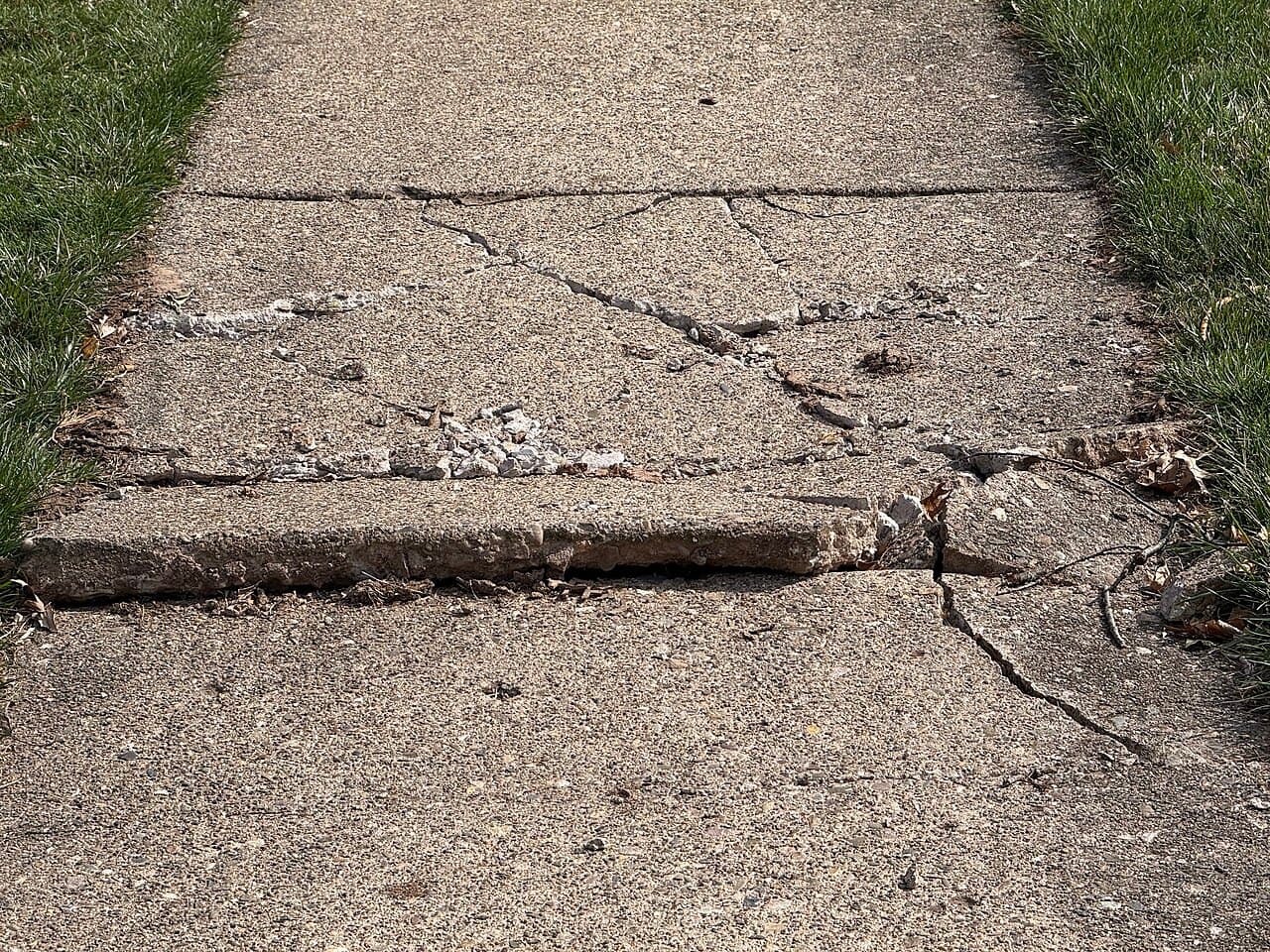
- The slab has to be a good candidate. FHWA says the ideal candidates are slabs with localized settlement that are generally free of cracking.[1] A slab broken into loose pieces is usually a replacement job.
- The lift is slow. FHWA and one foam manufacturer both say a slab should not be lifted more than 1/4 inch at a time at any one hole, to keep stresses in the concrete from building up.[1][3]
- Hole placement is the craft. FHWA says the hole pattern can only be set by experienced personnel, because the slab has to be lifted without creating stresses that crack it.[1]
How mudjacking works
Mudjacking pumps a cement-based grout under the slab. FHWA notes that grouts used to raise slabs are slightly stiffer than those used only to fill voids, and are made of cement with fine aggregate, pozzolans or fly ash, and water.[1] The grout is mixed on site and pushed through hoses by a pump.
The holes are larger than for foam. For filling voids under a slab with concrete-based grout, FHWA describes drills that cut holes 1 1/4 to 2 inches across, and drive packers used with 1.0-inch holes.[1] For raising a slab with grout, it gives holes spaced 6 feet or less center to center and 12 to 18 inches from a transverse joint or slab edge.[1]
Pumping starts in the middle of the dip and works outward,[1] raising the lowest part first while keeping the slab from bending sharply. The crew finishes by plugging each hole and later filling it with a patching material.[1] Cement grout needs time to set: for grout used to fill voids under slabs, FHWA's guide keeps traffic off a slab grouted with cement for at least 3 hours unless a fast-setting material is used.[1]
How foam lifting works
Foam lifting uses polyurethane, which FHWA describes as two liquid chemicals that combine to form a strong, lightweight foam, which expands after injection to fill the voids under the slab.[1] The two liquids are stored, heated and proportioned in a self-contained pumping unit and mixed at the injection gun.[1][3]
The holes are small. For filling voids, FHWA says holes for polyurethane should be no more than 5/8 inch across,[1] and Alchatek says the most common bit sizes are 3/8 and 5/8 inch.[2] Alchatek's procedure for its polyurethane says holes are typically drilled 3 to 4 feet apart to create a continuous lift.[2] Under the slab, according to Alchatek, the foam first fills the voids and compresses the soil, and only then starts lifting the slab.[2]
As an example of the material, Alchatek's AP Lift 430 Fast has an unconfined density of 3 pounds per cubic foot, expands about 25 times when unconfined, and reaches 90% of full strength in 15 minutes.[4] FHWA lists rapid curing, with opening times of 15 to 30 minutes,[1] among polyurethane's advantages, along with the point that because it is light it does not add to the settlement.[1]
Afterwards, FHWA notes that the small holes are often left unpatched because they are already filled with foam;[1] Alchatek, by contrast, says to finish by patching the holes with hydraulic cement.[2] Good crews protect the surface, because foam left on the surface turns dark yellow in sunlight.[2]
The liquids need care while they are pumped. Alchatek's safety data sheet says its A side contains diisocyanates (MDI) and warns that it may cause allergy or asthma symptoms or breathing difficulties if inhaled,[5] and its specification calls for well-ventilated work areas, open doors and windows, and mechanical ventilation in confined spaces.[3] For a garage or basement floor, ask the crew how they will ventilate and when you can go back in.
What a crew checks before it lifts
Most of a good job happens before any material goes in. Alchatek tells installers to check first for binds: new siding, replacement slabs, railings or other structures that could stop the slab from lifting or be damaged.[2] Tight joints may be saw cut so the slab can move freely.[2][3]
Alchatek's specification also requires locating utilities and drain pipes, inspecting drain pipes before and after the job, with a sewer camera if needed, so foam cannot get into a cracked pipe, and marking any conduit in the slab.[3] Alchatek lists ground penetrating radar to find utilities, drain lines and post-tension cables among a lifting crew's tools.[2]
To track movement during the lift, Alchatek's procedure lists dial indicators that read in increments of 0.001 inch, along with zip or laser levels;[2] its specification adds survey equipment and string lines.[3]
Lifting does not fix the cause
A lift puts the slab back where it was. It does not change why it dropped. FHWA warns that if the underlying causes of the settlement are not dealt with, the same problems will come back.[1] Read why concrete slabs sink to find the likely cause, and how to keep a slab from sinking again for what to do afterwards.
When to call a licensed pro
Slab lifting is not a homeowner job. The equipment alone puts it out of reach: Alchatek's specification for its foam calls for a plural-component proportioner capable of at least 1,500 psi, with separately controlled heaters and heated hoses.[3] Lifting too fast or in the wrong place cracks the slab, pushes material where it should not go, or lifts something next to it.
In Virginia, the Board for Contractors says that if the work is valued at $1,000 or more, a valid Virginia contractor's license is required for the license category the contractor works in, and that "Unlicensed contracting is against the law."[6] Virginia's concrete contracting specialty (CEM) covers repairing, grinding and grouting concrete,[7] and the regulation adds that the CBC, RBC and H/H classifications also provide for this work.[7] How to check a contractor's licence in Virginia walks through the lookup. For what it costs, see concrete leveling costs in Virginia, and if the slab is badly broken, read whether to lift or replace.
Loclis lists DPOR-licensed concrete businesses with their licence number and class. Browse slab lifting and leveling, look up concrete contractors in Blacksburg, or see all concrete and hardscaping answers.
Describe the sunken slab once and licensed local businesses quote it.
Common questions
- Is foam lifting better than mudjacking?
- Neither is right for every slab. Foam uses smaller holes, is light, and is ready for traffic within minutes; cement grout uses larger holes and takes longer to set. Ask contractors which they use and why it suits your slab, and compare written quotes for the same area.
- How big are the holes?
- It depends on the material and the packer. For filling voids under a slab with cement grout, the Federal Highway Administration describes holes 1 1/4 to 2 inches across, and drive packers used in 1-inch holes. For filling voids with polyurethane it says no more than 5/8 inch, and one foam maker gives 3/8 and 5/8 inch as the common bit sizes. Grout holes are patched afterwards; foam holes are small and often already filled with foam.
- How soon can I walk or drive on a lifted slab?
- One foam product's data sheet says it is traffic ready in 15 minutes, and the Federal Highway Administration gives opening times of 15 to 30 minutes for polyurethane. For cement grout pumped only to fill voids under a slab, FHWA keeps traffic off for at least 3 hours unless a fast-setting material is used. Ask your contractor for the figure for the material they use.
- Is the foam safe to have under my garage or basement floor?
- Once cured, one manufacturer's specification describes the material as "chemically inert" and requires foam certified to NSF/ANSI 61-5, a drinking water system components standard. The liquids need care while they are pumped: its safety data sheet warns of allergy or asthma symptoms if inhaled. Ask the crew how they will ventilate an indoor job and when it is safe to go back in.
- Can a lifted slab sink again?
- Yes, if whatever caused it to sink is still at work. The Federal Highway Administration warns that the same problems come back when the underlying causes are not dealt with, which is why drainage and soil matter as much as the lift.
Sources
- [1] Concrete Pavement Preservation Guide, Second Edition (FHWA-HIF-14-004), Chapter 4: Slab Stabilization and Slab Jacking, Federal Highway Administration. Checked October 26, 2026.
- [2] Slab Lift Process (Geotech Procedures), Alchatek. Checked October 26, 2026.
- [3] Section 31 43 00: Concrete Raising (AP Lift 430 guide specification), Alchatek. Checked October 26, 2026.
- [4] AP Lift 430 Fast Technical Data Sheet, Alchatek. Checked October 26, 2026.
- [5] AP 400 Series Part A Safety Data Sheet, Alchatek. Checked October 26, 2026.
- [6] What You Should Know Before You Hire a Contractor, Virginia Board for Contractors, Department of Professional and Occupational Regulation. Checked October 26, 2026.
- [7] 18VAC50-22-30. Definitions, Virginia Administrative Code (Board for Contractors). Checked October 26, 2026.
Want a pro to handle it?
Describe the job once. Licensed local businesses send quotes, and you pay only when you book one.
Get a quote from a local pro