How much does a fence cost in Virginia?
No Virginia agency publishes fence prices, so the real number comes from written quotes on your own fence line. The price is driven by total length, height, material, the number of gates and corners, the ground, removal of an old fence, and any zoning permit or survey your locality requires. Get at least three bids on identical specifications.
Free to ask. Local shops send quotes, and you pay only when you book one.
By Kasra Taheri, Founder, LoclisPublished
Researched and drafted with AI, then checked claim by claim against the sources listed below before it was published. Prices and rules change; the dates beside each source say when it was last checked.
Step by step
Read when to stop and call a pro, further down this page, before you start.
Step 1: Measure the fence line
Walk the line with a long tape, add up the total feet, and count the corners, ends and gates you want.
Step 3: Decide on the specification
Settle the height, material, style and gate sizes so every bidder prices the same fence.
Step 4: Get at least three bids
Ask for written bids on identical specifications and be wary of any bid far below the others.[1]
Step 5: Compare the line items
Check that each bid lists removal of the old fence, post setting, gates, hardware, permits and cleanup the same way.
Step 7: Keep the deposit modest
Hold the first payment to the lesser of 10% or $1,000 unless the job needs special-order materials.[1]
No Virginia agency, licensing board or locality publishes a price list for fences, so the honest answer is that a fence costs whatever written quotes on your own fence line say, and those quotes vary a great deal. You can predict which way they will move. Length, height, material, gates, corners, the ground, tear-out of an old fence and local permit requirements explain most of the difference between a modest backyard fence and an expensive one.
What drives the price
Total length. Almost everything in a fence is priced by the foot or by the post, so measure the line first. A rectangle that runs along the back and both sides of a suburban lot can be several hundred feet; a single run to screen a patio may be a few dozen.
Height and style. A 4-foot picket fence and a 6-foot solid privacy fence use very different amounts of lumber, and taller fences catch more wind, which calls for bigger or deeper posts. Check the height you want against your locality's rules before pricing it. In Fairfax County, front-yard fences are generally limited to four feet and side and rear fences to seven feet.[4] Other places set different limits.
Material. Pressure-treated pine is the usual starting point; cedar, vinyl, aluminum, chain link and composite each price differently. The posts matter most for how long you get from what you pay. Virginia Cooperative Extension's post table says southern pine posts last 3 to 7 years untreated and 25 to 30 years treated,[6] while the same table gives red cedar 15 to 20 years untreated.[6] A cheap quote with untreated or above-ground-rated posts is not a cheap fence. See how long a wood fence lasts for more.
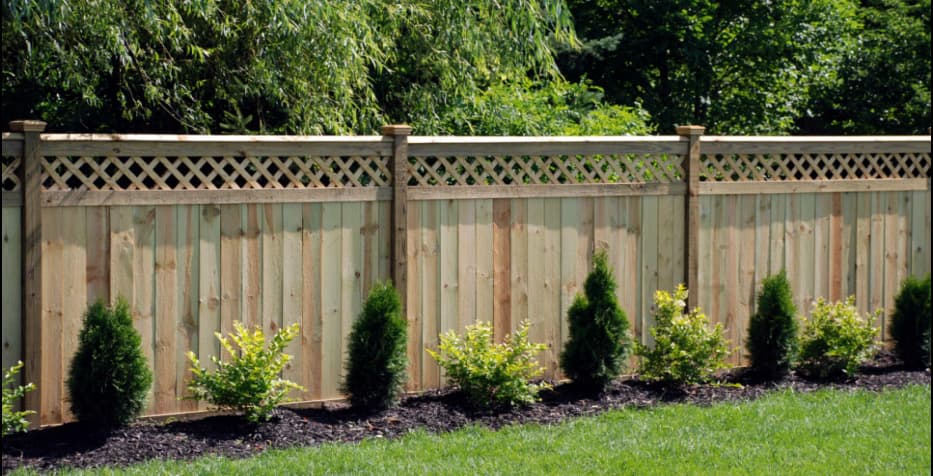
Posts, corners and gates. Every corner and end post takes the most strain and is usually set heavier. Gates add posts, hinges, latches and labour, and a wide double drive gate costs far more than a walk gate. Each set post uses concrete: QUIKRETE's directions call for each hole about three times the post's diameter and one-third of the post's length deep, plus 6 inches of gravel,[7] which is real material on a long fence. How to set a fence post in concrete explains the work.
The ground. Rocky soil, roots, clay and slopes all slow the digging. A sloping yard means stepping or racking each section. Utility lines change where posts can go; Virginia 811 marks buried utility lines for free,[8] and an installer should not dig before they are marked.
Tear-out and haul-away. Removing an old fence, pulling its concrete collars and disposing of the debris is a separate line item. Ask for it to be listed.
Permits and surveys. Virginia's building code exempts fences of any height from permits unless the fence is required for pedestrian safety or is a swimming pool barrier,[5] but zoning can still cost money. Virginia Beach requires a zoning permit for any fence or wall within 30 feet of a public right-of-way,[3] and its fence bulletin, revised in November 2025, puts the fee at $61.[3] The same application needs a current survey or site plan sealed by a Virginia registered surveyor, architect or engineer,[3] and chain-link fences there need landscaping between the fence and any public right-of-way.[3] If you do not have a usable survey, that is an added cost. Do you need a permit for a fence in Virginia? covers the rules in more detail.
How to compare quotes
DPOR's Board for Contractors puts it simply: "Solicit at least three bids for the work you need. Do not automatically accept the lowest."[1] It adds: "Make sure all bids are based on the same set of specifications"[1] and "Beware of any bid substantially lower than the others."[1] For a fence, a comparable written quote shows:
- The total footage, height and style, and the exact material for posts, rails and boards or panels.
- Post size, spacing, setting method and depth, and whether posts are rated for ground contact.
- Each gate's width, hardware and the posts that carry it.
- Removal and disposal of any old fence.
- Who obtains any zoning or building permit and who submits the 811 request.
- Cleanup, the warranty in writing, and start and finish dates.
DPOR also reminds homeowners that "Virginia law requires all licensed contractors to provide a written contract for residential work."[1] Its rule of thumb is an initial deposit of no more than 10% of the total price or $1,000, whichever is less,[1] noting that for custom-made items or special orders a reasonable deposit could be as high as 30% of the total contract value.[1] Two more lines from the same guide are worth keeping: "Don't pay 100% of the bill until the job is 100% complete" and "Never pay cash."[1]
Licences
Under Va. Code § 54.1-1100, Class C contractors perform or manage work where a single contract is over $1,000 but less than $30,000,[2] Check the business on DPOR's licence lookup before you sign.
Doing it yourself
Building your own fence saves labour but not materials, and the hardest part is setting straight, solid posts. If you go that way, rent a power auger only after the 811 marks are down, and set the end and corner posts first.
Stop and call a pro if
- The fence will be a pool barrier or is required for pedestrian safety, the two cases where the state building code does not exempt a fence from a permit.[5]
- The line runs across a steep slope, a drainage swale or marked utilities.
- You are not sure where the property line is.
- You want a masonry wall or a fence on top of a retaining wall.
Browse fence installers, decks and fences, all exterior answers, or exterior businesses around Blacksburg. To price your own fence, describe the fence job once and local businesses send written quotes.
Common questions
- Is there an average fence price for Virginia?
- Not from a primary source. No Virginia agency or licensing board publishes fence prices, and the per-foot figures online are usually estimates from lead-generation sites. Written quotes on your own fence line, compared on identical specifications, are the number to trust.
- What makes one fence quote much higher than another?
- Usually a difference in what is included: post size and depth, board thickness, gate hardware, removal of the old fence, permit work and cleanup. Ask every bidder to price the same specification and to list those items separately, then compare line by line.
- Do I have to pay for a permit?
- Often not a building permit, since Virginia's building code exempts most fences. Some localities charge for zoning approval; Virginia Beach's fence bulletin, revised in November 2025, lists a $61 fee for fences within 30 feet of a public right-of-way, plus a sealed survey or site plan.
- Is a cheaper wood fence a false economy?
- It can be if the posts are not treated for ground contact. Virginia Cooperative Extension's post table gives untreated southern pine 3 to 7 years and treated southern pine 25 to 30 years, so the posts decide how long the fence stands.
- How much should I pay up front?
- DPOR's consumer guide suggests an initial deposit of no more than 10% of the price or $1,000, whichever is less, rising to as much as 30% for custom or special-order items. Do not pay in full until the job is complete, and never pay cash.
Sources
- [1] What You Should Know Before You Hire a Contractor, Virginia Department of Professional and Occupational Regulation, Board for Contractors. Checked October 26, 2026.
- [2] Va. Code § 54.1-1100, Definitions (Contractors), Code of Virginia, Virginia General Assembly. Checked October 26, 2026.
- [3] Fence and Wall Bulletin, City of Virginia Beach Zoning Administration. Checked October 26, 2026.
- [4] Residential Fences and Walls, Fairfax County Department of Code Compliance. Checked October 26, 2026.
- [5] 13VAC5-63-80, Section 108 Application for permit (Virginia Uniform Statewide Building Code), Virginia Administrative Code, Virginia General Assembly. Checked October 26, 2026.
- [6] Fencing Materials for Livestock Systems, publication 442-131 (archived), Virginia Cooperative Extension, Virginia Tech. Checked October 26, 2026.
- [7] Setting Posts Project (Fast-Setting Concrete), The QUIKRETE Companies. Checked October 26, 2026.
- [8] Virginia 811: Safety is in Your Hands, Virginia 811. Checked October 26, 2026.
Want a pro to handle it?
Describe the job once. Licensed local businesses send quotes, and you pay only when you book one.
Get a quote for Roofing