How much does a French drain cost in Virginia?
There is no reliable statewide price for a French drain: each one is priced by its length and depth, the soil and rock, what is in the way, and above all the outlet. Get two or three itemized written quotes. In Fairfax County, a French drain system is on a flood program that, when we checked on October 27, 2026, reimbursed 50% of costs up to $5,000.
Free to ask. Local shops send quotes, and you pay only when you book one.
By Kasra Taheri, Founder, LoclisPublished
Researched and drafted with AI, then checked claim by claim against the sources listed below before it was published. Prices and rules change; the dates beside each source say when it was last checked.
This is a job for a licensed pro in Virginia
This page explains what the work involves, the permits, what a licensed pro does and what drives the cost. It does not give step-by-step instructions, because this work needs a licence, a permit or both, and doing it wrong can injure someone. Before you hire, check the licence on Virginia's DPOR record.
There is no reliable statewide price for a French drain. Each one is priced by its run, its soil and, above all, where the water ends up, so the number that matters is an itemized written quote for your yard. What you can know before you call is what drives the price, what a sound job includes, and where help with the bill exists. In Fairfax County, a French drain system is on a flood program that, when we checked on October 27, 2026, reimbursed 50% of costs up to $5,000.[1][2]
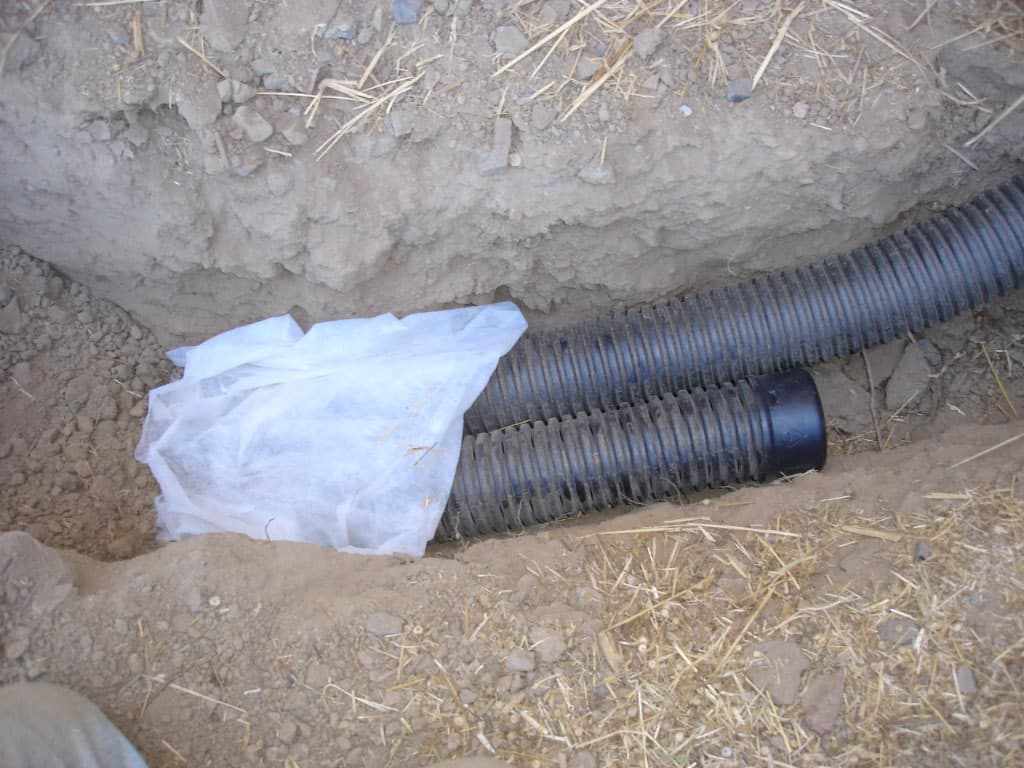
What a French drain quote is paying for
A French drain is a trench, stone, fabric, perforated pipe and an outlet, plus everything it takes to put the yard back. A typical quote covers:
- excavating the trench and hauling away or spreading the spoil;
- landscape fabric, washed stone and perforated pipe;
- any catch basins and connections for downspouts or a sump pump discharge;
- the outlet: open lower ground, a pop-up emitter, or a dry well;
- backfill, topsoil and seed or sod over the trench.
If a quote is one number, ask for it broken out. You cannot compare two bids, or know what you are paying for, without the line items.
What drives the price
Length and depth. The pipe has to fall all the way to the outlet. On flat ground that means a deeper trench at the low end, and a deeper trench means more digging, more stone and more spoil.
Soil and rock. Clay, roots and rock slow the work, and a contractor who hits rock partway along a run may need different equipment or a different route.
Access. A machine that fits through the gate digs far faster than a crew with shovels. Fences, tight side yards, steep slopes and soft lawns all add time.
What is in the way. Driveways, walks, patios and trees force longer routes. So do buried lines. Virginia law sets a two-foot tolerance zone on either side of each utility mark, where only certain kinds of digging, such as hand tools, are allowed.[8] A trench that crosses several marks is slower and costs more.
Restoration. Putting topsoil, seed or sod back over a long trench, and replacing any plants or pavers that were in the way, is real work and should be on the quote.
The outlet can cost as much as the drain
The cheapest outlet is lower ground on your own property where the pipe can simply end. Where that does not exist, the water needs somewhere else to go, and that is where prices climb.
A pop-up emitter in the lawn needs little more than extra pipe and a fitting. A dry well is a bigger job, and in the Northern Virginia Soil and Water Conservation District's guidance, a dry well works only if a permeable soil layer is found within a reasonable depth.[7] Some contractors suggest a rain garden instead. Virginia Cooperative Extension's rain garden fact sheet, updated in June 2024, says rain garden costs "can range from as low as $5 to more than $20 per square foot,"[5] with labor for digging, grading and hauling away excess soil among the costs.[5]
Sometimes the right answer is not a French drain at all. When the water is surface runoff, an open swale or regrading may do the job, and Extension's grass swale fact sheet says the biggest costs are for the equipment and labor to grade the swale so it flows properly.[6] Ask the contractor to say why a buried drain is the right tool for your problem.
Permits and the 811 call
Whether a drain needs a land-disturbing permit is decided locally, by the area disturbed. Montgomery County requires a land disturbing permit when more than 10,000 square feet is disturbed, but minor activities such as individual home landscaping, repairs and maintenance work do not need one.[9] Fairfax County's soil and water district says a permit is needed there if more than 2,500 square feet will be disturbed to build a rain garden or dry well.[7] Ask your county or city before work starts, especially near a stream, a floodplain or an easement.
The locate call costs you nothing. Virginia 811 marks public utility lines for free, and on a hired job your contractor is responsible for contacting Virginia 811.[8]
Help with the bill
Fairfax County. When we checked on October 27, 2026, Fairfax County's Flood Mitigation Assistance Program, run by the Northern Virginia Soil and Water Conservation District, offered 50% reimbursement, up to a maximum of $5,000, for projects that protect a property from flood damage,[1] and "Install a French drain system around foundation" is on its Approved List of Practices.[2] All work must be finished before you apply, only expenses on or after July 1, 2024 are eligible, and the application needs itemized invoices or receipts, proof of payment and photos of the finished work.[1] That is one more reason to insist on an itemized invoice.
Statewide. The Virginia Conservation Assistance Program, run through local soil and water conservation districts, funds certain stormwater practices. When we checked on October 27, 2026, its dry well page said: "Dry Wells will be reimbursed at 80% of total costs with a maximum payment of $7,000.00."[3] The order of steps is the reverse of Fairfax's flood program: the Northern Virginia district explains that a project must be approved before it is installed, work done before approval cannot be reimbursed, each parcel is limited to a lifetime maximum of 2 approved and installed practices, and you take on a 10-year maintenance agreement.[4] New homes are not eligible until one year after the residential occupancy permit is issued.[4] Call your local district before you sign a contract.
What to ask for in a written quote
- Where the water is coming from, in the contractor's view, and why a French drain fixes it.
- The route, length and depth of each run, and where the outlet will be.
- The pipe size and type, the stone and the fabric.
- How the fall will be checked before the trench is backfilled.
- Catch basins, downspout connections and any cleanout or inspection point.
- Who places the Virginia 811 request and who handles any permit.
- Lawn and bed repair, and whether spoil is hauled away.
For residential work, Board for Contractors rules require a written contract that states when work is to begin and the estimated completion date, the total cost, the amounts and schedule of progress payments including the down payment, and a listing of specified materials and work.[11]
When to call a licensed pro
A French drain is excavation near buried lines, and its value depends on fall and outlet decisions that are hard to undo once the trench is filled. Hire a contractor who does drainage regularly and holds a Virginia licence for the size of the job. A Class C licence covers a single job over $1,000 but less than $30,000; Class B starts at $30,000.[10] Look the licence up on DPOR's License Lookup before you pay a deposit.[12]
To understand what you are buying, read how a French drain works, and for a drain that only handles roof water, compare what it costs to bury downspouts. Browse drainage and French drain businesses, find excavation businesses in Blacksburg, or see more excavation answers. Loclis's own fees are on the pricing page.
Describe the wet area once, and licensed local contractors send itemized quotes.
Common questions
- Is a French drain priced by the foot?
- Often the trench is, but the total rarely is. The outlet, catch basins, downspout connections, rock in the ground, hand digging near utility marks and lawn repair are usually separate line items. Ask for every item on the quote so you can compare bids that are built the same way.
- Why do French drain quotes vary so much?
- Contractors may be pricing different jobs. One may plan a short run to a pop-up emitter, another a longer run to a dry well, another regrading first. Ask each one where the water comes from and where it will go, then compare the plans as well as the prices.
- Can I get help paying for a French drain in Virginia?
- In Fairfax County, a French drain system is on the Flood Mitigation Assistance Program's approved list, which reimbursed 50% up to $5,000 when we checked on October 27, 2026. Statewide, the Virginia Conservation Assistance Program funds some practices, such as dry wells, through local soil and water conservation districts, with approval required before work starts.
- Is regrading cheaper than a French drain?
- It can be, when the problem is ground that slopes toward the house or a low spot that holds water. A drain cannot fix bad grading on its own. Ask a contractor to check the grade first and to quote both options when either could work.
- Do I need a permit for a French drain?
- It depends on the locality, the area disturbed and what is nearby. Montgomery County exempts minor home landscaping and requires a permit above 10,000 square feet of disturbance; Fairfax County sets 2,500 square feet for rain gardens and dry wells. Ask your county before work starts.
Sources
- [1] Flood Mitigation Assistance Program (FMAP), Northern Virginia Soil and Water Conservation District, Fairfax County. Checked October 27, 2026.
- [2] Flood Proofing Practices: Approved List of Practices, Fairfax County Flood Mitigation Assistance Program, Northern Virginia Soil and Water Conservation District. Checked October 27, 2026.
- [3] Dry Wells, Virginia Association of Soil and Water Conservation Districts. Checked October 27, 2026.
- [4] Conservation Assistance Programs, Northern Virginia Soil and Water Conservation District, Fairfax County. Checked October 27, 2026.
- [5] Stormwater Management for Homeowners Fact Sheet 5: Rain Gardens (SPES-13P), Virginia Cooperative Extension, Virginia Tech. Checked October 27, 2026.
- [6] Stormwater Management for Homeowners Fact Sheet 4: Grass Swales (SPES-12P), Virginia Cooperative Extension, Virginia Tech. Checked October 27, 2026.
- [7] Control Heavy Runoff - Solving Drainage and Erosion Problems, Northern Virginia Soil and Water Conservation District, Fairfax County. Checked October 27, 2026.
- [8] Homeowners FAQ, Virginia 811. Checked October 27, 2026.
- [9] Erosion and Sediment Control, Montgomery County, Virginia. Checked October 27, 2026.
- [10] Va. Code § 54.1-1100, Definitions, Code of Virginia, Virginia General Assembly. Checked October 27, 2026.
- [11] 18VAC50-22-260, Filing of charges; prohibited acts, Virginia Administrative Code, Board for Contractors. Checked October 27, 2026.
- [12] License Lookup, Virginia Department of Professional and Occupational Regulation. Checked October 27, 2026.
Want a pro to handle it?
Describe the job once. Licensed local businesses send quotes, and you pay only when you book one.
Get a quote from a local pro